Mechanically together, running, and still wearing the bodywork. Here is the car in my own photographs, what an H-code 1971 Mach 1 actually is, and exactly what is left to do.
We earn a commission when you buy through our Amazon links, at no extra cost to you. It never changes the order of the picks, and we say so when the cheaper thing is the better buy. How this works.
There is a 1971 Mustang Mach 1 in my garage. It is an H-code car, it is mechanically together, and what is left on it is paint and body work, plus a few interior pieces. Everything else is done.
This page is that car in my own photographs, alongside an accurate explanation of what an H-code 1971 Mach 1 actually is. What it is not is a rebuild diary with dates and receipts, because I did not keep one, and inventing a timeline for my own car is exactly the kind of thing this site exists not to do. The captions describe what is in the frame and stop there.
The shape that makes the 1971 car what it is: long hood, twin scoops, and a roofline that runs almost flat all the way to the tail. She is blue, she is on chrome five-spokes with raised-white-letter radials, and from twenty feet she looks finished.
What the H-code actually designates
On a 1964 to 1973 Mustang, the fifth character of the VIN is the engine code. For 1971, H designates the 351 cubic inch two-barrel V8 — an optional engine rated at 240 horsepower in the literature of the day.
For 1971 through 1973 Mustangs, the 351 in question is the 351 Cleveland. The Windsor version of the 351 was not part of the Mustang engine lineup in those years, which removes an ambiguity that genuinely does exist on a 1970 H-code car, where either engine family could turn up behind the same VIN letter.
The "2V" in 351C-2V refers to the two-barrel carburetor and, more importantly, to the cylinder heads that came with it: the small-port 2V heads with open combustion chambers. The 4V version of the Cleveland used substantially larger ports and bigger valves. That head difference, not the carburetor, is what separates the two engines in character — the 2V makes its torque low and early, which is exactly what you want in a car you drive rather than a car you race.
The rest of the H-code specification is unglamorous and, in this context, a compliment: a cast-iron crankshaft, two-bolt main bearing caps, forged-steel connecting rods and cast-aluminum pistons, on regular-grade fuel. Compression across the 351 Cleveland range was reduced progressively through the early 1970s, from 9.5:1 in 1970 down to 8.0:1 by 1973 and 1974, as emissions requirements and regular fuel took hold.
One number needs context every time it appears. Ford quoted gross horsepower through 1971 and switched to SAE net ratings for 1972, at which point published figures dropped across the board on engines that had not meaningfully changed. A 1971 gross figure and a modern net figure are not comparable numbers, and anyone putting them side by side is selling something.
What a 1971 Mach 1 is
The Mach 1 was not a separate model. It was a package on the SportsRoof body — the fastback — and 1971 was the first year of the larger restyled Mustang that ran through 1973. In the VIN, body code 05 is the Mach 1 fastback.
The engine lineup underneath that package is the part people get wrong. The base engine in a 1971 Mach 1 was the 302 two-barrel, the F-code. The H-code 351C-2V was a step up from it. Above the H sat the M-code 351 four-barrel, then the Q-code 351 Cobra Jet from May 1971, and above those the 429 Cobra Jet and Super Cobra Jet.
Which means an H-code Mach 1 is a genuine 351 Cleveland car that is not one of the big-block cars — the version that got driven, the version that was on the road rather than under a cover. That is the one I have.
The face of it. Honeycomb grille, the two amber sports lamps set into it, the running-horse badge in the middle, and hood pins either side of the scoops. Look at the hood and you can see the paint is not new.
The tail panel, which is my favorite angle on this car: three-segment lamps at each corner and a honeycomb panel across the middle with the horse in the center of it. It is also where the paint tells on itself — look along the trunk lid edge and the quarter seams.
The engine bay
This is the part that is done. The car runs, it drives, and the mechanical side of the restoration is behind me — which is why what is left is all cosmetic.
The 351 Cleveland, in Ford blue with a chrome air cleaner on top. Nothing in here is show-polished and everything in here works, which is the correct order to do it in.
Same bay, different angle. Belts, alternator, master cylinder, and inner fenders that have seen forty-odd years of Texas. The engine bay is a fair picture of the whole car right now — sorted underneath, honest on the surface.
Inside
The interior is black, it is largely there, and it is where the remaining odds and ends live. A few pieces still need replacing. I am not going to list which ones until they are bought, because a shopping list I have not acted on is not information.
The dash. Three round pods across the binnacle, the deep-set instrument hood, factory radio in the center stack and the shifter on the console. The 1971 dash is a genuinely good piece of design and it photographs badly in a parking lot, so you will have to take my word for some of it.
Wheel and front seats. High-backs, black, and in better shape than the outside of the car is.
The console and center stack, with the shifter in the middle of it. This is the part of the interior that still has items on the list.
The back seat of a SportsRoof, which is a place for a jacket rather than a person. Black, intact, and folded into that low fastback roofline.
A door panel, which nobody ever photographs and everybody notices when it is wrong. Molded panel, armrest, pull and crank, all present.
The speedometer, reading to 120, with the horse at the bottom of the dial. The lens is hazed — that is forty-odd years of sun, and it is on the list of small things rather than big ones.
The upgrades
The car is not stock and I have never pretended it is. Everything in this section is something I put on it, and it all comes from the same idea: fix what the factory compromised, leave alone what the factory got right, and do the work while the thing is already apart.
Induction: an Edelbrock intake, and a four-barrel on top of it
The H-code left the factory as a two-barrel engine. That is the single biggest thing holding a 351C-2V back and it is also the easiest one to fix, so it is what I fixed: an Edelbrock intake manifold and a four-barrel carburetor in place of the factory two-barrel setup. That is the classic breathing upgrade on this engine and it has been for as long as people have owned them.
Be precise about what that is, because plenty of people are not. It is a change above the heads. The cylinder heads on my car are still the small-port 2V castings with the open chambers, exactly as described further up this page, and I have not been inside them. A four-barrel conversion does not turn a 2V Cleveland into a 4V Cleveland — the ports and the valves are the difference between those two engines and they live in the head, not on top of it. Anyone telling you otherwise is selling something.
What it does do is real enough on its own. The factory two-barrel is a small carburetor on a cast-iron manifold, sized for emissions and economy on regular fuel. An aluminum dual-plane with a square-bore four-barrel flange gives the engine a bigger, better-shaped path to breathe through and gives you a carburetor you can actually tune. Edelbrock's own application for the Performer 351-2V says it plainly: it is for engines that came stock with the 2V carburetor and 2V heads, it takes a 4150-style square-bore carburetor, and the published range runs from off idle to 5,500 rpm.
That range is the reason a Performer is the right shape of manifold here rather than something angrier. A single-plane intake makes its case high in the rev range, and this is a car that gets driven on the road. Low and early is the whole character of a 2V Cleveland; the point of the swap was to give that character more air, not to trade it away for a number at the top of the dial.
The other reason to do it now rather than later is simple. The manifold is bolted to both heads, through the valley, under the distributor, with the coolant system open. If the engine is already apart, that is an afternoon. If the engine is together, in the car, and running, it is a weekend and a new set of gaskets you were not planning to buy. Every induction job is cheap while the engine is open and expensive afterwards.
Ignition: getting the points out of it
The other thing I did while I was in there was convert the ignition to electronic — replacing the mechanical breaker points inside the distributor with a solid-state module.
I am not going to name a brand on this one. I did not write it down and I am not going to look at a photograph of a closed distributor cap and guess, which is the same rule the rest of this page runs on. What I can describe accurately is the class of part, because they all work the same way: a small trigger assembly goes inside the distributor you already have, under the cap you already have, in place of the points and condenser. The distributor stays. The vacuum advance stays. The engine bay looks exactly the same with the cap on.
Points are a wear item pretending to be an ignition system. The rubbing block wears against the cam, the gap closes, the dwell changes, and the timing walks away from where you set it — which is why points were a scheduled service item for as long as cars had them. An electronic module removes that entire category of maintenance. It does not make the car faster in any way I would try to quantify, and I am not going to pretend it did. It makes the car consistent, which on a fifty-year-old engine is worth more.
One number matters and it is the one people skip: on an eight-cylinder application these modules need a coil with at least 1.5 ohms of primary resistance. Feed one a low-resistance coil meant for a different ignition system and you will cook it. Measure the coil that is already on the car before you buy anything — it may already be the right one.
Induction and ignition are the two halves of one job. You have given the engine more air and more fuel; the spark has to be reliable enough to light it the same way every time. Doing one without the other is how you end up with a car that runs beautifully on the third attempt.
Wheels: American Racing Torq Thrust
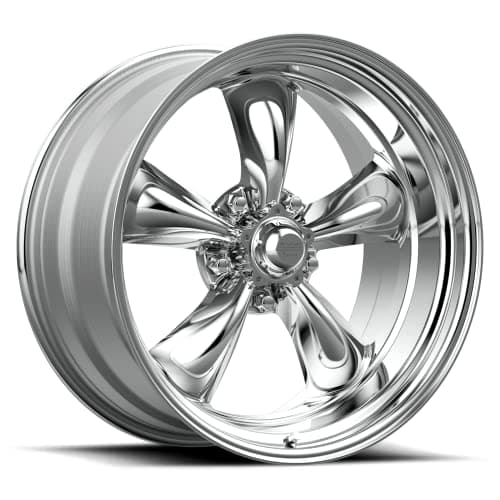
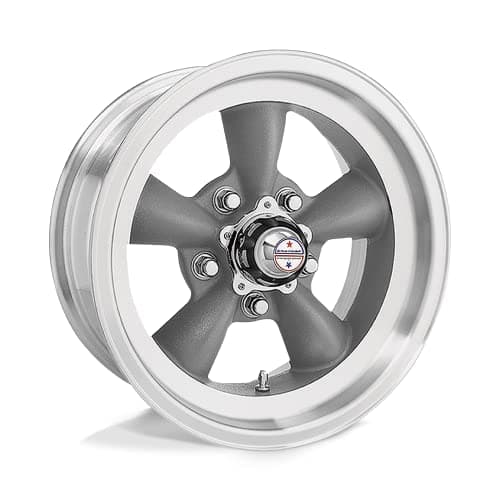
The wheels on the car are American Racing Torq Thrust — the five-spoke that has been a fixture on street machines and muscle cars since the era this car came from. It is the wheel people picture when they picture a car like this, which is precisely why it is on it.
A word on identifying them, because it is genuinely useful and almost nobody explains it: within the Torq Thrust line, the II has straight spokes and the D has spokes with an outward curve to them. That is the tell. Look at the close-up of the wheel further down this page and form your own view — I am not going to state a model and a rim size for my own car off the back of a parking-lot photograph, because that is exactly the sort of detail this site does not guess at. What the frame actually shows is what I will claim: polished five-spokes with a small chrome center cap, wrapped in BFGoodrich Radial T/A raised white letters.
The one specification you have to get right before you order anything is the bolt pattern. A classic Mustang is 5 x 4.5 inches, also written 5x114.3mm and known as the small-Ford pattern. American Racing sells the Torq Thrust in that pattern and in the 5 x 4.75 GM pattern, and the two listings sit next to each other looking completely identical. Read the numbers, not the picture.
Exhaust: Flowmaster Super 40s
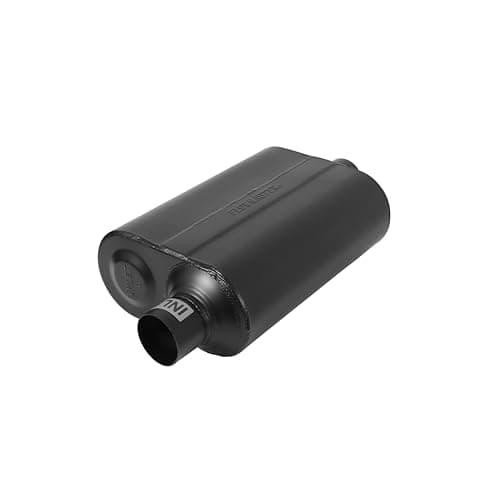
Flowmaster Super 40 series mufflers, and I will be honest about what that means rather than hiding behind the word "sporty". It is an aggressive muffler. It is meant to be. Flowmaster describes the Super 40 as carrying the deep, powerful sound of the original 40 series, with their Delta Flow chambering added to cut the interior resonance that the older design is famous for.
That description matches the car. Outside, at idle, it makes the noise this shape is supposed to make — the deep, uneven, slightly impolite one. On the inside, the claim Flowmaster makes for the Delta Flow design is less resonance than a straight 40 series gives you, and "less" is doing real work in that sentence. If you want a car you can hold a quiet conversation in at seventy, Flowmaster publishes an entire range of quieter chambers and you should buy one of those instead.
For a car you actually want to hear, it is the right muffler, and it is the one I would fit again.
The tachometer, which is the one I am actually proud of
The car needed a tachometer. On a 1971 Mustang that turns out to be a far bigger question than it sounds, because an original-style factory tach is not a gauge you drop into an empty hole in the dash — it is a cluster-level part, and the correct route costs accordingly. The number I kept running into was north of a thousand dollars.
I did not want to spend that. I also did not want the usual alternative, which is a modern tach in a plastic cup clamped to the top of the steering column. That solves the problem by ruining the thing I like most about this car. The 1971 instrument panel is one of the best pieces of design Ford did in that decade — the deep-set binnacle, the round pods, the way the whole thing lights up at night — and hanging a gauge in front of it is not a restoration, it is a compromise you have to look at every time you drive.
So I did the third thing. I built a modern, working tachometer into the existing cluster. It reads properly, it lights with the rest of the dash, and the original-style ribbon connections behind the cluster stayed functional — nothing was cut out of the car to make room for it. From the driver's seat the dash looks like the dash. From the passenger seat the dash looks like the dash. It just has a working tach in it now.
I am not going to write the wiring up as a how-to. It was a custom fit to this cluster, in this car, and a step-by-step from me would be a step-by-step for exactly one Mustang. What is worth taking from it is the approach, which applies to most old-car problems: integrate before you replace. The expensive route and the ugly route were both available and both obvious. The third option — keep the original part, keep the original connections, put the modern function inside it — took more thought and less money than either, and it is the only one of the three that leaves the car looking like itself.
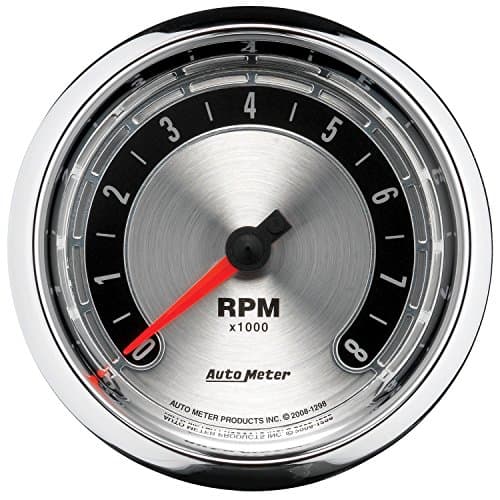
If you are attempting the same job, two things decide whether it works. The first is the format: you want an in-dash tachometer rather than a cup-mounted one, and 3-3/8 inches is the common in-dash size — measure your opening before you buy, because every part of this job is the fit. The second is the lighting. A gauge that reads correctly but glows the wrong color at night will announce itself from the passenger seat forever.
What follows is the current, live-listed equivalent of everything in this section: the intake, the four-barrel, the points-replacement module and the coil it needs, the wheels, the mufflers, and the class of tach and wiring kit the dash job takes. To be completely clear about what that list is — these are not my receipts. I bought mine when I bought them and the part numbers on the shelf today are not necessarily the part numbers I paid for. What they are is the same part in the same class, from the same maker wherever I named one, and where I never named one I have said so rather than picking a brand on your behalf.
What is actually left
Here is the honest state of it, and it is the reason this page exists in the form it does: she is mechanically together, and what remains is paint, body work and a few interior pieces. That is the whole list.
It is also the least photogenic phase of any restoration, because the car looks approximately finished in every photograph and is not. The two frames below are the ones that tell the truth about where the body is.
This is what "paint and body to go" looks like up close. The blue is mottled and patchy across the door and quarter, and along the bottom of the quarter panel and the rocker there is bare work showing through. Mid-restoration, and not hiding it.
Same story from the back. Across the roof and the rear glass surround the finish goes light and dark in patches. From across a car park you would never see it; from here you cannot see anything else.
I have deliberately not put a date on finishing it. A 1971 Mach 1 that runs and drives and needs paint is a perfectly good car to own in that state, and the fastest way to make a project miserable is to promise a deadline to people on the internet.
What I am still not going to tell you
I am not going to name a factory color code, a condition on the day I bought it, a date range or a cost, because those are the details that are easy to write approximately and impossible to un-write once somebody quotes them back at you. The upgrades above are named because I fitted them and I know what I fitted; the part numbers on them are not, for the same reason. Every other page on this site runs on published specifications and cites where the numbers came from. This page runs on my own car, and the same standard applies: those get written when I write them down properly.
What you are getting instead is the car itself, photographed as she actually is, described as what is visible and nothing more.
Chrome five-spokes and BFGoodrich Radial T/A raised white letters. Not a concours choice and not pretending to be — it is what a lot of these cars actually wore, and it is what is on mine.
The rear three-quarter, which is the angle the 1971 restyle was designed around. That roofline is why people either love or hate this generation, and it is the reason I have one.
Parked up, front three-quarter, in the sun. This is the version of the car most people see and the reason the body work is easy to keep putting off.
Full profile, which is the best single photograph of what this car is: the SportsRoof fastback line, the gray lower body treatment along the rocker, and a stance that has not needed changing.
Meanwhile, the other project
The Mach 1 is the slow one. The 4Runner is the one that gets used — it is built out as an overland rig, including the twelve-volt accessory wiring I did myself, and the gear that lives on it has a whole section of this site to itself. If you came here for the vehicle projects, that is the other half of them.
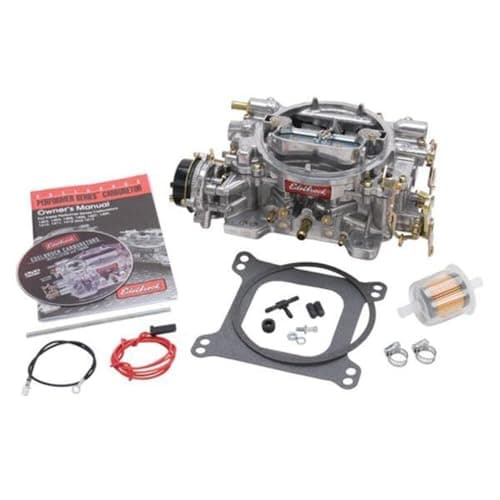
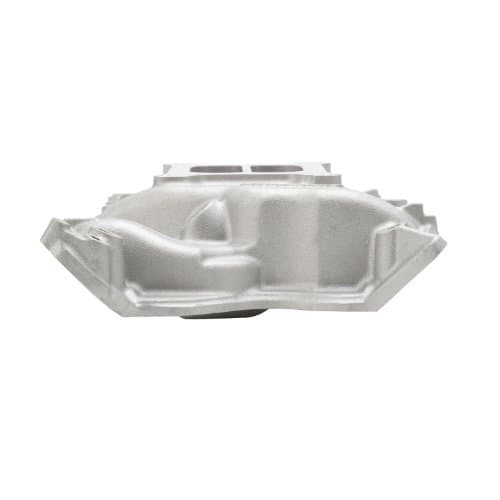
The dual-plane that turns a 2V-head 351 Cleveland into a four-barrel engine without touching the heads — which is precisely the swap that is on my car.
600 cfm, square bore, electric choke, calibrated for economy — the carburetor the Performer manifold was designed around, and the safe answer on a street 351.
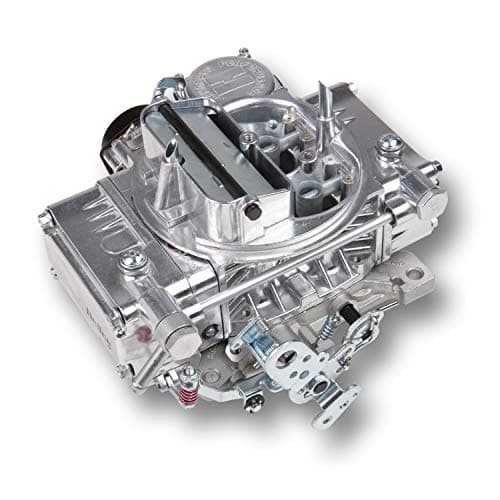
The same 600 cfm on the same square-bore flange, from the other camp — and it ships with the Ford kickdown lever already on it, which matters on an automatic Mustang.
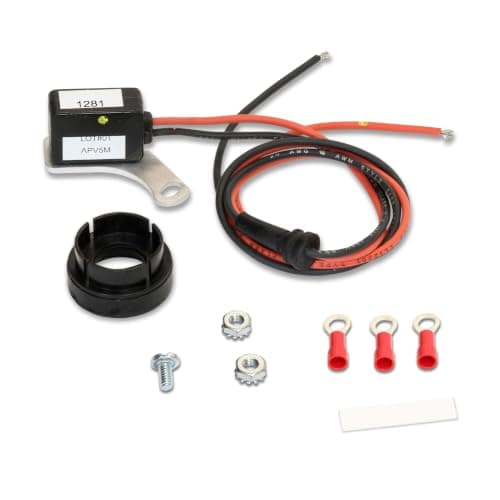
The module class that killed the points on my car: it goes inside the original Motorcraft distributor, under the original cap, and nothing on the outside of the engine changes.
The polished one-piece Torq Thrust II on the small-Ford 5x4.5 pattern — the finish that puts a bright five-spoke under a car like this one. The 15x7 in this finish and pattern is not listed at the moment, so this is the same wheel an inch narrower.
The Super 40 in 2.5 inch offset-in, center-out — the fitment that suits a dual system under a classic car, and the muffler that makes the noise I actually wanted.
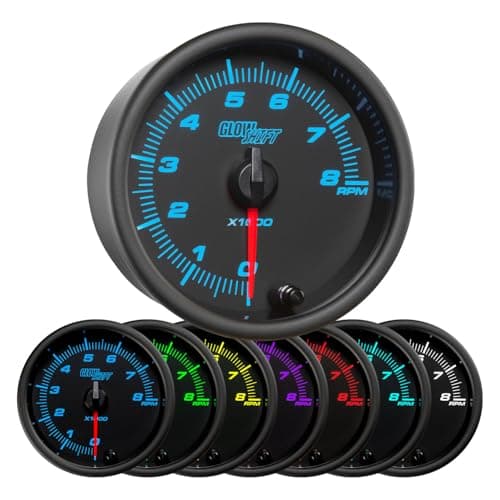
An in-dash 3-3/8 inch tach with a real air-core movement — the class of gauge you reach for when the tach has to live inside an existing cluster instead of on top of the column.
Half the money for the same 3-3/8 inch in-dash format, with a selectable backlight color — which is genuinely useful when you are trying to match an existing dash glow.
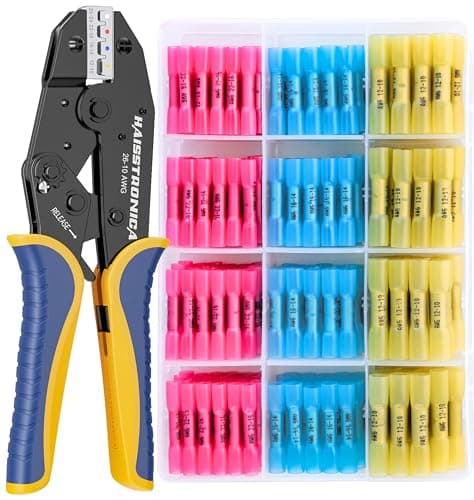
A ratcheting crimper and the connectors to go with it — the difference between a gauge that works for ten years and a gauge that works until the car goes over a bump.
#ad · Live prices from the Amazon Creators API, as of October 19, 2026. Where we have no verified live price we show none — a gap beats a number that has rotted.
In detail
The picks, in full
01
The intake, exactly
2750 Performer 351-2V Intake Manifold
Ford 351C-2V / Boss 351Dual-plane, low-rise4150 square-bore flangeIdle to 5,500 rpm
8.5/10
The dual-plane that turns a 2V-head 351 Cleveland into a four-barrel engine without touching the heads — which is precisely the swap that is on my car.
Application fit
10
Street usability
9
Build quality
9
Value
6
What's good
+Edelbrock's own application is explicit: engines that came stock with a 2V carburetor AND 2V heads, which is the H-code car exactly
+The published range starts off idle rather than at 2,500 rpm, so the torque you actually drive on is not traded away for a number at the top of the dial
+Square-bore 4150 flange means the carburetor choice is wide open and stays that way
What's not
−Non-EGR, so it is not the part for anything that has to pass an EGR-equipped inspection
−Aluminum against iron heads means you are buying gaskets, coolant and an afternoon, not just a manifold
−It costs about as much as the carburetor going on top of it, which surprises people
Skip it if…
…your Cleveland has 4V heads. This is the small-port manifold; on 4V heads you want the 4V casting, and this one leaves port mismatch everywhere.
600 cfm, square bore, electric choke, calibrated for economy — the carburetor the Performer manifold was designed around, and the safe answer on a street 351.
Application fit
9
Drivability
9
Tunability
7
Value
6
What's good
+No power valve to blow out on a backfire, which is the failure mode that ruins a Saturday on the alternative design
+Metering rods rather than jets for the tuning you will actually do, and Edelbrock publishes the calibration table
+Electric choke means the car starts and drives away cold without a hand on the linkage
What's not
−Calibrated for economy out of the box — a hotter engine wants the calibration kit on top of the purchase price
−Non-EGR, the same caveat as the manifold
−Amazon's price on the genuine Edelbrock unit moves around; check it against a specialist retailer before you click
Skip it if…
…you want to tune it by feel with a screwdriver in a parking lot. Metering rods are a better system and a slower one, and a Holley is the carburetor for people who like turning things.
600 cfm, model 4160Vacuum secondariesElectric choke, single inletFord kickdown lever
8.3/10
The same 600 cfm on the same square-bore flange, from the other camp — and it ships with the Ford kickdown lever already on it, which matters on an automatic Mustang.
Application fit
9
Drivability
8
Tunability
9
Value
7
What's good
+The Ford kickdown provision out of the box saves a linkage argument on an automatic car
+Vacuum secondaries open on demand rather than on throttle position, which is the forgiving setup on a heavy street car
+The parts and tuning knowledge behind a Holley 4160 is effectively infinite and mostly free
What's not
−The power valve is a real part that a backfire can damage, and that is the classic Holley complaint
−More gasketed joints below fuel level than the Edelbrock design, which is the other classic Holley complaint
−A secondary metering plate instead of a jetted block means the deeper tuning steps cost parts
Skip it if…
…you want to bolt it on and never think about it again. This is the carburetor that rewards attention; the Edelbrock is the one that never asks for any.
Ford V8, 1957-74Motorcraft single-point12V negative groundFits under the stock cap
9.0/10
The module class that killed the points on my car: it goes inside the original Motorcraft distributor, under the original cap, and nothing on the outside of the engine changes.
Application fit
9
Ease of install
9
Keeps it stock-looking
10
Value
8
What's good
+Installs inside the distributor you already have, so the timing marks, the vacuum advance and the look of the engine bay all survive
+No points to burn, no gap to reset, no dwell to chase — the maintenance item simply stops existing
+PerTronix states the operating window plainly (8-16V, up to 15,000 rpm), which is more than most of this category does
What's not
−Requires a coil of at least 1.5 ohms on a V8 — run it on a low-resistance coil and you will cook the module
−It is a sealed unit: when it fails it fails completely, and points at least limp
−Wrong-application kits are easy to order by mistake; this one is single-point Motorcraft, not dual-point
Skip it if…
…your distributor is a dual-point or an aftermarket replacement. The kit is matched to the distributor, not to the engine, and the wrong one does not fit.
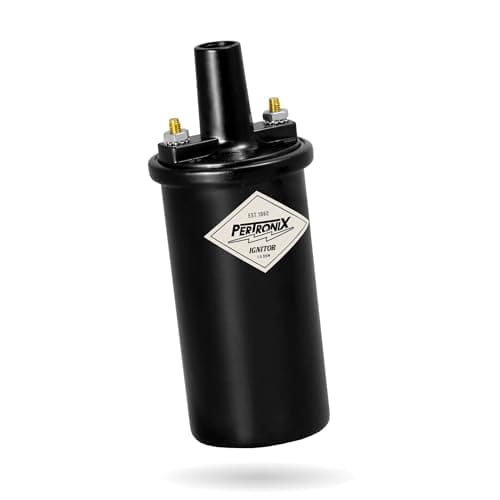
40,000 volts1.5 ohm primaryEpoxy-filled canister6V and 12V
8.3/10
1.5 ohms, which is the number the Ignitor needs on a V8, in an epoxy-filled canister — buy it with the module rather than after you have killed one.
Application fit
9
Build quality
8
Period-correct look
8
Value
8
What's good
+Meets the 1.5-ohm minimum the Ignitor specifies for eight cylinders, so the pairing is the manufacturer's own
+Epoxy fill instead of oil means no seep down the coil bracket in a hot engine bay
+A black canister disappears against a period engine bay in a way a chrome one does not
What's not
−A working stock coil of the right resistance does the job; this is an upgrade, not a requirement
−40,000 volts only becomes useful once the plug gap is opened up to use it
−Not the coil for a system that still has an external ballast resistor doing this job
Skip it if…
…you have not measured the resistance of the coil already on the car. Measure first — the coil you own may already be correct, and this is the cheapest thing to not buy.
15 x 6 in5x114.3 (5x4.5)-6 mm offsetPolished, one piece
8.3/10
The polished one-piece Torq Thrust II on the small-Ford 5x4.5 pattern — the finish that puts a bright five-spoke under a car like this one. The 15x7 in this finish and pattern is not listed at the moment, so this is the same wheel an inch narrower.
Application fit
8
Finish
8
Period-correct look
9
Value
8
What's good
+5x114.3 is the classic Mustang pattern, so this is the bolt-on version of the look rather than the adapter version
+One-piece cast construction is the cheaper and structurally simpler half of the Torq Thrust range
+Polished rather than painted-center, which is what a bright five-spoke on raised white letters actually is
What's not
−Six inches wide — American Racing also lists this polished wheel in 15x8 for the same pattern, so settle width against your tire size before ordering
−Polished aluminum is a maintenance finish — it hazes if the car lives outside, and mine does
−Listed and sold as a single wheel, which is easy to misread as a set
Skip it if…
…your car is a 5x4.75 GM pattern. The Torq Thrust line covers both and the listings sit right next to each other — read the pattern before the picture.
Price as of October 19, 2026. Prices move — Amazon's is the one that counts.
#ad · we may earn a commission from this link to VN105 Torq Thrust D 15x7, Gray with Machined Lip
08
The muffler, in the classic dual size
952546 Super 40 Series Chambered Muffler
2.5 in offset in / center out16-gauge aluminized steel10 x 5 in case19.5 in overall length
8.3/10
The Super 40 in 2.5 inch offset-in, center-out — the fitment that suits a dual system under a classic car, and the muffler that makes the noise I actually wanted.
Sound character
9
Build quality
8
Fitment flexibility
8
Value
8
What's good
+Delta Flow chambering is what separates the Super 40 from the original 40 — the same deep tone outside, with less interior resonance
+A fully MIG-welded 16-gauge case is a muffler you fit once and then stop thinking about
+Offset in, center out is the geometry that actually clears a classic floor pan and rear axle
What's not
−Aluminized, not the 409S stainless of the 85-series part numbers — cheaper, and it will rust first
−Still an aggressive muffler by anyone's standard; 'less resonance' is relative to a 40 series, not to a stock system
−Universal fitment means clamps, hangers and possibly a tailpipe are your problem
Skip it if…
…the car is a highway cruiser and you value the radio. Flowmaster publishes the whole range for a reason and the quieter chambers exist.
3-3/8 in, in-dash0-8,000 rpmAir-core movement12V and 16V systems
7.8/10
An in-dash 3-3/8 inch tach with a real air-core movement — the class of gauge you reach for when the tach has to live inside an existing cluster instead of on top of the column.
Build quality
9
Signal compatibility
9
Ease of integration
7
Value
6
What's good
+In-dash rather than cup-mounted, which is the whole difference when the gauge is going behind an existing lens
+Air-core movement with a stated 333 ms full sweep, so the needle behaves like an instrument rather than a suggestion
+One-to-four pulse selectable covers 2 through 8 cylinders, so it does not care what ignition is ahead of it
What's not
−The chrome bezel and spun aluminum dial are a modern look — inside a factory cluster that is a problem to solve, not a feature
−Costs more than the entire budget end of this category
−AutoMeter says plainly that some adaptation may be required, and on a fifty-year-old dash that is an understatement
Skip it if…
…you have not measured the opening you are putting it in. Every part of this job is the fit, and 3-3/8 inches is a specification, not an approximation.
Price as of October 19, 2026. Prices move — Amazon's is the one that counts.
#ad · we may earn a commission from this link to 1298 American Muscle 3-3/8 in In-Dash Tachometer
10
The budget version of the same job
Black 7 Color 8,000 RPM In-Dash Tachometer, 3-3/8 in
3-3/8 in (85 mm)0-8,000 rpm7 selectable colorsIn-dash mount
7.5/10
Half the money for the same 3-3/8 inch in-dash format, with a selectable backlight color — which is genuinely useful when you are trying to match an existing dash glow.
Build quality
6
Signal compatibility
7
Ease of integration
8
Value
9
What's good
+Seven backlight colors is the cheap route to making a modern gauge disappear into an old cluster's lighting
+Same 3-3/8 inch in-dash format as the AutoMeter, so the fabrication work is identical
+Cheap enough that ruining one while working out the install is annoying rather than expensive
What's not
−The movement is not in the same class as an air-core gauge, and the listing does not claim it is
−Multi-color lighting is a modern aesthetic; used at full brightness it looks exactly like what it is
−Documentation is thinner, which matters when you are wiring it into something unusual
Skip it if…
…the tach is going somewhere permanent and hard to reach. The premium on a better gauge is bought with the hours it takes to change it.
A ratcheting crimper and the connectors to go with it — the difference between a gauge that works for ten years and a gauge that works until the car goes over a bump.
Build quality
7
Range covered
7
Ease of use
9
Value
9
What's good
+A ratcheting crimper does not release until the crimp is complete, which removes the one variable that ruins hand-crimped joints
+Heat-shrink connectors seal the joint as well as making it, and behind a dash that is worth the small extra cost
+22-10 AWG covers everything on a gauge, sender and lighting circuit
What's not
−Butt connectors only — no ring or spade terminals in this kit, and a gauge install usually wants a ground ring
−The crimper is sized for insulated connectors, not for open-barrel terminals
−The piece count is weighted to the small sizes, which is where you run out first
Skip it if…
…you already own a ratcheting crimper. Buy the connectors on their own and put the money into a better gauge instead.
Price as of October 19, 2026. Prices move — Amazon's is the one that counts.
#ad · we may earn a commission from this link to 200-Piece Ratchet Crimper Kit with Heat-Shrink Connectors
How these were picked
These are the current equivalents, not my receipts.
The work on this page is mine and I have described it in my own words above. What I have not done is pretend the listings here are the exact parts I bought — I did not keep the part numbers, and inventing them would be worse than saying so. Each one is the same part in the same class, from the same maker wherever I named one. The specifications come from the manufacturer's own published pages, the prices from a live lookup, and the scores are judgments against a published rubric rather than measurements I took.
Questions
Frequently asked
What does H-code mean on a 1971 Mustang?+
H is the engine code in the fifth position of the VIN. On a 1971 Mustang it designates the 351 cubic inch two-barrel V8 — a 351 Cleveland, since the Windsor 351 was not offered in 1971 through 1973 Mustangs — rated at 240 horsepower gross in period literature.
Was the 351 Cleveland standard in a 1971 Mach 1?+
No. The standard engine in a 1971 Mach 1 was the 302 two-barrel (F-code). The H-code 351C-2V was the next step up, followed by the M-code 351 four-barrel, the Q-code 351 Cobra Jet from May 1971, and the 429 Cobra Jet and Super Cobra Jet above those.
What is the difference between a 351C-2V and a 351C-4V?+
Carburetor and, more significantly, cylinder heads. The 2V uses small-port heads with open combustion chambers; the 4V uses much larger ports and bigger valves. The 2V makes its torque lower in the rev range, which suits a street car. The 4V trades that for top-end breathing.
What is left to do on the car?+
Paint and body work, plus a few interior pieces. Everything else is done — she is mechanically together and she runs. There is no finish date, deliberately: a Mach 1 that drives and needs paint is a perfectly good car to own in that state.
Does an Edelbrock intake and a four-barrel turn a 351C-2V into a 4V engine?+
No, and it is worth being blunt about that. An intake-and-carburetor swap is a breathing change above the cylinder heads. The heads are what separate a 2V Cleveland from a 4V Cleveland — the 2V uses small ports and open chambers, the 4V uses much larger ports and bigger valves — and a manifold does not change either. What the conversion does give you is a better-shaped path to the heads you have and a carburetor you can tune, which on a factory two-barrel engine is a genuine and worthwhile gain.
What does an electronic ignition conversion actually replace?+
The mechanical breaker points and condenser inside your existing distributor, and nothing else. A trigger module fits under the original cap, so the distributor, the vacuum advance and the look of the engine bay all stay. It removes a wear item rather than adding power: points wear, the gap closes and the timing walks, and an electronic module simply stops that happening. One requirement people skip — on a V8 these modules need a coil of at least 1.5 ohms primary resistance, so measure the coil already on the car before you order anything.
Can you fit a modern tachometer in a classic Mustang dash without replacing the cluster?+
Yes — that is exactly what is in my car. A modern working tach is built into the existing instrument cluster, the original-style ribbon connections behind it are still functional, and the dash looks like the factory dash. It was a custom fit to this cluster, so there is no universal how-to, but the two things that decide the job are format and light: use an in-dash gauge rather than a column-mounted cup (3-3/8 inches is the common in-dash size), measure the opening before you buy, and match the backlight to the dash you have.
Why is there no cost, timeline or part-number list on this page?+
Because I did not keep one, and approximating it would be worse than leaving it out. The photographs are mine and the captions describe only what is in the frame. The car, the H-code designation, the upgrades I fitted and what is left to do are facts I can state today; a factory color code, a purchase condition, exact part numbers and a date range are not.
How do I verify what my own Mustang left the factory as?+
The VIN decodes the body, engine and assembly plant. Beyond that, Marti Auto Works holds Ford's production database for 1967 onward and issues documented reports, and the Ford Heritage Vault publishes original factory literature for the model year. Those two sources settle most arguments.
We do not run a testing lab and we do not pretend to. Where a measured number came from a manufacturer's published specification or someone else's lab, we name them and link them. Where we could not verify something, we say so on the page rather than quietly leaving it out. Read the full method.