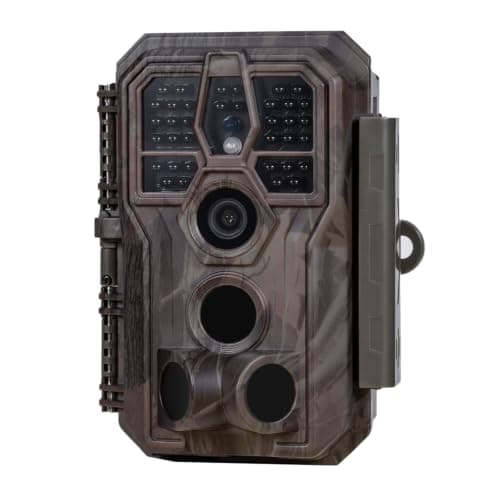
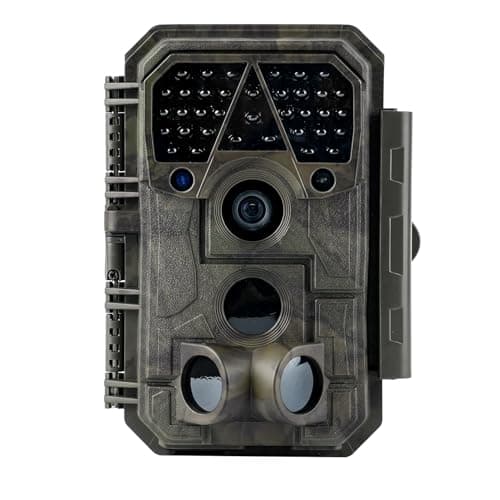
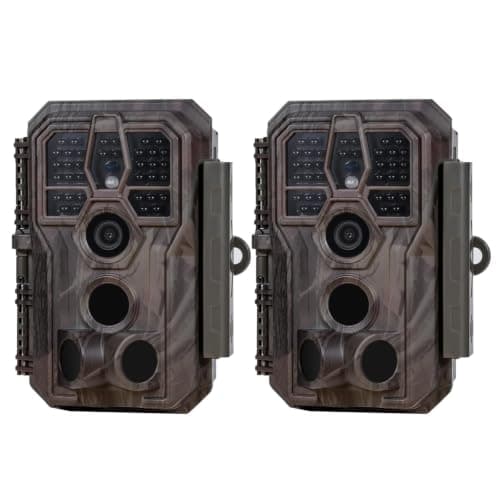
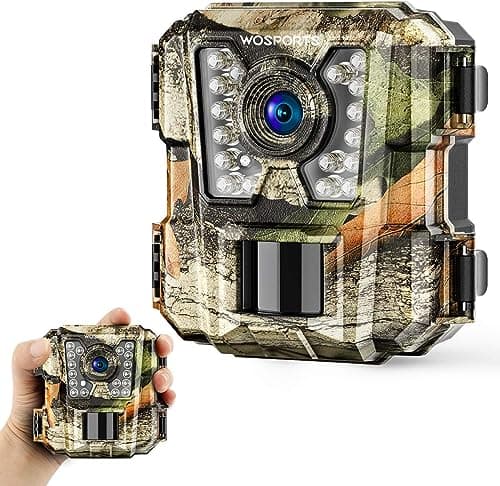
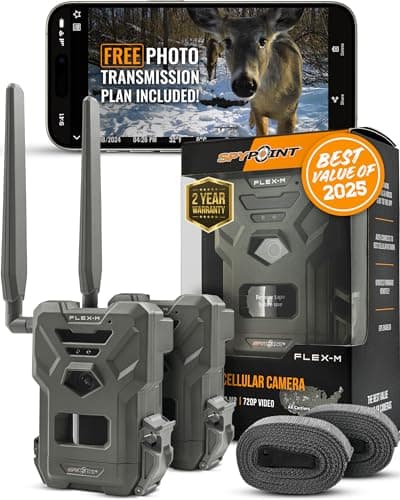
The short answer: one brand lets you run a cellular trail camera without a subscription, and it is SPYPOINT. Their free transmission plan sends the first 100 photos each camera takes every month at no cost, and they state plainly that it “isn't a trial or a limited time offer.” Trail Cam Pro's brand-by-brand plan comparison lists no free tier at all for Moultrie, Tactacam, Stealth Cam, Browning or Bushnell — on those, a plan is the price of the camera sending you anything.
So the honest version of this page runs in two halves. The cellular pick that needs no plan is first, with its ceiling stated rather than buried. Then five card-based cameras with no running cost whatsoever — four worth buying and one on the page purely as a warning — because for a great many hunters the card camera is the better purchase and nobody selling a data plan is going to say so.
Cellular trail cameras solve exactly one problem: you cannot get to the camera without disturbing the area you are trying to hunt. If that is not your problem, the subscription is a recurring cost for a convenience you already have.
Run the numbers honestly. A cellular plan at $12 a month across a six-month season is $72 a camera per year. Three cameras over three seasons is more than $640 — enough to buy twelve card-based cameras. That arithmetic is why this page exists.
The trade is real: you have to walk in to pull the card, which puts scent and disturbance in the spot. Whether that costs you more than $640 is a genuine judgment call and it depends entirely on your property.
What “no subscription” actually means here
Three genuinely different products get sold under that phrase, and they do not do the same job. Picking the wrong one is the most expensive mistake available in this category, because you find out in October.
Cellular on a free plan — one brand, with a ceiling
SPYPOINT publishes a free transmission tier: the first 100 photos per camera, per month, permanently rather than as a trial. Past that the camera keeps shooting and the images go to the microSD card, so you lose the delivery, not the photographs. Their paid tiers are on the same plan sheet — from $5 a month for 250 photos up to $15 a month for unlimited, or $10 a month for unlimited if you pay annually. Do the honest thing and work out how many images your site actually produces before you decide the free plan is enough.
On the camera itself I am relying on other people's measurements and I will name them. The Amazon listing claims a 0.5-second trigger, 28MP stills, 720p video with sound and 90 feet of detection and flash. TechGearLab, who do test these, publish a 0.4-second trigger for the Flex-M, call it about half as fast as some premium cameras, and found it struggled with motion blur at night — worst on an animal crossing side-to-side rather than walking toward the lens. That is the honest shape of this camera: the plan is the reason to buy it, not the imaging.
Card-based — no network, no account, no bill, ever
The other five picks here write to an SD card and nothing else. There is no plan to lapse mid-season, no coverage question, no app outage and no account. The purchase price is the entire lifetime cost, and the trade is that you walk in to collect the card.
WiFi and Bluetooth cameras are not cellular, whatever the listing implies
A camera that pairs to your phone over WiFi or Bluetooth only transfers while you are standing near it. It saves you the fiddle of pulling and reading a card; it does not save you the trip, and it will not put a photograph on your phone while you are at work. Only a cellular radio on a carrier network does that. If a listing says “no monthly fee” and “WiFi” in the same breath, that is what it means.
Treat “lifetime free data” claims with the skepticism they have earned
Every photograph a cellular camera sends crosses somebody's carrier network, and carriers bill for that. A camera advertising lifetime included data is a company choosing to absorb that cost, with nothing holding it to the decision after your return window closes. It is not a technical breakthrough. Buy the free-tier route from a brand that publishes its plan sheet, or buy a card camera and own the outcome outright.
Who each of these is for
- SPYPOINT Flex-M twin pack — you need images sent to your phone, you have signal at the tree, and your camera watches a trail or a scrape rather than a feeder, so 100 photos a month per camera is a real allowance rather than a joke.
- GardePro E5S — you drive or walk past the camera anyway and simply want the best card-based camera for about fifty dollars, with no-glow infrared for ground that gets hunted by other people.
- Meidase P70 — same job, and you would rather buy from a listing that states outright it is non-cellular and non-WiFi instead of leaving you to work it out.
- GardePro E5S two-pack — you are covering an entry trail and an exit trail on the same property and want both cameras identical, so one set of settings and one battery type covers everything.
- WOSPORTS mini — public land, where concealment beats image quality and the camera needs to be cheap enough that losing it is survivable.
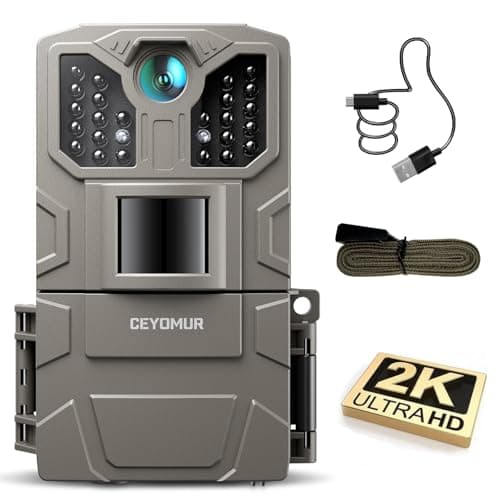
- CEYOMUR 36MP — nobody. It is in the table so you can see what the twenty-dollar tier actually buys you, which is a listing with no trigger speed on it.
Running card-based cameras well
Batch your card pulls
The disturbance cost of checking cameras is per-visit, not per-camera. Pull every card in one loop, in the middle of the day, ideally in wind or rain that will move scent, and preferably when you are going in for another reason anyway.
Buy two cards per camera
Swap a fresh card in and take the full one home rather than standing at the camera scrolling through images. It halves your time on site and it is the single easiest improvement to make.
Lithium AAs, not alkaline
Lithium cells hold voltage far better below freezing, which is exactly when you are running these cameras and exactly when alkalines fail. The cost difference disappears once you stop replacing dead batteries mid-season.
Choose no-glow for pressured ground
On public land or heavily hunted private ground, no-glow infrared is worth the reduced night range — it is invisible both to deer and to the people who might otherwise notice your camera.
Lock it, or hide it
On public land, a cable lock through the housing and a security box are the difference between a camera and a donation. A genuinely small camera mounted high and angled down is often more effective concealment than any lock.