We earn a commission when you buy through our Amazon links, at no extra cost to you. It never changes the order of the picks, and we say so when the cheaper thing is the better buy. How this works.
The lumen number on a budget flashlight listing is the single least trustworthy figure in the outdoor gear market. Manufacturers who follow the ANSI/NEMA FL 1 standard measure output at the front of the lens after thirty seconds of running, which is a real number. Manufacturers who do not, quote the emitter's theoretical maximum at the instant of switch-on, which is roughly double and lasts about as long as it takes to read this sentence.
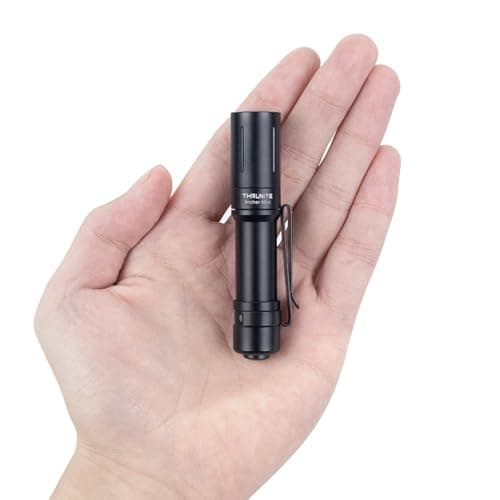
So the first thing to look for is not lumens. It is whether the manufacturer publishes a runtime chart at all. ThruNite and Olight do. Most of the sub-twenty-dollar listings do not, and that absence is the specification.
After that: charging standard, waterproof rating and size. USB-C means the cable in your bag already works. IPX8 is a genuine submersion rating; IPX4 is splash resistance and will not survive a dropped light in a creek. And a light too big for a front pocket is a light in a drawer, same as a knife.
The number on the front of the box is the least useful specification in this category, and it is worth understanding before you spend anything — how many lumens you need covers lumens against candela, what the FL 1 standard is for, and how to spot an output claim with nothing behind it.
#ad · Live prices from the Amazon Creators API, as of October 19, 2026. Where we have no verified live price we show none — a gap beats a number that has rotted.
A light that hits 2,000 lumens for ninety seconds and then steps down to 300 is, for practical purposes, a 300-lumen light. Thermal management is why: small pocket lights cannot dissipate the heat that high output generates, so they throttle. The runtime chart shows this and the headline number hides it.
Charging standard matters more than you expect
USB-C is the right answer in 2026. Proprietary magnetic chargers — Olight's in particular — work well and charge fast, but if you lose the puck you are buying another one. Micro-USB in a new purchase is a sign the design is old.
Understand the IP rating you are buying
IPX4 survives splashing. IPX7 survives one meter of immersion for thirty minutes. IPX8 survives deeper immersion for longer, per the manufacturer's stated depth. For a light that lives in a pocket and might see rain, IPX7 is the sensible floor.
Buy the size you will carry, then buy a second one
The best-value approach in this category is a good pocket light plus a cheap keychain light, rather than one expensive light. The keychain light is the one you will actually have at 6pm in a parking lot, and the pocket light is the one that does real work.
How these were picked
I haven't handled these. Here's what I did instead.
Everyone in this category says they tested twenty of these. I haven't tested any, and I say so. What I do instead: read the manufacturer's manual and published specification, compile the numbers that decide the purchase, do the arithmetic in the open, check the live price, and name one product to skip. The scores above are judgments from that research against a published rubric — they are not measurements I took, because I do not have a lab and I am not going to pretend otherwise.
Questions
Frequently asked
How many lumens do I actually need for EDC?+
Between 200 and 500 covers essentially every everyday use — finding something under a seat, walking a dark path, checking a breaker panel. Above 1,000 lumens in a pocket light is mostly a thermal management problem and a battery drain, not a usability improvement.
Are rechargeable flashlights better than AA models?+
For daily carry, yes — better output, smaller size, no disposable cell cost. For emergency kits the answer flips: a light that takes AA or AAA cells can be brought back to life anywhere, and a lithium cell that has been sitting flat in a drawer for two years cannot.
What does IPX8 mean on a flashlight?+
It means the light survived continuous immersion beyond one meter, at a depth and duration the manufacturer specifies. IPX7 is one meter for thirty minutes. Neither rating covers saltwater or pressure at depth.
Is a magnetic base worth having?+
Under a vehicle, absolutely — it turns the light into a hands-free work lamp. In a pocket it collects every steel shaving and key you own. Whether it is a feature or a nuisance is entirely about where you use the light.
We do not run a testing lab and we do not pretend to. Where a measured number came from a manufacturer's published specification or someone else's lab, we name them and link them. Where we could not verify something, we say so on the page rather than quietly leaving it out. Read the full method.