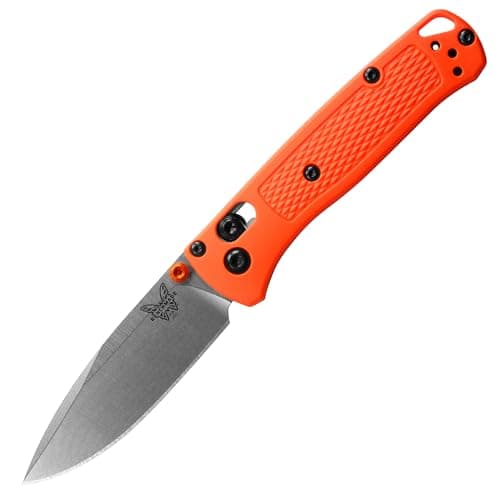
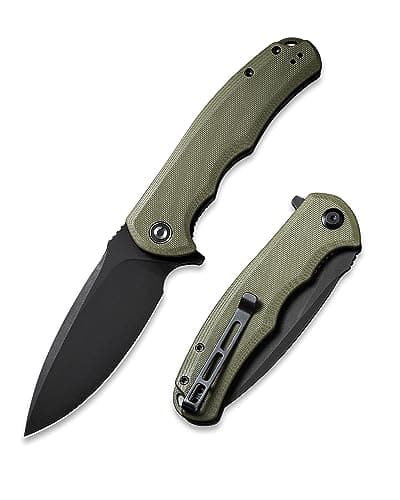
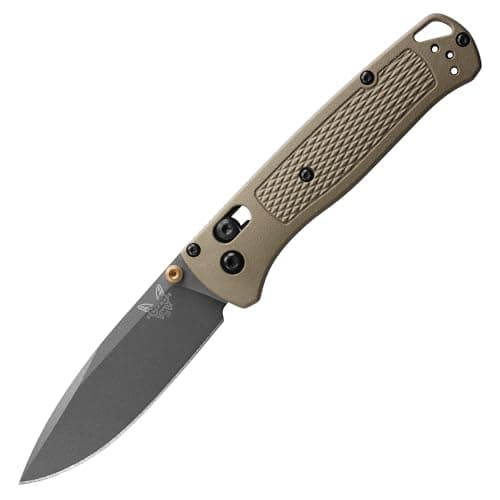
The short answer: a Benchmade is worth it if you will carry it for years, you sharpen with diamond abrasives or a guided system, and the difference between a 1.85-ounce knife and a 3-ounce knife is the difference between carrying and not carrying. Outside those three conditions, a $40 CIVIVI or Kizer does the cutting just as well and the extra $160 buys you very little.
That is an unusual thing for a site that earns a commission to say, and it is worth being clear about why we are saying it: the cheap knife pays us less. If commission drove the ranking, this page would end differently.
What follows is what the money actually buys, item by item, so you can decide whether any of it applies to you.
What $200 buys, specifically
1. Weight, and this is the strongest argument
The Bugout is 1.85 ounces with a 3.24-inch blade. Getting that combination requires skeletonized liners, thin Grivory scales and careful design, and almost nothing at a third of the price comes close. If weight is what stops you carrying a knife, this is a genuine engineering answer to a genuine problem.
2. CPM-S30V steel
A powder metallurgy stainless with excellent edge retention and good corrosion resistance. It is meaningfully better than the D2 in a $40 knife, particularly on rust. The caveat runs through everything on this page: without diamond abrasives you cannot maintain it properly, and an unmaintained S30V blade performs worse than a maintained budget one.
3. The Axis lock
Fully ambidextrous, one-handed to open and close, keeps fingers out of the blade path. Spyderco's compression lock does the same thing and cheaper liner locks do not. It is a real ergonomic advantage that you notice every single day.
4. LifeSharp
Benchmade's service program will sharpen, clean and adjust the knife for its lifetime. Read their current terms for what is covered, but as a proposition it is genuinely unusual and it is the part of the price that no budget maker offers at all.
5. Manufacturing tolerances
Centered blades, consistent detents, even grinds, no lock rock. Budget knives vary between units here in a way premium ones largely do not. Whether that is worth $160 depends entirely on whether it bothers you.
The three cases where the answer is no
You do not own a diamond sharpening system
This is the big one. Premium steel with no way to sharpen it becomes permanently dull premium steel. If your plan is a pull-through in a kitchen drawer, buy a $40 knife in 14C28N and put the savings into a Work Sharp — you will end up with a sharper knife.
You lose knives
Be honest here. A knife that lives loose in a pocket, gets lent out, or comes off a belt has a nonzero attrition rate, and there is no version of a $200 loss that feels good.
This would be your first good knife
Almost nobody's second knife is the same shape as their first. Blade length, handle size, lock type and clip position are all preferences you discover by carrying, and discovering them on a $40 knife is much cheaper.
The honest bottom line
If you have carried knives for a while, you know what you like, and you own a sharpening system: the Bugout is a genuinely excellent object and the weight advantage alone justifies it. If any one of those three is not true, buy the CIVIVI and spend the difference on abrasives. That is the recommendation that costs us money, which is roughly how you can tell it is the real one.