Skip to content
Steve's Outpost

Section 01 · Knives & EDC

Best 18650 Chargers

If you own a light with a removable cell, the charger is not an accessory. It is the part that decides whether the cell lasts three years or catches fire in a drawer.

By Stephen V.Updated How we pick
#ad

We earn a commission when you buy through our Amazon links, at no extra cost to you. It never changes the order of the picks, and we say so when the cheaper thing is the better buy. How this works.

Nitecore Nitecore UMS2 Dual-Slot USB Charger

The one to own if you own one

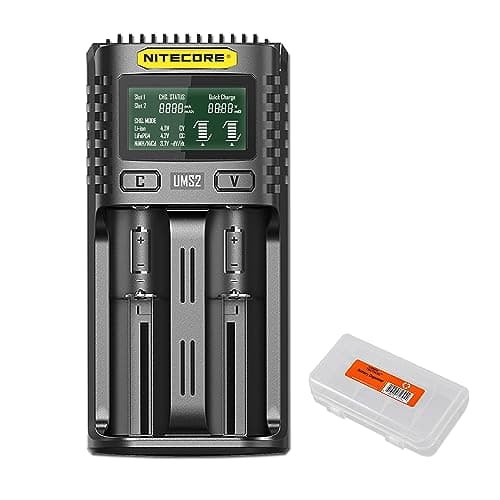
Nitecore UMS2 Dual-Slot USB Charger

Two bays, both lithium formats plus the AAs and AAAs already in your drawer, and a readout that tells you what it is actually doing. It costs less than one decent cell.

If every light you own charges over USB-C internally, you do not need a bay charger at all — and that is a legitimate reason to buy lights with onboard charging instead.

$28.95Amazon (affiliate link)

Price as of November 23, 2026. Prices move — Amazon's is the one that counts.

#ad · we may earn a commission from this link to Nitecore UMS2 Dual-Slot USB Charger

The verdict first: buy the Nitecore UMS2. It is for anyone who owns more than one light with a removable cell, and it handles both lithium formats plus the alkaline and NiMH sizes already in your house. If you want to understand the state of your cells rather than just top them up, the XTAR VC2SL has the clearest readout in the category and a capacity test mode. The budget pick is the Nitecore UI2 — the cheapest two-bay here that does the job, and the right first purchase if you have been charging cells on something found in a drawer.

Prices on this page are a live lookup with an as-of date under the table.

Why the charger is not optional

A lithium-ion cell is a managed chemistry. Charging it correctly means a constant current up to a defined voltage, then a constant voltage while the current tails off, and stopping at the right point. A charger that pushes past that point degrades the cell quickly and, in the failure case, vents it. A charger that stops early leaves you with less capacity than you paid for and no way to know.

Protected cells have a small circuit board that guards against overcharge and over-discharge, and that circuit is a backstop rather than a plan. The charger is the plan. This is also why a generic USB brick with spring contacts is the wrong tool: it has no idea what chemistry it is talking to.

What to look for, in order

1. Format coverage

18650 and 21700 are the two formats worth standardizing on for flashlights, and the difference between them is capacity against size — 18650 against 21700 covers which one your lights should use. A charger that takes both, plus AA and AAA, is one device instead of three.

2. A readout you can actually use

Four blinking LEDs tell you a cell is charging. A display tells you the voltage, the current it is pushing and the capacity it has put back in. The second one lets you spot a cell that is on its way out before it strands you, and the price difference is a few dollars.

3. Bay count honestly assessed

Two bays covers two lights or a light plus a spare, which is most people. Four bays matter if you run a headlamp, a work light and a pocket light on the same format. One bay is a travel charger, not a bench charger.

4. Automatic current selection

A charger that picks a safe current for the cell it detects is the difference between a device you can hand to somebody else and a device that needs a manual. Every charger on this page does this.

The safety part, stated plainly

Charge cells on a hard, non-flammable surface rather than on a bed or a sofa. Do not charge unattended overnight if you can avoid it. Retire any cell with a torn wrapper, a dented case or a bulge — a damaged wrapper on a lithium cell is a short circuit waiting for a metal surface, and re-wrapping is a repair for people who know what they are doing. Never carry a loose cell in a pocket with keys or coins.

None of that is alarmism. It is the same care a fuel can gets, for the same reason: stored energy in a small package.

How to choose between the four

  1. Do you own several lights on removable cells? The UMS2, for the format coverage and the readout.
  2. Do you want to test cells as well as charge them? The XTAR, for the capacity mode and the display.
  3. Is this your first charger? The UI2. Two bays, no cleverness, correct behavior.
  4. Does it live in a pack? The single-bay travel charger, kept there permanently so a dead light is a twenty-minute problem rather than a weekend one.

The short answer

Quick picks

#ProductBest forScorePrice
01
Nitecore Nitecore UMS2 Dual-Slot USB Charger
Nitecore UMS2 Dual-Slot USB Charger

Two bays, both formats plus almost every other cell you own, and a readout that tells you what it is actually doing. It costs less than one decent cell, which is the whole argument.

Best overall charger
9.0
$28.95Amazon (affiliate link)
02
XTAR XTAR VC2SL Two-Bay Charger
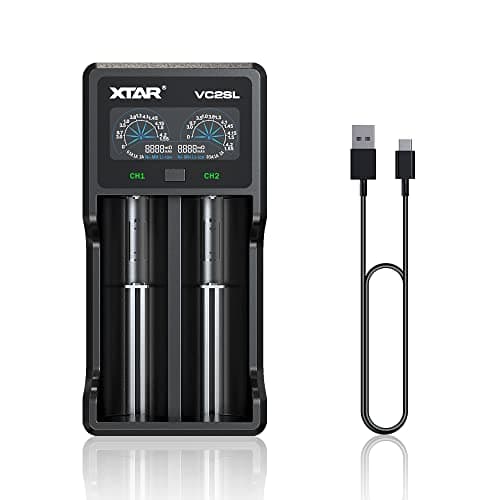
XTAR VC2SL Two-Bay Charger

The clearest display in the category and a capacity test mode, so you can tell a tired cell from a good one instead of guessing. It doubles as a power bank, which earns its place in a bag.

Best readout
8.8
$21.99Amazon (affiliate link)
03
Nitecore Nitecore UI2 Dual-Slot Charger
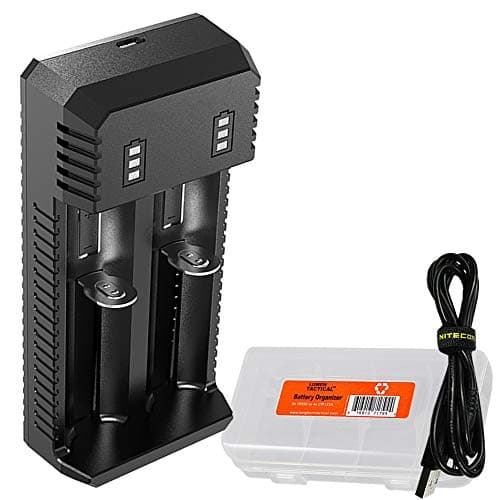
Nitecore UI2 Dual-Slot Charger

The right first purchase: two bays, automatic current selection and no more charging lithium cells on something found in a drawer. It tells you nothing about the cell, which is the trade.

Best budget — the cheapest two-bay that does the job
7.0
Check price → (affiliate link)
04
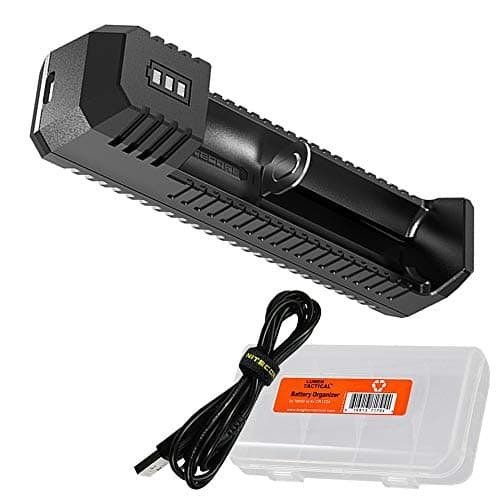
Nitecore Nitecore UI1 Single-Slot Charger
Nitecore UI1 Single-Slot Charger

Single bay, barely bigger than the cell it charges, and cheap enough to leave permanently in a pack. The one that stops a dead light being a dead light all weekend.

Best for travel
8.0
$11.99Amazon (affiliate link)

#ad · Live prices from the Amazon Creators API, as of November 23, 2026. Where we have no verified live price we show none — a gap beats a number that has rotted.

In detail

The picks, in full

01
Nitecore Nitecore UMS2 Dual-Slot USB Charger

Best overall charger

Nitecore UMS2 Dual-Slot USB Charger

2 bays18650, 21700, AA, AAA and moreLCD readoutUSB input
9.0/10

Two bays, both formats plus almost every other cell you own, and a readout that tells you what it is actually doing. It costs less than one decent cell, which is the whole argument.

Compatibility
10
Information shown
9
Build quality
8
Value
9

What's good

  • Takes both flashlight formats and the household ones, which means one charger rather than three
  • The display shows charging current and cell voltage, so you can see a tired cell before it strands you
  • Selectable charge current, which matters — slow charging is kinder to cells than fast charging

What's not

  • Two bays fills up quickly if you have several lights
  • USB input means charge speed depends on the supply you plug it into
  • The interface takes a read of the manual to use properly

Skip it if…

…all your lights charge over USB-C internally. Then you do not need a bay charger at all, and that is a legitimate reason to buy lights with onboard charging.

$28.95Amazon (affiliate link)

Price as of November 23, 2026. Prices move — Amazon's is the one that counts.

#ad · we may earn a commission from this link to Nitecore UMS2 Dual-Slot USB Charger

02
XTAR XTAR VC2SL Two-Bay Charger

Best readout

XTAR VC2SL Two-Bay Charger

2 baysUSB-C inputCapacity test modeUSB output (power bank)
8.8/10

The clearest display in the category and a capacity test mode, so you can tell a tired cell from a good one instead of guessing. It doubles as a power bank, which earns its place in a bag.

Information shown
10
Compatibility
9
Build quality
7
Value
9

What's good

  • The capacity test tells you whether a cell is still worth carrying, which is information no other cheap tool gives you
  • USB-C input in a category still full of micro-USB
  • Discharges to a USB port, so a spare 21700 becomes a phone charge

What's not

  • Capacity testing takes hours and people expect it to be quick
  • Two bays again
  • Plastic construction feels its price

Skip it if…

…you just want cells charged without thinking. The single-bay chargers do that for half the money.

$21.99Amazon (affiliate link)

Price as of November 23, 2026. Prices move — Amazon's is the one that counts.

#ad · we may earn a commission from this link to XTAR VC2SL Two-Bay Charger

03
Nitecore Nitecore UI2 Dual-Slot Charger

Best budget — the cheapest two-bay that does the job

Nitecore UI2 Dual-Slot Charger

2 bays18650 and 21700USB inputAutomatic current selection
7.0/10

The right first purchase: two bays, automatic current selection and no more charging lithium cells on something found in a drawer. It tells you nothing about the cell, which is the trade.

Compatibility
7
Information shown
4
Build quality
7
Value
10

What's good

  • Cheap enough that there is no excuse for using an unknown charger
  • Picks a sensible charge current on its own
  • Small enough to live in a bag

What's not

  • No display, so you get a light rather than information
  • Lithium-ion only — no AA or AAA
  • No capacity testing

Skip it if…

…you want to know the state of your cells rather than just top them up. Spend the extra on the UMS2 or the XTAR.

Check price on Amazon → (affiliate link)

No buyable offer at the last price check (November 23, 2026). We show nothing rather than a stale number.

#ad · we may earn a commission from this link to Nitecore UI2 Dual-Slot Charger

04
Nitecore Nitecore UI1 Single-Slot Charger

Best for travel

Nitecore UI1 Single-Slot Charger

1 bay18650, 21700 and moreUSB inputPocket size
8.0/10

Single bay, barely bigger than the cell it charges, and cheap enough to leave permanently in a pack. The one that stops a dead light being a dead light all weekend.

Portability
10
Compatibility
9
Information shown
3
Value
10

What's good

  • Small enough that there is no reason not to have one in a bag
  • Takes every common flashlight cell format
  • Costs about what a takeaway coffee does

What's not

  • One bay
  • No display
  • Slow, which is fine for overnight and irritating otherwise

Skip it if…

…this is your only charger and you own more than one light. Buy a multi-bay for the bench and keep this for travel.

$11.99Amazon (affiliate link)

Price as of November 23, 2026. Prices move — Amazon's is the one that counts.

#ad · we may earn a commission from this link to Nitecore UI1 Single-Slot Charger

Buying notes

Buy cells from the brand that made your light

Or from a known cell maker through a reputable seller. The counterfeit market in high-capacity 18650s is large, and a cell claiming a capacity no manufacturer produces is a re-wrapped lower-capacity cell at best.

Match protected or unprotected to the light

Some lights require protected cells, some have the protection built into the driver, and some will not physically fit a protected cell because the circuit makes it longer. Check the light's manual rather than guessing.

Label your cells and rotate them

A marker pen and a number on the wrapper is all it takes. Cells age at different rates and mixing an old cell with a new one in a multi-cell device is how you discover which one was old.

Where the chargers sit beside the lights

EDC flashlights under $50 includes the removable-cell light that makes a charger worth owning, and rechargeable tactical lights is the tier where onboard charging usually makes a bay charger optional.
How these were picked

I haven't handled these. Here's what I did instead.

Everyone in this category says they tested twenty of these. I haven't tested any, and I say so. What I do instead: read the manufacturer's manual and published specification, compile the numbers that decide the purchase, do the arithmetic in the open, check the live price, and name one product to skip. The scores above are judgments from that research against a published rubric — they are not measurements I took, because I do not have a lab and I am not going to pretend otherwise.

Questions

Frequently asked

What is the best 18650 charger?
The Nitecore UMS2 for most people: two bays, 18650 and 21700 plus AA and AAA, automatic current selection and a readout. The XTAR VC2SL is the pick if you want the clearest display and a capacity test mode.
Can I charge 18650 cells with a phone charger?
Not directly, and not safely on a generic brick with spring contacts. Lithium-ion cells need a constant-current then constant-voltage profile with a correct cut-off, which is what a purpose-built cell charger does and a phone brick does not.
Do I need a charger if my flashlight charges over USB?
No. If every light you own charges internally, a bay charger buys you nothing — and choosing lights with onboard charging is a legitimate way to avoid owning one. You want a bay charger when you keep spare cells or run several lights on the same format.
How long do 18650 cells last?
A few hundred full charge cycles for a good cell, and far fewer if it is regularly run flat or charged by something that does not stop at the right voltage. Capacity decline is gradual, which is why a charger with a capacity readout is worth the few extra dollars.
Is 21700 better than 18650?
It holds more energy and it is physically larger, so it is better in a light designed for it and useless in one that is not. The two formats are not interchangeable in either direction, and every charger on this page takes both.

Keep reading

Receipts

Sources

We do not run a testing lab and we do not pretend to. Where a measured number came from a manufacturer's published specification or someone else's lab, we name them and link them. Where we could not verify something, we say so on the page rather than quietly leaving it out. Read the full method.