We earn a commission when you buy through our Amazon links, at no extra cost to you. It never changes the order of the picks, and we say so when the cheaper thing is the better buy. How this works.
Airing down before a trail and back up afterwards is the single most effective thing you can do for traction, and it is free. What is not free is the compressor, and the whole category is sold on the wrong number.
CFM is airflow, usually quoted at zero PSI where it is highest and least relevant. Duty cycle is the percentage of time the compressor can run before it must stop and cool, and it is usually quoted at a specific pressure — or, in this category, not quoted at all.
Airing four 33-inch tires from 18 PSI back to 35 is roughly fifteen to twenty minutes of continuous work. A compressor with a 25 percent duty cycle at 100 PSI needs three times that long in cooling breaks. That is the difference between leaving the trailhead and standing at it for an hour.
VIAIR publishes both figures. Most of the field publishes one. That difference is most of the ranking below.
VIAIR publishes duty cycle, which almost nobody else in this category does — and duty cycle is the specification that decides whether you air up four tires or overheat halfway.
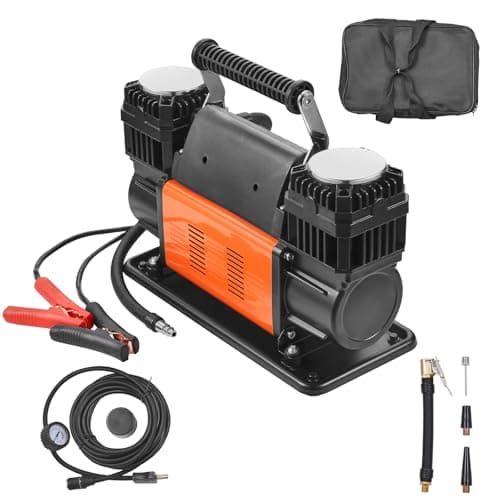
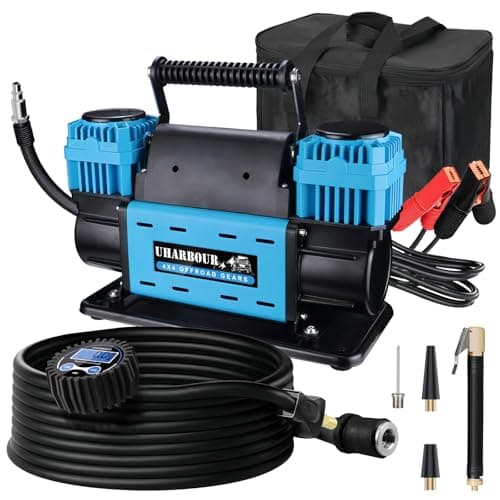
10.6 CFM quoted with no duty cycle stated. CFM tells you how fast air moves; duty cycle tells you for how long — and airing up four tires from trail pressure is fifteen to twenty minutes of continuous work.
#ad · Live prices from the Amazon Creators API, as of October 19, 2026. Where we have no verified live price we show none — a gap beats a number that has rotted.
In detail
The picks, in full
01
Best overall
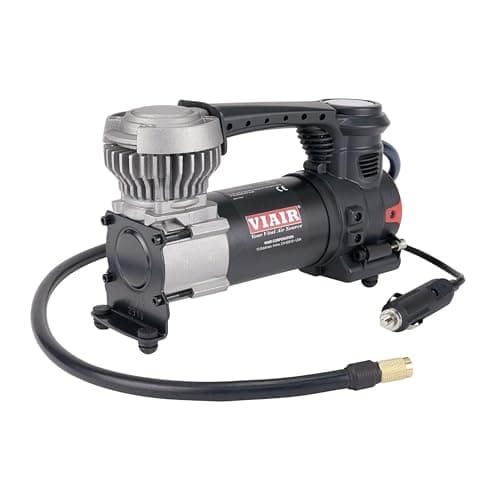
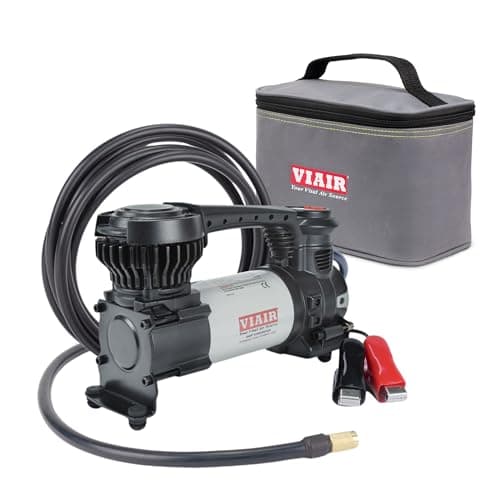
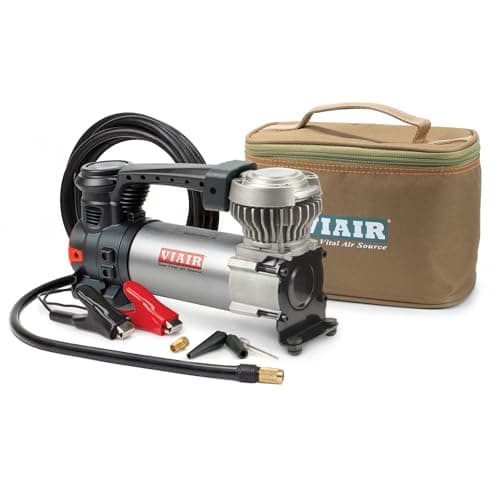
VIAIR 88P Portable Compressor
120 PSI maxUp to 33 in tires12V direct batteryPublished duty cycle
8.2/10
VIAIR publishes duty cycle, which almost nobody else in this category does — and duty cycle is the specification that decides whether you air up four tires or overheat halfway.
Airflow
7
Duty cycle
9
Build quality
9
Portability
8
Value
8
What's good
+VIAIR publishes real duty cycle figures rather than only peak CFM
+Rated for tires up to 33 inches, which covers most trail vehicles
+Direct battery clamps rather than a cigarette-lighter plug, which is the difference between working and tripping a fuse
+Long track record and available spare parts
What's not
−Slower than the twin-cylinder units
−Needs battery clamps, so the hood has to be open
Skip it if…
…you run 37-inch tires. Buy the larger VIAIR — this one will do it slowly and work very hard.
10.6 CFM quoted with no duty cycle stated. CFM tells you how fast air moves; duty cycle tells you for how long — and airing up four tires from trail pressure is fifteen to twenty minutes of continuous work.
Airflow
8
Duty cycle
3
Build quality
5
Portability
5
Value
6
What's good
+High claimed airflow
+Cheaper than the equivalent VIAIR
What's not
−Duty cycle — the percentage of time a compressor can run before it must cool — is the specification that decides whether it finishes the job, and it is absent
−A compressor with a 25% duty cycle at pressure needs 45 minutes of cooling for 15 minutes of work
−CFM figures are typically quoted at zero PSI, where they are highest and least relevant
−VIAIR publishes both figures, which is why their equivalent costs more
Skip it if…
…you are choosing on the CFM number. Buy a compressor whose maker publishes duty cycle at pressure.
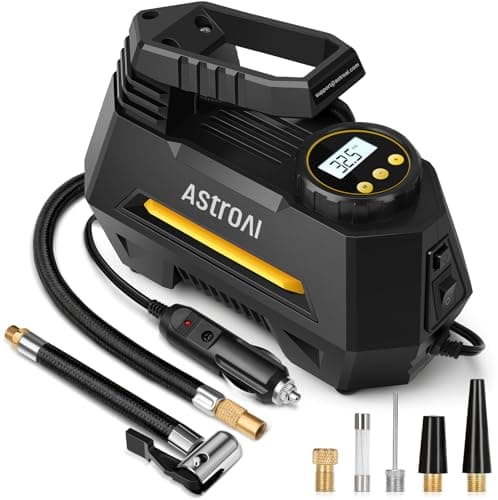
This is the most common reason a compressor underperforms. Anything drawing serious current needs to connect directly to the battery with clamps, not through a cigarette-lighter socket, which is typically fused at 10 to 15 amps. Plugging a real compressor into an accessory socket either blows the fuse or starves the motor.
Air down before the trail, not after you are stuck
Dropping from 35 PSI to 18 or 20 roughly doubles your contact patch, dramatically improving traction in sand and on rock. Do it at the trailhead. Do not exceed your tire's debeading limits, and air back up before you return to pavement — low pressure at highway speed builds sidewall heat and causes failures.
Carry a separate gauge
Built-in gauges on portable compressors are frequently several PSI out. A $10 pencil or digital gauge is more accurate than most of them and is worth checking against.
Let it cool
If the housing is too hot to hold, stop. Overheating is what kills these, and the failure is usually permanent.
How these were picked
I haven't handled these. Here's what I did instead.
Everyone in this category says they tested twenty of these. I haven't tested any, and I say so. What I do instead: read the manufacturer's manual and published specification, compile the numbers that decide the purchase, do the arithmetic in the open, check the live price, and name one product to skip. The scores above are judgments from that research against a published rubric — they are not measurements I took, because I do not have a lab and I am not going to pretend otherwise.
Questions
Frequently asked
What CFM do I need in an air compressor?+
Around 2 CFM handles 33-inch tires at a reasonable pace; 4 CFM and up is comfortable for 35s and larger. But CFM without a duty cycle figure is close to meaningless, because a fast compressor that must stop every three minutes is slower overall than a modest one that runs continuously.
What is duty cycle on an air compressor?+
The percentage of time it can run before it must cool, usually quoted at a specific pressure. A 50% duty cycle at 100 PSI means ten minutes of running needs ten minutes of cooling. It is the number that determines whether you finish airing up.
Can I run a compressor from the cigarette lighter?+
Only a small inflator. Accessory sockets are typically fused at 10 to 15 amps, and a real off-road compressor draws far more. Direct battery clamps are not a preference in that case, they are a requirement.
How low should I air down my tires?+
Eighteen to twenty PSI suits most sand and rock on a standard tire, and 12 to 15 is used in deep sand with care. Below about 12 PSI you risk unseating the bead unless you run beadlocks. Always air back up before highway speeds.
We do not run a testing lab and we do not pretend to. Where a measured number came from a manufacturer's published specification or someone else's lab, we name them and link them. Where we could not verify something, we say so on the page rather than quietly leaving it out. Read the full method.