We earn a commission when you buy through our Amazon links, at no extra cost to you. It never changes the order of the picks, and we say so when the cheaper thing is the better buy. How this works.
There are two ropes in vehicle recovery and they are not interchangeable, which is the single most important thing on this page.
A kinetic recovery rope (or snatch strap) is designed to stretch — typically 20 to 30 percent. The recovering vehicle takes a run-up, the rope stretches, stores energy, and releases it to pull the stuck vehicle out. It is used for recovery.
A tow strap has minimal stretch and is for towing a vehicle that already rolls. Using a tow strap for a snatch recovery puts an enormous shock load through both vehicles' anchor points. Using a kinetic rope for towing keeps it under sustained load it was never designed for. Both mistakes break things and the things break at speed.
After that, the ratings. Minimum breaking strength should be roughly two to three times your vehicle's gross weight for a kinetic rope. Shackles need a working load limit that matches, and they attach to rated recovery points — never a tow ball, never a hitch pin hole.
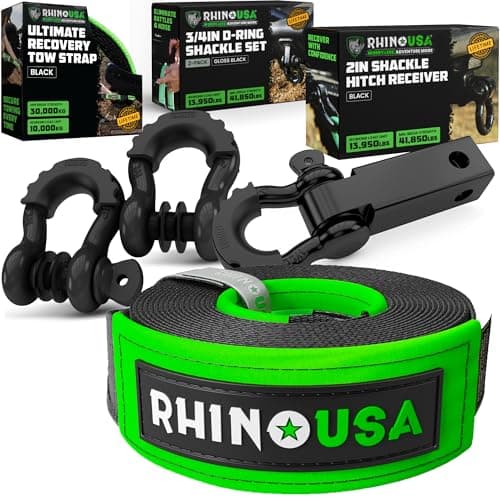
The 20-foot Rhino strap with both kinds of connection point in the bag — D-ring shackles for a bumper and a shackle receiver for a 2-inch hitch — in a package that actually fits in a normal vehicle's storage.
The metal hooks are the problem, and they are the reason nearly every serious recovery guide says to buy a strap with loops instead. A hook that comes loose under load becomes a steel projectile traveling at the speed the strap releases at.
#ad · Live prices from the Amazon Creators API, as of October 19, 2026. Where we have no verified live price we show none — a gap beats a number that has rotted.
In detail
The picks, in full
01
Best overall
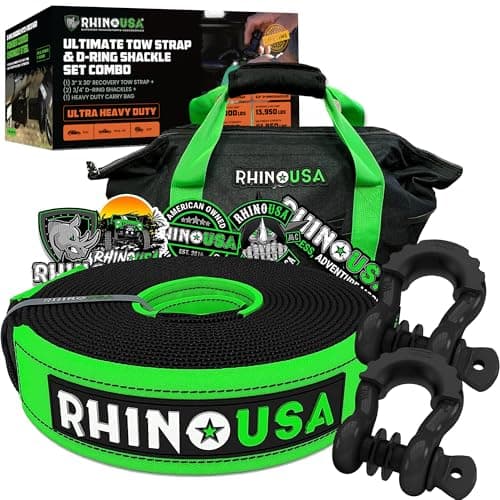
Rhino USA 30ft Recovery Combo Kit
30 ft strapD-ring shackles includedPublished break strengthLifetime warranty
8.4/10
A rated strap and rated shackles from a company that publishes both numbers, which is the whole specification in recovery gear.
Rated strength
9
Hardware safety
9
Length
9
Durability
8
Value
7
What's good
+Break strength published for both strap and shackles, which most kits do not do
+Thirty feet gives you room to position the recovery vehicle safely off the obstacle
+Rhino USA's warranty is genuine and its ratings are documented
+D-ring shackles rather than hooks — hooks are the classic recovery hazard
What's not
−More expensive than unbranded kits
−Nylon strap absorbs water and gets heavy and dirty
Skip it if…
…you need a kinetic recovery rope. A tow strap has minimal stretch and is the wrong tool for snatching a stuck vehicle free.
The 20-foot Rhino strap with both kinds of connection point in the bag — D-ring shackles for a bumper and a shackle receiver for a 2-inch hitch — in a package that actually fits in a normal vehicle's storage.
Rated strength
8
Hardware safety
9
Length
6
Durability
8
Value
6
What's good
+Covers a vehicle with bumper recovery points and one with only a hitch, from the same bag
+Packs small enough to live in a vehicle permanently, which is the point of recovery gear
+Chromoly D-rings with rubber isolators, so they do not rattle in the bumper between uses
What's not
−Costs more than the 30-foot kit above, because it adds the hitch receiver — buy that one if you already own a receiver shackle
−Twenty feet limits recovery vehicle positioning
−A tow strap for static pulls on flat ground, not a snatch strap
Skip it if…
…you wheel with a group on tight trails. The extra ten feet is what lets the recovery vehicle find solid ground.
Price as of October 19, 2026. Prices move — Amazon's is the one that counts.
#ad · we may earn a commission from this link to Rhino USA 20ft Tow Strap Kit with D-Rings and Hitch Receiver
05
Skip this one
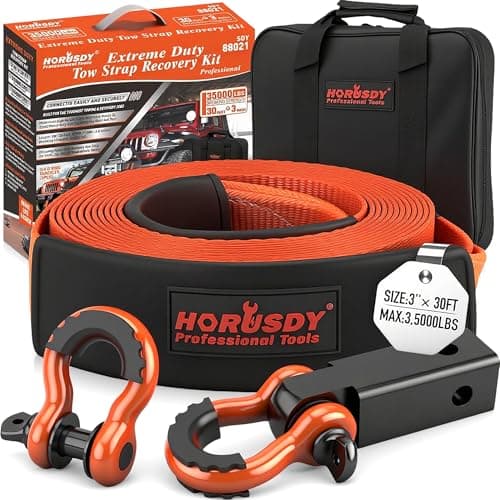
HORUSDY Tow Strap with Hooks 3in x 30ft
3 in x 30 ft36,000 lb break strengthMetal hooks sewn on
5.8/10
The metal hooks are the problem, and they are the reason nearly every serious recovery guide says to buy a strap with loops instead. A hook that comes loose under load becomes a steel projectile traveling at the speed the strap releases at.
Rated strength
7
Hardware safety
2
Length
9
Durability
6
Value
5
What's good
+Long strap
+High stated break strength
+Cheap
What's not
−Hooks can disengage under shock load or if the angle changes mid-recovery, and there is nothing holding them on once they do
−Hook attachment points are rarely load-rated even when the strap is — the strap's 36,000 lb rating tells you nothing about the hook
−A looped strap plus a rated shackle through a rated recovery point is the configuration that fails safely
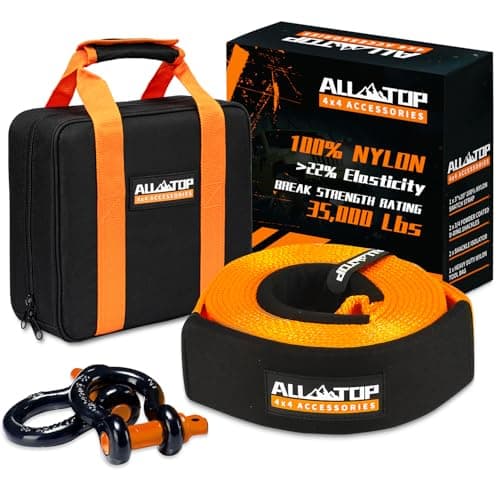
−The Rhino USA and ALL-TOP kits use loops and rated shackles for similar money
Skip it if…
…you will use it. This is the item on this whole site most likely to hurt someone, and the fix costs nothing extra.
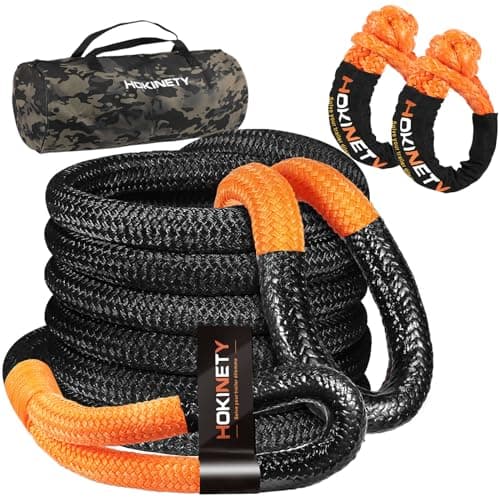
Kinetic recovery rope rated 2-3x your gross vehicle weight, for pulling a stuck vehicle free
Tow strap with loops (not hooks), for towing a rolling vehicle
Two rated shackles — soft shackles are lighter and cannot become a projectile
Tree saver strap — a wide strap that will not ring-bark a tree used as an anchor
Gloves, and a line damper if you also carry a winch
A bag — recovery gear caked in mud loose in a vehicle is unpleasant and wears out fast
Soft shackles are the upgrade to make
A soft shackle is a loop of high-strength synthetic rope. It is rated as high as a steel shackle, weighs a fraction as much, cannot rust seized, and if the system fails it does not become a lump of steel traveling at speed. There is very little argument left for steel shackles on a recovery kit.
Attachment points
Rated recovery points bolted to the frame, or a factory recovery hook if your vehicle has one. Not a tow ball, not the pin hole in a hitch receiver, not a suspension arm, not a bumper bracket. Those are rated for steady loads and they fail under shock as projectiles.
Nobody in the arc
Everyone stands well outside the arc a failed line would sweep, which is roughly one and a half times the line length to either side. Spectators go behind a vehicle or well off to the side, and nobody films from between the two trucks.
Inspect before every use
Cuts, abrasion, UV fading, and any hardening or glazing on a nylon strap mean it is retired. Recovery gear is a consumable and it fails all at once.
How these were picked
I haven't handled these. Here's what I did instead.
Everyone in this category says they tested twenty of these. I haven't tested any, and I say so. What I do instead: read the manufacturer's manual and published specification, compile the numbers that decide the purchase, do the arithmetic in the open, check the live price, and name one product to skip. The scores above are judgments from that research against a published rubric — they are not measurements I took, because I do not have a lab and I am not going to pretend otherwise.
Questions
Frequently asked
What is the difference between a kinetic rope and a tow strap?+
A kinetic rope stretches 20 to 30 percent, storing energy to pull a stuck vehicle free — it is for recovery. A tow strap has minimal stretch and is for towing a rolling vehicle. Swapping them puts enormous shock loads through hardware not designed for it.
What strength recovery strap do I need?+
Roughly two to three times your vehicle's gross weight as a minimum breaking strength. For a 6,000 lb truck that is 12,000 to 18,000 lb, and most quality kits are rated well above.
Are soft shackles as strong as steel ones?+
Rated soft shackles match or exceed comparable steel shackles, weigh a fraction as much, cannot rust seized, and cannot become a steel projectile if something fails. For vehicle recovery there is very little argument left for steel.
Can I attach a recovery strap to a tow ball?+
No. Tow balls are rated for steady towing loads and fail under shock loading — a failed tow ball leaves at high speed and has killed people. Use rated recovery points, a tree saver strap, or a properly rated hitch receiver shackle mount.
We do not run a testing lab and we do not pretend to. Where a measured number came from a manufacturer's published specification or someone else's lab, we name them and link them. Where we could not verify something, we say so on the page rather than quietly leaving it out. Read the full method.