We earn a commission when you buy through our Amazon links, at no extra cost to you. It never changes the order of the picks, and we say so when the cheaper thing is the better buy. How this works.
Overlanding builds go wrong in a predictable order: people buy the rooftop tent first, because it is the visible part, and the recovery gear last, because it is not. That is exactly backwards in terms of what will matter on a trip.
The list below is ordered by how likely each item is to be the thing you actually needed. Buy in this order and every purchase earns its place before the next one.
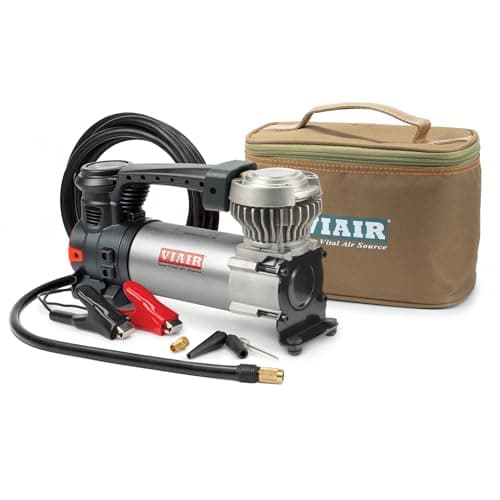
VIAIR publishes duty cycle, which almost nobody else in this category does — and duty cycle is the specification that decides whether you air up four tires or overheat halfway.
#ad · Live prices from the Amazon Creators API, as of October 19, 2026. Where we have no verified live price we show none — a gap beats a number that has rotted.
120 PSI maxUp to 33 in tires12V direct batteryPublished duty cycle
8.2/10
VIAIR publishes duty cycle, which almost nobody else in this category does — and duty cycle is the specification that decides whether you air up four tires or overheat halfway.
Airflow
7
Duty cycle
9
Build quality
9
Portability
8
Value
8
What's good
+VIAIR publishes real duty cycle figures rather than only peak CFM
+Rated for tires up to 33 inches, which covers most trail vehicles
+Direct battery clamps rather than a cigarette-lighter plug, which is the difference between working and tripping a fuse
+Long track record and available spare parts
What's not
−Slower than the twin-cylinder units
−Needs battery clamps, so the hood has to be open
Skip it if…
…you run 37-inch tires. Buy the larger VIAIR — this one will do it slowly and work very hard.
Tire repair plug kit and a spare that is actually inflated. The most common trail failure by a wide margin, and the one most people are least prepared for.
A full-size spare and the tools to change it. Including a jack that works on soft ground.
2. Navigation and communication
Offline maps on your phone, downloaded before you leave signal
A paper map and a compass, and the ability to use them
A satellite communicator if you travel beyond cell coverage
A power bank, because navigation on a phone eats battery
Radios, once you travel with other vehicles — and the honest answer to "GMRS or CB" is both. See the comms section of my 4Runner build, which runs a GMRS mobile as a base station for handhelds and a CB for talking to everyone else.
2b. A trauma kit, and the training for it
A genuine tourniquet, gauze, a pressure dressing, gloves and shears, mounted where you can reach it with a door open — not buried in a drawer.
A separate, cheap first-aid kit for the cuts and blisters you will actually get. They are different objects.
A bleeding-control course. It costs a couple of hours and outperforms every product on this list.
This sits here, above water and power, for one reason: it is the only item on the list where buying the wrong thing can kill somebody. Vehicle trauma and first-aid kits covers what belongs in one, how to mount it, and the counterfeit tourniquet problem — which is documented, industrial in scale, and the reason a cheap tourniquet is not a bargain.
3. Water and food
A gallon per person per day, plus a reserve. Water is the thing you genuinely cannot improvise.
A filter or purification if you will resupply from streams
A cooler to start with; a 12V fridge later, once you have the power to run it
Stove and fuel, with more fuel than you planned
4. Power
Dual battery with a DC-to-DC charger, if you run a fridge
A solar panel for stationary days
A jump starter — the failure that ends trips most often is a flat battery
5. Sleep and shelter
A ground tent, or a rooftop tent if the roof load arithmetic works
Sleeping pad with a real R-value — this matters more than the tent
Sleeping bag rated below your expected low
A vehicle awning, which is the highest-value comfort purchase in the whole list
6. Recovery for the vehicle itself
Basic tool kit sized to your vehicle's fasteners
Fluids: oil, coolant, brake fluid, and a funnel
Fuses, zip ties, self-amalgamating tape, wire, hose clamps
A winch, once you genuinely need one and can size it to 1.5x GVWR
What people buy far too early
A rooftop tent. The most visible purchase and the least likely to matter on a trip. Check your roof rating first, and consider whether a ground tent solves it.
A winch. Boards, a compressor and a strap resolve the large majority of recoveries. A winch is for when you travel alone in genuinely difficult terrain.
A roof rack full of jerry cans. Weight high on the vehicle is the worst place for it, and most people never use the fuel.
A 12V fridge before the power to run it. The fridge is the easy purchase; the dual battery is the one that makes it work.
The things nobody mentions
A tire pressure gauge you trust. Built-in compressor gauges are often several PSI out.
Gloves. Recovery gear, hot exhausts and steel cable all argue for them.
A trash system. Multi-day trips generate more than you expect and there is nowhere to put it.
A shovel. Recovery, fire management, and burying what needs burying.
Your vehicle's wheel lock key. The single most common reason someone cannot change their own tire.
How these were picked
I haven't handled these. Here's what I did instead.
Everyone in this category says they tested twenty of these. I haven't tested any, and I say so. What I do instead: read the manufacturer's manual and published specification, compile the numbers that decide the purchase, do the arithmetic in the open, check the live price, and name one product to skip. The scores above are judgments from that research against a published rubric — they are not measurements I took, because I do not have a lab and I am not going to pretend otherwise.
Questions
Frequently asked
What should I buy first for overlanding?+
Recovery boards and an air compressor. They are the cheapest items on the list and the most likely to be what you actually needed. The rooftop tent is the most visible purchase and the least likely to matter on a given trip.
Do I need a winch for overlanding?+
Not initially. Traction boards, airing down and a strap recovery with another vehicle handle most situations. A winch matters when you travel alone in difficult terrain — and then it should be sized to 1.5 times your gross vehicle weight.
How much water should I carry?+
A gallon per person per day for drinking, plus cooking and washing, plus a reserve of at least a day. Water is the one item you cannot improvise, and it is the reason most unplanned trips get cut short.
Do I need a dual battery setup?+
If you run a 12V fridge overnight, effectively yes. A compressor fridge will discharge a starter battery to the point the vehicle will not start, and repeated deep discharge damages a starter battery permanently.
What is the most common overlanding failure?+
A flat tire, followed by a flat battery. Both are prevented by cheap, unglamorous items — a plug kit, an inflated full-size spare, a jack that works on soft ground, and a jump starter.
We do not run a testing lab and we do not pretend to. Where a measured number came from a manufacturer's published specification or someone else's lab, we name them and link them. Where we could not verify something, we say so on the page rather than quietly leaving it out. Read the full method.