The lumen number is measured at the emitter for the first thirty seconds. The runtime chart is where the honest information lives, and most brands do not publish one.
We earn a commission when you buy through our Amazon links, at no extra cost to you. It never changes the order of the picks, and we say so when the cheaper thing is the better buy. How this works.
Headlamp listings have the same problem as flashlight listings, only worse, because the batteries are smaller. A claimed 1,000 lumens from a headlamp-sized cell is real for perhaps ninety seconds before thermal management steps the output down — and the claimed runtime is measured at the lowest mode, which is a different number about a different thing.
ANSI/NEMA FL 1 exists precisely so these figures can be compared: output measured out the front of the lens after thirty seconds, runtime measured to 10 percent of initial output, plus impact and water resistance. Manufacturers who follow it publish a runtime chart. Those who do not, publish one big number.
The second decision is battery type, and the right answer depends entirely on use. Rechargeable is better for a lamp you use weekly. Replaceable AAA cells are better for a lamp that sits in an emergency kit for two years, because a lithium pack that has self-discharged flat is a dead lamp and a fresh AAA is available at any gas station.
Camping and a blackout ask different things of a headlamp: on a trip you can plan charging, and in an outage you cannot. If the light is going in a kitchen drawer rather than a pack, flashlights for a power outage ranks on runtime, hands-free use and a battery chemistry you can still buy with the power off — which is why primary cells come out ahead there and not here.
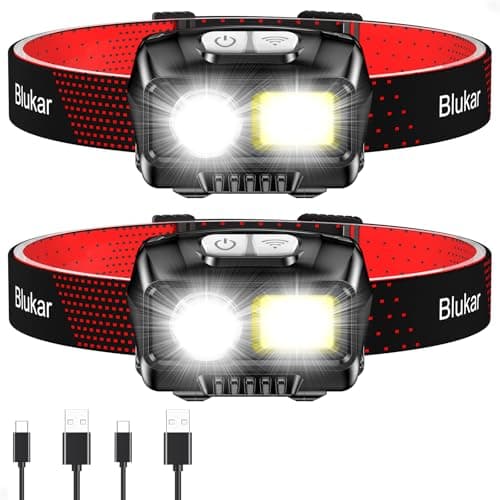
A 1000+ lumen claim with a 12-hour runtime claim, from no named manufacturer, with no runtime chart. Those two numbers cannot both be true from a headlamp battery, and the absence of a maker means nobody has to answer for it.
#ad · Live prices from the Amazon Creators API, as of October 19, 2026. Where we have no verified live price we show none — a gap beats a number that has rotted.
In detail
The picks, in full
01
Best overall
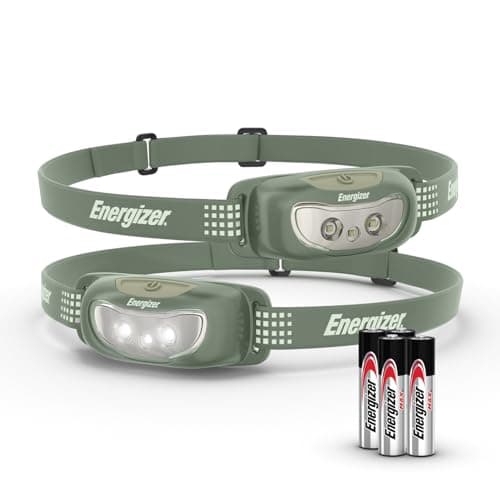
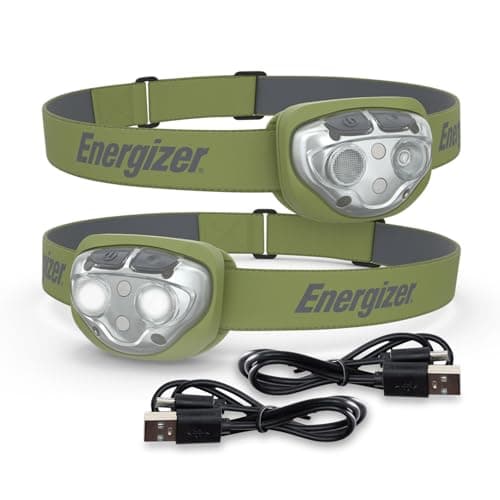
Energizer PRO-400 Rechargeable (2-Pack)
RechargeableIPX4 water resistantMultiple modesTwo-pack
7.6/10
Two rechargeable headlamps from a battery company, with an IPX4 rating actually stated rather than implied.
Real output
7
Battery life
8
Comfort
8
Weather resistance
6
Value
9
What's good
+Two lamps means one for the truck and one for the pack, which is how headlamps actually get lost
+Energizer states its water resistance rating rather than saying 'waterproof'
+Multiple modes including a red night-vision mode on most models
What's not
−IPX4 is splash resistance, not immersion — do not drop it in a creek
−Output is modest next to the inflated claims on cheaper lamps
Skip it if…
…you need serious throw for night navigation. This is a camp and close-work lamp.
A 1000+ lumen claim with a 12-hour runtime claim, from no named manufacturer, with no runtime chart. Those two numbers cannot both be true from a headlamp battery, and the absence of a maker means nobody has to answer for it.
Real output
4
Battery life
4
Comfort
5
Weather resistance
4
Value
5
What's good
+Extremely cheap
+Two units
What's not
−1000 lumens for 12 hours from a headlamp-sized cell would be a genuine engineering breakthrough. Real lamps step output down within minutes for thermal reasons, and the runtime figure is measured at the lowest mode
−ANSI/NEMA FL 1 exists precisely so these figures can be compared — a lamp not quoting it is not comparable to anything
−No named manufacturer means no warranty and no recourse
−Energizer's two-pack costs the same and states its ratings
Skip it if…
…you plan to rely on the numbers. Buy from a maker who publishes a runtime chart — the Energizer two-packs cost the same.
Camp tasks — cooking, finding something in a tent, walking to the toilet block — are 20 to 100 lumen jobs. Night hiking on rough ground wants 200 to 400. Above that you are mostly burning battery and blinding whoever you look at.
A red mode is genuinely useful
Red light preserves dark adaptation and is far less disruptive to other people in camp. It is also the mode to use inside a tent at 3am if you would like to remain popular.
Check the IP rating, and check it is stated
IPX4 handles rain. IPX7 survives immersion in a meter of water for thirty minutes. A lamp that says "waterproof" without an IP number has not been tested to anything.
Comfort decides whether you wear it
Weight over 100 grams starts to bounce when you move. A rear battery pack balances heavier lamps but adds bulk. If it is uncomfortable, it ends up in your hand, which defeats the entire purpose.
Buy two
Headlamps are cheap and easy to lose. Two-packs are common and cost barely more than singles. One lives in the pack, one lives in the vehicle, and you are never without one.
How these were picked
I haven't handled these. Here's what I did instead.
Everyone in this category says they tested twenty of these. I haven't tested any, and I say so. What I do instead: read the manufacturer's manual and published specification, compile the numbers that decide the purchase, do the arithmetic in the open, check the live price, and name one product to skip. The scores above are judgments from that research against a published rubric — they are not measurements I took, because I do not have a lab and I am not going to pretend otherwise.
Questions
Frequently asked
How many lumens does a camping headlamp need?+
One to two hundred covers essentially all camp tasks. Two to four hundred for night hiking on rough ground. The very high numbers on budget listings are peak emitter output for the first few seconds, not sustained brightness.
Rechargeable or replaceable batteries?+
Rechargeable for regular use — better output, no ongoing cost. Replaceable AAA for emergency kits, where a lamp may sit for two years: a self-discharged lithium pack is a dead lamp, and a fresh AAA is available anywhere.
What does IPX4 mean on a headlamp?+
Protection against splashing water from any direction — rain, essentially. IPX7 means immersion in one meter for thirty minutes. A lamp claiming "waterproof" with no IP number has not been tested to a standard.
Why does a red light mode matter?+
Red light preserves your dark adaptation, so you can see by starlight again quickly after turning it off, and it is far less disruptive to everyone else in camp. It also attracts fewer insects.
We do not run a testing lab and we do not pretend to. Where a measured number came from a manufacturer's published specification or someone else's lab, we name them and link them. Where we could not verify something, we say so on the page rather than quietly leaving it out. Read the full method.