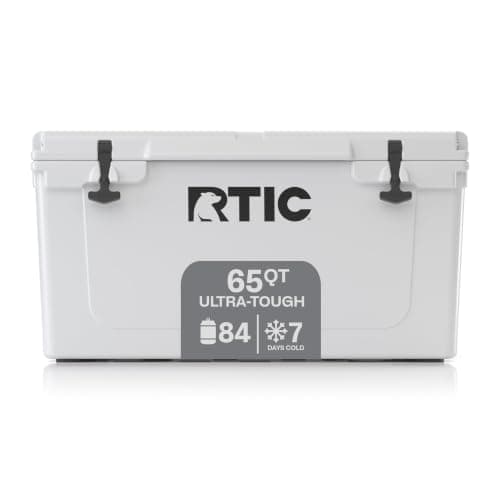
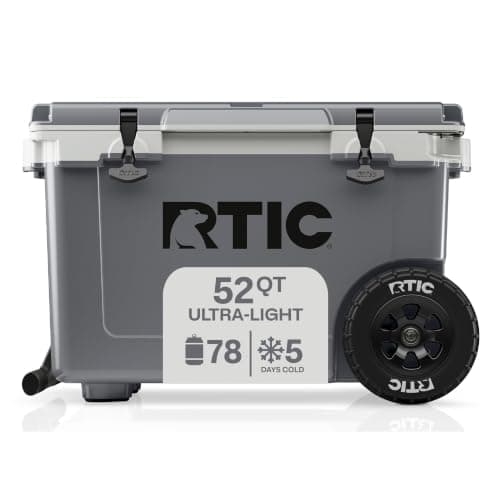
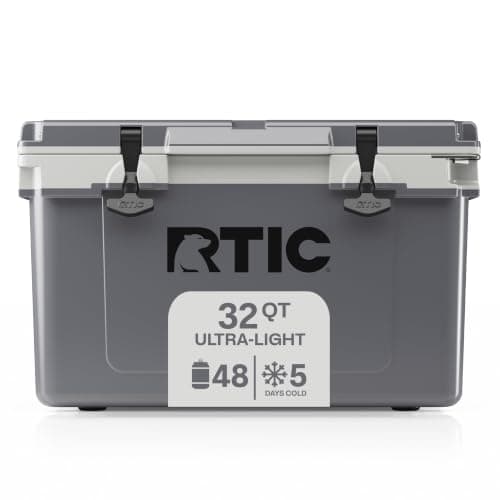
The short answer: about 20 to 25 quarts per person for a weekend, ice included. Two people for two nights is a 45-quart cooler. A family of four for a long weekend is 65 to 75. A week for four is two coolers rather than one enormous one.
The part people get backwards: bigger is not safer. A cooler needs to be roughly two-thirds to three-quarters full to hold ice well, because air is what carries heat in and every opening dumps the cold air out. A 65-quart cooler with a weekend's food for two in it will lose ice faster than a full 32.
Sizing by trip
| Trip | Cooler size | Notes |
|---|
| Day trip, 2 people | 20–25 qt | Soft cooler is fine |
| Weekend, 2 people | 35–45 qt | The most useful all-round size |
| Weekend, family of 4 | 65–75 qt | Consider a wheeled model |
| Week, 2 people | 65 qt | Plus a small cooler for drinks |
| Week, family of 4 | 2 coolers | Food in one, drinks in the other |
The two-cooler system
This is the single most effective thing you can do and it costs nothing extra if you already own a small cooler. Drinks get opened constantly; food does not. Putting them in the same box means every drink run dumps the cold air keeping your food safe.
Put food in the large cooler and open it three times a day. Put drinks in a cheap smaller cooler and open it as often as you like. Your food cooler will hold ice roughly twice as long, and you did not spend anything.
The ice ratio
Aim for roughly a 2:1 ratio of ice to contents by volume for multi-day trips, or 1:1 for a single night. That sounds like a lot of ice and it is — most people underestimate this badly, then blame the cooler.
Pack it in layers
- Block ice on the bottom — it melts slowest and forms a cold base.
- Items you need last, in sealed containers, above it.
- More ice.
- Items you need first, at the top.
- Cubed ice packed into every remaining gap.
Frozen water bottles are excellent block ice — they melt slowly, and they give you cold drinking water rather than a pool of meltwater.
Keeping food safe, not just cold
Perishable food needs to stay at or below 40°F. A cheap fridge thermometer in the cooler tells you whether you are actually there, which matters more than how much ice is visibly left. Raw meat goes in sealed containers at the bottom so nothing drips onto anything else.
How these were picked
I haven't handled these. Here's what I did instead.
Everyone in this category says they tested twenty of these. I haven't tested any, and I say so. What I do instead: read the manufacturer's manual and published specification, compile the numbers that decide the purchase, do the arithmetic in the open, check the live price, and name one product to skip. The scores above are judgments from that research against a published rubric — they are not measurements I took, because I do not have a lab and I am not going to pretend otherwise.