We earn a commission when you buy through our Amazon links, at no extra cost to you. It never changes the order of the picks, and we say so when the cheaper thing is the better buy. How this works.
The short answers, worked below: a boned-out whitetail needs roughly 50 to 65 quarts. A mule deer, 65 to 85. A boned-out elk needs 150 to 200 quarts, which in practice means two large coolers or three medium ones. A hog under 150 pounds fits in 45 to 65.
Nobody publishes this because it requires stacking three numbers that get discussed separately: live weight, boned-out yield, and the ice ratio. Here they are together.
Everything on this page assumes the animal is already in quarters and in bags. Getting it there — the sequence, the kit and the gutless method — is on the field dressing page, and it starts well before you think about cooler space.
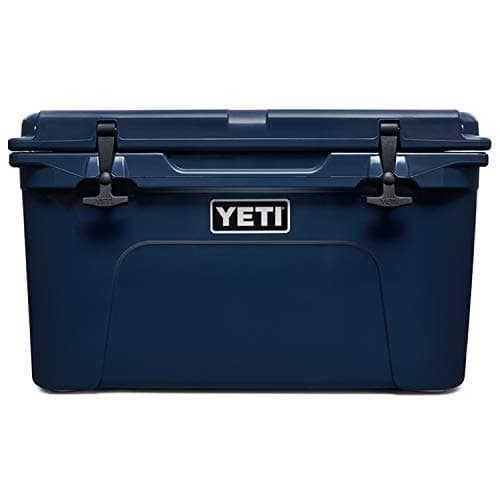
The build quality is genuinely excellent and the price premium over RTIC is not matched by a proportional ice-retention gain. Buy it for the durability and the resale value, not for the ice.
#ad · Live prices from the Amazon Creators API, as of October 19, 2026. Where we have no verified live price we show none — a gap beats a number that has rotted.
In detail
The picks, in full
01
Best for a full animal or a long trip
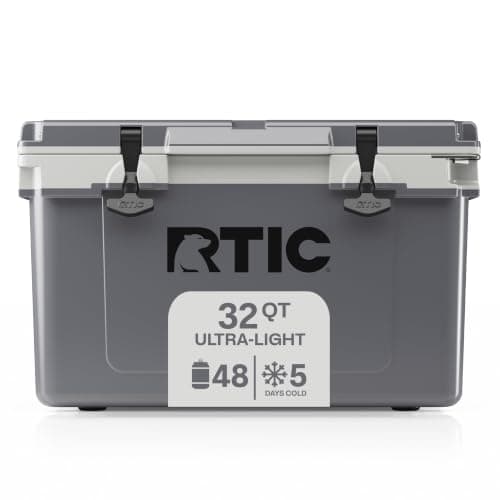
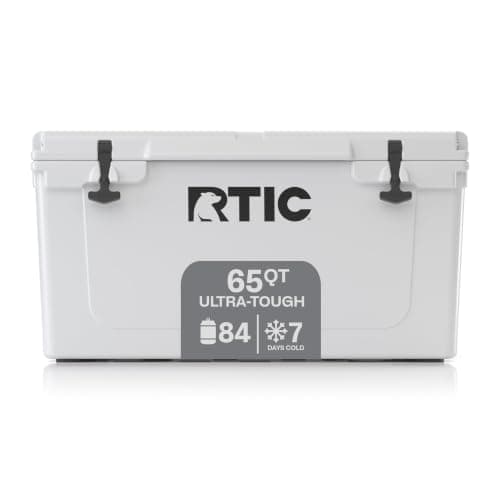
RTIC 65 QT Ultra-Tough
65 qtRotomoldedUltra-Tough build3 in insulation
7.8/10
Sixty-five quarts of rotomolded capacity — the size that takes a boned-out deer or a week of food for four.
Ice retention
9
Build quality
9
Weight
3
Capacity/size
10
Value
8
What's good
+Genuinely large capacity, and rotomolded construction throughout
+Handles the abuse of a truck bed
+Substantially cheaper than the equivalent premium-brand size
What's not
−Extremely heavy when loaded — this is a two-person lift
−Takes a lot of ice to pre-chill
−Too large for a weekend for two
Skip it if…
…you camp for weekends with one other person. A 65-quart cooler two-thirds empty is a heavy box of warm air.
The build quality is genuinely excellent and the price premium over RTIC is not matched by a proportional ice-retention gain. Buy it for the durability and the resale value, not for the ice.
Ice retention
9
Build quality
10
Weight
4
Capacity/size
8
Value
5
What's good
+Build quality and hardware are a visible step above everything cheaper
+Certified bear resistant with the right lock configuration
+Holds resale value better than any other cooler
+Five-year warranty
What's not
−Roughly double the price of an equivalent RTIC
−Very heavy empty
−Ice retention advantage over good mid-tier coolers is smaller than the price gap suggests
Skip it if…
…ice retention is your only criterion. That is the one place where the premium is hardest to justify.
Boned-out venison yield runs roughly 30 to 40 percent of live weight. Working from the middle of that range:
Animal
Typical live weight
Approx. boned-out meat
Whitetail doe
110–140 lb
~40–50 lb
Whitetail buck
150–200 lb
~55–70 lb
Mule deer
180–250 lb
~65–90 lb
Hog
100–200 lb
~40–75 lb
Cow elk
450–550 lb
~160–195 lb
Bull elk
600–750 lb
~215–265 lb
These are approximations from typical field-dressed yields and vary substantially by animal, region and how aggressively you trim. Use them to size a cooler, not to plan a freezer.
Step 2: the ice ratio
You need roughly as much ice by volume as meat — call it 1:1 for a couple of days, and closer to 2:1 of ice to meat if the meat is going to sit for several days in warm weather. Less than 1:1 and the cooler warms unevenly, which is where meat spoils.
Block ice lasts substantially longer than cubed because it has less surface area per volume. A practical approach is block ice on the bottom for longevity, meat in the middle, cubed ice packed into the gaps.
Step 3: quarts
As a working rule, one pound of boned-out meat plus its ice occupies roughly one quart of cooler space. So:
Cow elk: ~175 lb → 150–200 qt total, i.e. two 100s or three 65s
Bull elk: ~240 lb → 200–250 qt total
Two medium coolers beat one enormous one for a practical reason: a 150-quart cooler loaded with meat and ice weighs well over 250 pounds and cannot be lifted into a truck by two people. Multiple 65s can be.
Making the ice last
Pre-chill the cooler the night before with a sacrificial bag of ice. A warm cooler spends its first several hours cooling its own walls.
Keep it full. Air is the enemy. Fill dead space with more ice or with towels.
Drain the water — but not immediately. Ice water is colder than air and keeps meat cold. Drain once the meat is chilled through and you are worried about it sitting in liquid, and use a drain plug rather than opening the lid.
Shade and airflow. A cooler in direct sun in a truck bed is fighting a losing battle regardless of brand.
Cool the meat before it goes in. Warm meat put straight into a cooler melts a great deal of ice and cools slowly. Hang and cool quarters first if you can.
How these were picked
I haven't handled these. Here's what I did instead.
Everyone in this category says they tested twenty of these. I haven't tested any, and I say so. What I do instead: read the manufacturer's manual and published specification, compile the numbers that decide the purchase, do the arithmetic in the open, check the live price, and name one product to skip. The scores above are judgments from that research against a published rubric — they are not measurements I took, because I do not have a lab and I am not going to pretend otherwise.
Questions
Frequently asked
How many quarts do I need for a whole deer?+
Boned out, a whitetail buck yields roughly 55 to 70 pounds of meat, which with an equal volume of ice fits a 65 to 75-quart cooler. Bone-in quarters need substantially more space, closer to 100 quarts.
Can I fit an elk in one cooler?+
Not sensibly. A boned-out elk is 160 to 265 pounds of meat, which needs 150 to 250 quarts with ice. Two or three coolers are also the only way to physically lift the load.
How much ice do I need for meat?+
Roughly a 1:1 ratio of ice to meat by volume for a couple of days, closer to 2:1 for several days in warm weather. Block ice on the bottom, cubed packed into the gaps.
Should I drain the water from a cooler with meat in it?+
Not immediately — ice water is colder than air and keeps meat chilled. Drain once the meat is cooled through and you do not want it sitting in liquid, and use the drain plug rather than opening the lid.
Do I need a rotomolded cooler for game?+
For a day trip home, no — a standard cooler with enough ice is fine. For multi-day backcountry hunts in warm weather, the two to three inches of insulation in a rotomolded cooler makes a genuine difference.
We do not run a testing lab and we do not pretend to. Where a measured number came from a manufacturer's published specification or someone else's lab, we name them and link them. Where we could not verify something, we say so on the page rather than quietly leaving it out. Read the full method.