Start from the lure. Its weight determines the rod's power, its hook type determines the action, and where you fish determines the length. Choosing a rod any other way — by price, by brand, by what looked good on the rack — is how people end up owning three rods that all do the same thing.
If you want to stop reading now: buy a seven-foot medium-power, fast-action spinning rod rated for roughly quarter to three-quarter ounce lures and 8 to 15lb line. That covers more freshwater fishing than any other single setup, and every rod you buy afterwards will be a deliberate departure from it.
The four-step method
Step 1 — Lure weight sets the power
Every rod has a lure rating printed on the blank, something like "1/4 – 3/4 oz". Your most-used lure should sit in the middle of that range, not at the edge. A rod loaded at the bottom of its range does not flex enough to cast well; loaded at the top it flexes too much and you lose control.
Small lures under a quarter ounce want light or ultralight power. Quarter to three-quarter ounce wants medium. Half to one-and-a-half ounce wants medium-heavy. Heavy lures and heavy cover want heavy.
Step 2 — Hook type sets the action
Single hooks — jigs, worm hooks, drop shot — want a fast or extra-fast action. You need to drive a single hook point into a jaw, and the direct hookset of a fast tip does it.
Treble hooks — crankbaits, jerkbaits, topwater — want a moderate action. Three small hooks are already in the fish; the job now is not pulling them out. A moderate blank bends and absorbs the head shake that would otherwise tear them free.
This one rule prevents most of the "fish keep coming off" complaints in crankbait fishing.
Step 3 — Water sets the length
Six to six-and-a-half feet for tight creeks, kayaks and situations needing accuracy under cover. Six-and-a-half to seven for general purpose. Seven to seven-and-a-half for distance casting and better hooksets on long casts. Over eight feet for surf and specialized techniques.
Step 4 — Then, and only then, look at price
A $35 rod with the right power and action will out-fish a $200 rod with the wrong ones, every single time. Get the specifications right first; spend more once you know they are right and you want better components and sensitivity.
Spinning rod or casting rod
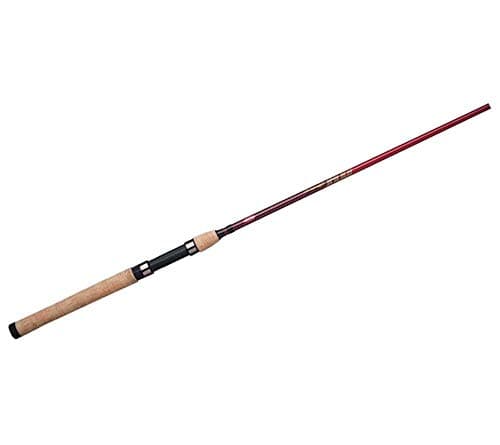
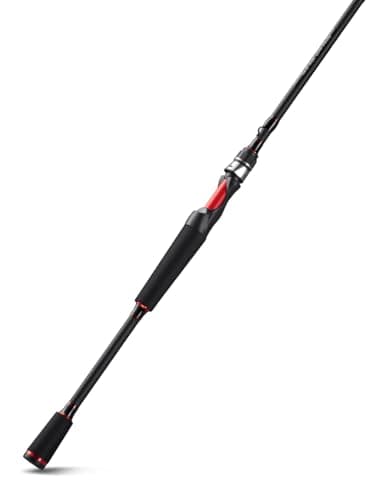
They are physically different blanks and not interchangeable. Spinning rods have larger guides positioned on the underside, because line comes off a fixed spool in loops. Casting rods have small guides on top and usually a trigger grip. Putting a spinning reel on a casting rod works badly and is a common first mistake.
What actually improves with price
- Guides — better inserts reduce line friction and last longer
- Blank material — higher-modulus graphite is lighter and more sensitive
- Reel seat — better lockup and less flex under load
- Handle — cork or better EVA, and comfort matters over a long day
None of those change whether the rod is right for your technique. That is entirely decided by the two words printed above the handle.
How these were picked
I haven't handled these. Here's what I did instead.
Everyone in this category says they tested twenty of these. I haven't tested any, and I say so. What I do instead: read the manufacturer's manual and published specification, compile the numbers that decide the purchase, do the arithmetic in the open, check the live price, and name one product to skip. The scores above are judgments from that research against a published rubric — they are not measurements I took, because I do not have a lab and I am not going to pretend otherwise.