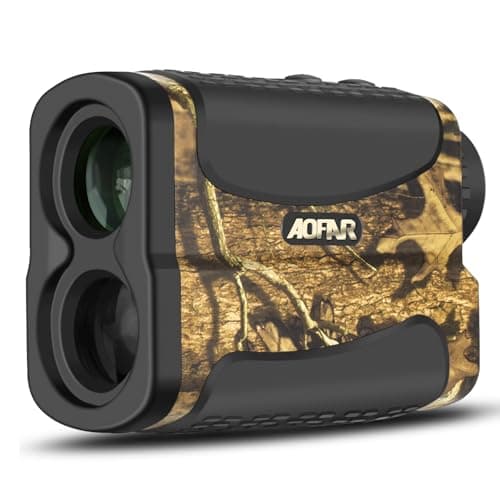
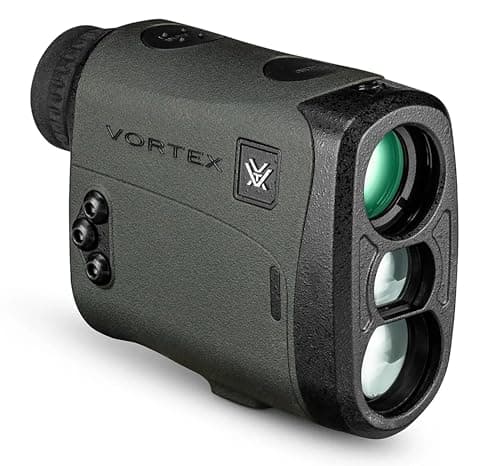
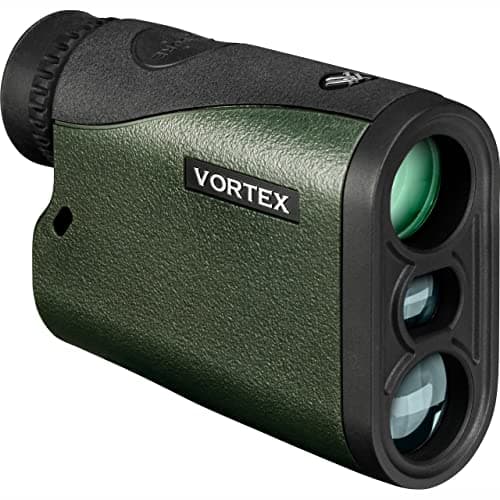
The verdict first: buy the Vortex Crossfire HD 1400. Not for the fourteen hundred yards — you will never use a tenth of that with a bow — but for angle compensation, which is the one feature archery genuinely needs and the one the cheap units leave out. It is for the hunter who shoots from elevated stands or on hills, which is most bowhunters. If your shooting is all flat and from the ground, the AOFAR HX-700N at under sixty dollars is honestly enough, and I will say so rather than talk you into four times the money.
This site already has a general hunting rangefinder roundup, and it ranks on usable range because that is what rifle hunters are buying. Archery turns that ranking upside down, so this is a separate page with a different winner rather than a reshuffle of the same one.
Why the angle is the whole story
An arrow drops a great deal more than a bullet, so your sight pins are calibrated to specific horizontal distances. From twenty feet up a tree, the straight line from your eye to a deer standing twenty-five yards out along the ground is longer than twenty-five yards — and if you hold the pin for that longer number, you shoot over the animal.
The difference is small at distance and large up close, which is exactly backwards from what people expect. At forty yards from a modest stand height it may be a yard; at fifteen yards from a high stand on a slope it can be several, and at archery distances several yards of error is the whole vital area. That is the entire case for the feature, and it is why it leads this page.
An angle-compensating rangefinder calculates the horizontal component and gives you the number your pins are actually set for. Manufacturers name the mode differently — angle compensation, true horizontal distance, angle range compensation — and they all mean the same thing. What matters is that the unit has it and that you know which mode it is in.
What you can safely ignore
- Maximum range. The biggest number on the box is the one that matters least to you. Those figures assume a highly reflective target in good conditions; on an animal in timber, expect meaningfully less. For a bow, anything that reads reliably to a hundred yards is over-specified, which is good news — being far inside a unit's range is what makes it fast and confident at forty.
- Ballistic solvers and holdover readouts. Useful on a rifle, irrelevant with a bow. Your pins are the solver.
- Extreme magnification. Six power is plenty when the target is inside sixty yards, and a wider field of view is more useful than more magnification for finding an animal quickly in the dark edge of a field.
What actually matters, in order
- Angle compensation. Covered above. The only non-negotiable.
- Speed to a reading on a non-reflective target. This is where cheap units genuinely suffer. A deer's hide reflects poorly, and a rangefinder that takes two seconds and three attempts is a rangefinder you will stop using at the moment it matters.
- Low-light performance. Legal shooting light at both ends of the day is when animals move, and it is precisely when a dim display over dim glass becomes useless. This is the single clearest difference between the budget tier and the Vortex units here.
- Scan mode. Underrated for stand hunting. You range the trees, the field edge and the trail crossing before anything shows up, then you are not fumbling with a device at full draw.
- One-handed operation and where it lives. You will be holding a bow. A unit you can operate with one hand, on a short tether or in a chest pocket you can reach without standing up, beats a better unit in a pack.
Rechargeable or disposable battery
Worth a thought rather than an argument. A rechargeable unit means one less odd cell to keep in the truck and one more thing to remember to charge before opening day. A disposable cell means you can carry a spare in the bottom of the pack for three seasons and it will still work. For a device that sits unused for ten months of the year, there is a real case for the disposable, and both are represented on this page.
Do you actually need one?
For bow hunting from a known stand, you can range your landmarks once with a borrowed unit, write the numbers down, and hunt that stand for a season without owning one. That genuinely works and it is the cheapest answer. What a rangefinder buys you is the ability to hunt somewhere new, and confidence on the one shot that is not from the spot you prepared. We argue that out honestly on its own page and we do not conclude that everybody needs one.
If you hunt with both a bow and a rifle, the decision changes — you want the longer-range unit, because the rifle is the side that benefits from it, and angle compensation is useful on both.
Buying notes
Check which mode it is in before the season, not during
Nearly every unit with angle compensation also has a straight-line mode, and some default to it. Knowing which number is on the screen is the entire value of the feature. Find the mode button at home.
Range your stand on the first quiet morning
The trail crossing, the field edge, the three trees you expect a deer to appear behind. Write them on tape inside the stand or in the notebook that lives in your pack. A ranged landmark beats a rangefinder you have to raise while something is looking at you.
Practice at the angle you will shoot from
A rangefinder that tells you the truth does not help if your pins were only ever verified on flat ground. Shoot from an elevated platform at least once before the season.
Treat the maximum range figure as marketing
Published maximums assume a reflective target. The useful question for a bowhunter is how fast it reads a brown animal at forty yards in poor light, and the answer to that is decided by glass and processing rather than by the number on the box.