We earn a commission when you buy through our Amazon links, at no extra cost to you. It never changes the order of the picks, and we say so when the cheaper thing is the better buy. How this works.
The short answer: if you bowhunt, yes. If you rifle hunt in timber where nothing is past 150 yards, honestly no — your rifle's point-blank range covers the error. Everything between those two cases depends on how steep your country is.
Here is the arithmetic that decides it. A typical compound bow arrow drops roughly 8 to 12 inches between 30 and 40 yards. A deer's vital zone is about 8 inches across. So a ten-yard estimation error at that distance is the difference between a clean kill and a wound, and human distance estimation in the field is routinely off by more than ten yards — worse across water, across a canyon, or in low light.
A centerfire rifle zeroed at 200 yards is typically within about three inches of point of aim all the way from the muzzle to roughly 250 yards. Inside that band, a twenty-yard estimation error changes almost nothing. That is why the honest answer differs so sharply between the two.
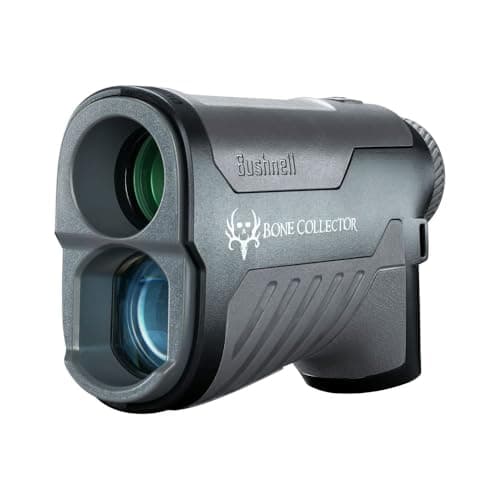
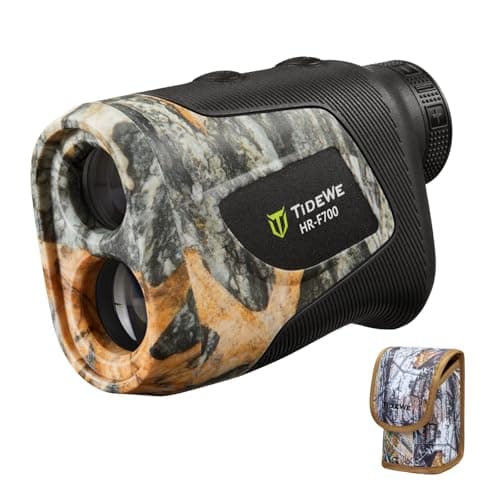
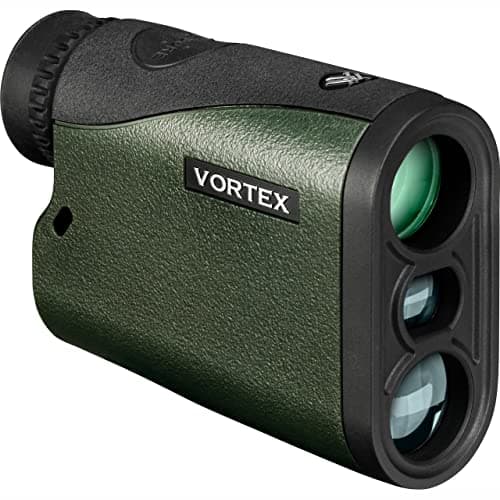
If the answer for you is yes and you shoot a bow, the buying decision is a different one from the rifle hunter's: rangefinders for bow hunting ranks on angle compensation and ranging speed rather than on maximum distance, because from twenty feet up a tree the straight-line number is not the one your pins are set for.
#ad · Live prices from the Amazon Creators API, as of October 19, 2026. Where we have no verified live price we show none — a gap beats a number that has rotted.
This is where a rangefinder earns its money and where estimation fails hardest, because the error is systematic rather than random.
Gravity acts on your arrow or bullet over the horizontal distance, not the line-of-sight distance. From a 20-foot treestand shooting at a deer 30 yards away on the ground, the line of sight is 30 yards but the horizontal distance is closer to 29. That is a small error. From a mountainside at a 45-degree angle, the line-of-sight distance is roughly 1.41 times the horizontal distance — range 60 yards along the sight line and the arrow only has to fly 42 yards of horizontal drop.
Aim for 60 when the ballistic answer is 42 and you shoot high, over the back. This is why angle compensation is the feature to buy on rather than maximum range, and why steep-country hunters need it far more than flatland hunters.
When you genuinely need one
Bowhunting, any terrain. Arrow trajectory is steep enough that estimation error becomes wounding error.
Any steep country. The angle problem above is systematic, not random.
Open-country rifle hunting past 300 yards. Beyond point-blank range, drop compensation needs a real number.
Across water or canyons. Human distance estimation is especially poor over featureless terrain, and these are the two classic cases.
When it is genuinely optional
Timber rifle hunting inside 150 yards. Your point-blank range covers it.
Fixed stands you have pre-ranged. Range your landmarks once with a borrowed unit, mark them, and you have the information permanently.
Shotgun deer hunting. Slug distances are short and the vital margin is comfortable.
The cheapest way to get the benefit
Pre-range your stand. On the first quiet afternoon, range every likely landmark from where you sit — that stump, the fence corner, the edge of the food plot — and write the distances on a card or in your phone. Now you have the numbers for free, permanently, with no device to fumble for at the moment of truth. That works for fixed stands and does nothing for spot-and-stalk, which is precisely the split above.
How these were picked
I haven't handled these. Here's what I did instead.
Everyone in this category says they tested twenty of these. I haven't tested any, and I say so. What I do instead: read the manufacturer's manual and published specification, compile the numbers that decide the purchase, do the arithmetic in the open, check the live price, and name one product to skip. The scores above are judgments from that research against a published rubric — they are not measurements I took, because I do not have a lab and I am not going to pretend otherwise.
Questions
Frequently asked
How accurate is human distance estimation?+
Poor, and it gets worse with distance, over water, over uniform terrain and in low light. Errors of ten yards or more at forty yards are routine — which is why the answer is different for archers, whose arrows cannot tolerate that error, than for rifle hunters, whose bullets can.
Does a rangefinder work through brush?+
Not reliably. The laser returns off the nearest thing it hits, so intervening branches give you the distance to the branch. Better units offer a distant-target mode that reports the furthest return instead, which is the setting to use in timber.
Rangefinder or rangefinding binoculars?+
Rangefinding binoculars combine two tools and are far more expensive. If you already glass with binoculars constantly, they remove a step at the moment it matters. If you glass occasionally, two separate tools cost much less.
Can I use a golf rangefinder for hunting?+
Functionally, mostly yes — the laser is the same. Golf units are optimized for reflective flags and typically lack a distant-target mode for brush, and some are not weather-sealed for field use. Angle compensation may also be locked out for tournament legality.
We do not run a testing lab and we do not pretend to. Where a measured number came from a manufacturer's published specification or someone else's lab, we name them and link them. Where we could not verify something, we say so on the page rather than quietly leaving it out. Read the full method.