We earn a commission when you buy through our Amazon links, at no extra cost to you. It never changes the order of the picks, and we say so when the cheaper thing is the better buy. How this works.
The short version: MOA and MRAD are two units for measuring the same thing — angle. Neither is more accurate than the other. The only genuine mistake is buying a scope whose reticle is in one unit and whose turrets are in the other, because then every correction requires a conversion under time pressure.
MOA
A minute of angle is one sixtieth of a degree. It subtends 1.047 inches at 100 yards, which everyone rounds to one inch — so 1 MOA is about 1 inch at 100 yards, 2 inches at 200, 5 inches at 500. Most MOA scopes adjust in quarter-MOA clicks, so one click moves the point of impact about a quarter inch at 100 yards.
MRAD
A milliradian is one thousandth of a radian. It subtends 3.6 inches at 100 yards, or precisely 10 centimeters at 100 meters — which is why it is elegant in metric. Most MRAD scopes adjust in 0.1 mrad clicks, so one click moves about 0.36 inches at 100 yards.
MOA is finer per click, MRAD is faster to communicate and to do arithmetic with. Both are more precise than any of us shoot.
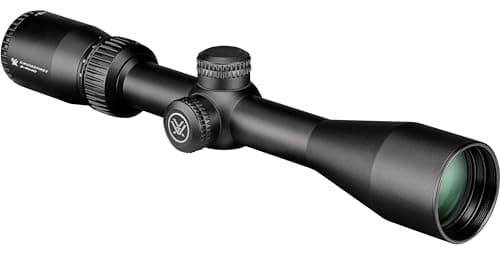
3-9x40 is the magnification range that covers essentially all North American big-game hunting, and the VIP warranty means a broken scope is replaced without argument.
#ad · Live prices from the Amazon Creators API, as of October 19, 2026. Where we have no verified live price we show none — a gap beats a number that has rotted.
3-9x40 is the magnification range that covers essentially all North American big-game hunting, and the VIP warranty means a broken scope is replaced without argument.
Glass clarity
8
Low light
8
Turret tracking
8
Durability
9
Value
9
What's good
+Fully multi-coated glass — every air-to-glass surface, which is what determines low-light usability
+3-9x is the most useful hunting range: 3x for timber, 9x for open country
+Vortex VIP warranty is unconditional and transferable
+Nitrogen purged and O-ring sealed, so no internal fogging
What's not
−Second focal plane, so the BDC holdovers are only correct at maximum magnification
−Not a long-range scope — 9x runs out past about 400 yards
Skip it if…
…you shoot past 400 yards. The magnification and the turret travel both run out, and that is a different scope.
Your group is 3 inches low and 2 inches right at 100 yards.
In MOA, 3 inches at 100 yards is about 3 MOA. At quarter-MOA clicks that is 12 clicks up. 2 inches right is 2 MOA, so 8 clicks left.
In MRAD, 3 inches at 100 yards is 3 ÷ 3.6 = 0.83 mrad. At 0.1 mrad clicks that is 8 clicks up. 2 inches is 0.56 mrad, so about 6 clicks left.
Same correction, different arithmetic. Neither is harder once you have done it twice.
The distance multiplier
Both scale linearly with distance, which is the entire point of an angular unit. 1 MOA is 1 inch at 100 yards and 4 inches at 400. 1 mrad is 3.6 inches at 100 yards and 14.4 at 400. A correction dialed at one distance is correct in angle at every distance.
Matching reticle to turrets
This is the only part that genuinely matters. If your reticle has MRAD hash marks and your turrets click in MOA, then every time you spot a miss with the reticle you must convert before you dial. That conversion happens in the field, under time pressure, and it is exactly when arithmetic goes wrong. Buy matched.
Which to choose
MOA if you think in inches and yards, shoot with people who do, or hunt in the US where that is the common language.
MRAD if you shoot in a metric context, participate in precision-rifle competition where MRAD dominates, or prefer the cleaner arithmetic.
Whichever your shooting partners use. Being able to say "come up 0.4" and have someone dial it correctly is worth more than either unit's theoretical advantage.
Red dots use MOA too
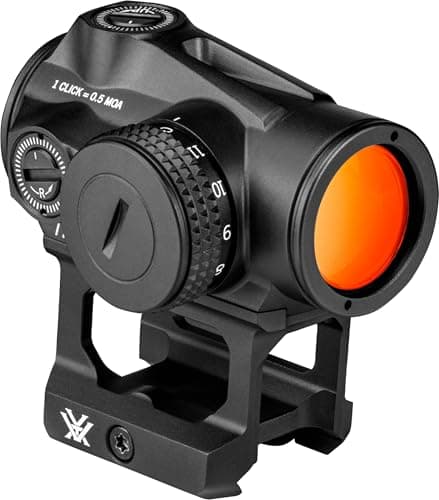
A 2 MOA dot covers about 2 inches at 100 yards; a 6 MOA dot covers about 6. That is the same arithmetic, applied to the dot's apparent size rather than to a correction — and it is the whole basis of the dot-size decision.
How these were picked
1 of these is mine. The rest are research, and I say which is which.
Anything carrying the "I run this one" stamp above is gear I actually own and use, and I write about it in those terms. What I do not do is invent numbers to dress that up — there are no group sizes, round counts or chronograph figures on this site, because I did not record them. For everything without the stamp: I read the manufacturer's published specification, compile the numbers that decide the purchase, do the arithmetic in the open, check the live price, and name one product to skip. Those scores are judgments against a published rubric, not measurements I took.
Questions
Frequently asked
Is MOA or MRAD more accurate?+
Neither. They are different units for measuring angle, like inches and centimeters. MOA has finer standard click values, MRAD has cleaner arithmetic. Both are far more precise than any shooter.
How many inches is 1 MOA at 100 yards?+
1.047 inches, universally rounded to 1 inch. So 1 MOA is about 1 inch at 100 yards, 2 at 200, 3 at 300 — it scales linearly with distance because it is an angle.
How many inches is 1 MRAD at 100 yards?+
3.6 inches, or exactly 10 centimeters at 100 meters — which is why MRAD is tidy in metric. At 0.1 mrad per click, one click moves about 0.36 inches at 100 yards.
Can I mix an MOA reticle with MRAD turrets?+
You can, and you should not. Every correction then requires a unit conversion in the field under time pressure, which is precisely when arithmetic errors happen. Buy matched reticle and turrets.
What does 2 MOA mean on a red dot?+
The dot appears to cover about 2 inches at 100 yards, 4 inches at 200 and so on. It describes the dot's apparent size — smaller dots are more precise and slightly harder to pick up quickly.
We do not run a testing lab and we do not pretend to. Where a measured number came from a manufacturer's published specification or someone else's lab, we name them and link them. Where we could not verify something, we say so on the page rather than quietly leaving it out. Read the full method.