We earn a commission when you buy through our Amazon links, at no extra cost to you. It never changes the order of the picks, and we say so when the cheaper thing is the better buy. How this works.
A fixed blade solves the one problem a folder cannot: there is no joint. No pivot to loosen, no lock to disengage under a hard cut, no gap for blood and grit to pack into. That is the entire argument, and it is a good one for anything involving batoning, game, or repeated heavy cuts.
The trade is carry. A fixed blade needs a sheath, the sheath needs a belt, and in most social contexts that is the end of the conversation. This is not an everyday carry category — it is a pack-and-belt category.
Three specifications decide these: whether the tang runs the full length of the handle, what the steel is, and whether the sheath retains the knife when you are moving. The third one gets ignored in almost every roundup and it is the one that will actually lose you a knife.
#ad · Live prices from the Amazon Creators API, as of October 19, 2026. Where we have no verified live price we show none — a gap beats a number that has rotted.
In detail
The picks, in full
01
Best overall
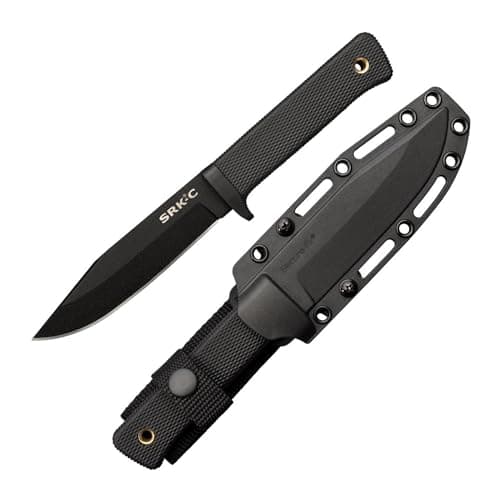
Cold Steel SRK Compact
5 in bladeSK-5 carbon steelKray-Ex handleSecure-Ex sheath
7.4/10
A five-inch SK-5 clip point with a grippy Kray-Ex handle, and the closest thing to a do-everything field knife on this list.
Edge retention
7
Toughness
9
Sheath quality
8
Corrosion resistance
4
Value
9
What's good
+SK-5 carbon steel takes a very keen edge and is easy to bring back on a simple stone
+Kray-Ex handle stays grippy wet, cold and gloved
+The included Secure-Ex sheath retains the knife properly rather than rattling
What's not
−Carbon steel rusts — this one needs wiping and oiling
−Blade coating scratches off with use
−Not a fine-detail knife; the blade stock is thick
Skip it if…
…you will store it wet or forget it in a pack. Carbon steel punishes neglect in a way stainless does not.
Full tang means the steel runs the entire length of the handle as one piece, with scales attached to either side. A partial or rat-tail tang is a thinner piece of steel embedded in the handle, and it is the failure point when you baton or pry. For camp and bushcraft work, buy full tang and treat anything else as a light-duty knife.
Carbon steel or stainless is a maintenance decision
Carbon steels like 1095 and SK-5 take a keener edge, come back faster on a stone, and throw sparks off a ferro rod — which is why the bushcraft world prefers them. They also rust if you look at them wrong. Stainless gives that up for the ability to put the knife away damp and find it intact.
There is no correct answer. There is only whether you are the kind of person who wipes and oils a blade after a wet day. Be honest about that before you spend.
Judge the sheath as hard as the knife
Kydex and molded polymer sheaths retain by friction and click audibly when seated — the most secure option and the loudest. Leather is quieter, repairable and holds moisture against the blade, which is a real problem with carbon steel. Nylon is cheapest and the most likely to let a knife work loose while you walk.
Whatever the material: invert the sheathed knife and shake it once. If it moves, you will lose it on a hillside eventually.
How these were picked
I haven't handled these. Here's what I did instead.
Everyone in this category says they tested twenty of these. I haven't tested any, and I say so. What I do instead: read the manufacturer's manual and published specification, compile the numbers that decide the purchase, do the arithmetic in the open, check the live price, and name one product to skip. The scores above are judgments from that research against a published rubric — they are not measurements I took, because I do not have a lab and I am not going to pretend otherwise.
Questions
Frequently asked
What blade length is best for a bushcraft knife?+
Four to five inches. Shorter than four and batoning becomes awkward because the blade barely clears the wood; longer than five and fine carving work gets clumsy. Almost every purpose-built bushcraft knife lands in that band for exactly this reason.
Is a full tang knife always better?+
For heavy use, yes. For a light camp or kitchen knife, a well-made hidden tang is perfectly sound and lighter. The distinction only becomes critical when lateral force is applied — batoning, prying, or a knife used as a lever.
Can I use a fixed blade for field dressing?+
Yes, and a drop point profile is the right shape for it. What you want to avoid is a thick, heavily coated survival blade with a deep clip point — it is hard to control near the hide and awkward to clean.
How do I stop a carbon steel blade rusting?+
Wipe it dry after every use, put a light film of mineral oil on it, and never store it in a leather sheath long term. A patina — the dull gray oxide that forms with use — is not rust and actually slows further corrosion.
We do not run a testing lab and we do not pretend to. Where a measured number came from a manufacturer's published specification or someone else's lab, we name them and link them. Where we could not verify something, we say so on the page rather than quietly leaving it out. Read the full method.