A compressor fridge holds temperature regardless of the weather. It also runs a battery down overnight, and that arithmetic is the actual purchase decision.
We earn a commission when you buy through our Amazon links, at no extra cost to you. It never changes the order of the picks, and we say so when the cheaper thing is the better buy. How this works.
A 12V compressor fridge is the single biggest quality-of-life upgrade in vehicle-based camping. No ice, no meltwater, no soggy food, and a temperature that holds regardless of whether it is 95°F outside. Everything in the fridge is dry and everything is the temperature you set.
The cost is electrical, and it is the part people work out afterwards. Here is the arithmetic.
A compressor fridge only runs perhaps a third of the time once it is cold. Typical real-world consumption in mild weather is around 0.5 to 1 amp-hour per hour, so call it 12 to 24 amp-hours over 24 hours, and considerably more in heat or with the lid opened often.
Now the battery. A lead-acid battery should not be discharged below 50 percent, so a 100Ah lead-acid battery gives you about 50 usable amp-hours — roughly two to four days. Lithium can be discharged much deeper, so 100Ah of lithium gives you most of that capacity. A starter battery, however, is not a deep-cycle battery: running one down to power a fridge overnight is how you end up unable to start the vehicle, and it damages the battery each time.
So the honest sequence is: work out your daily draw, compare it against your usable capacity, and buy the second battery or the solar panel before the fridge if the numbers do not work.
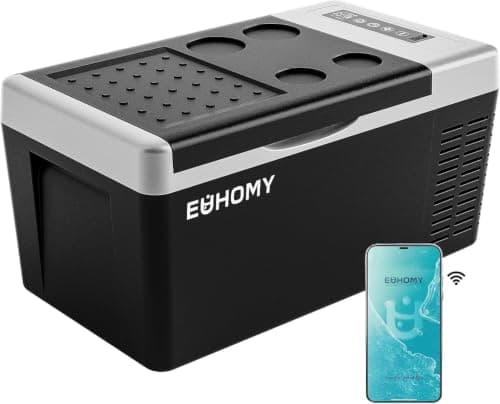
At nineteen quarts the value proposition of a 12V fridge inverts. You are paying $135 and a power budget to replace a $30 cooler and a bag of ice — and after the compressor housing, the usable interior is smaller than the number suggests.
#ad · Live prices from the Amazon Creators API, as of October 19, 2026. Where we have no verified live price we show none — a gap beats a number that has rotted.
In detail
The picks, in full
01
Best overall
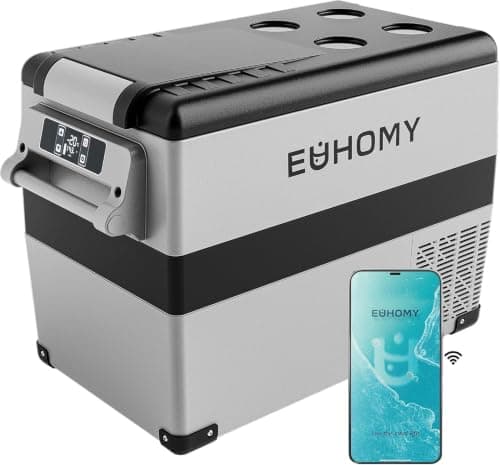
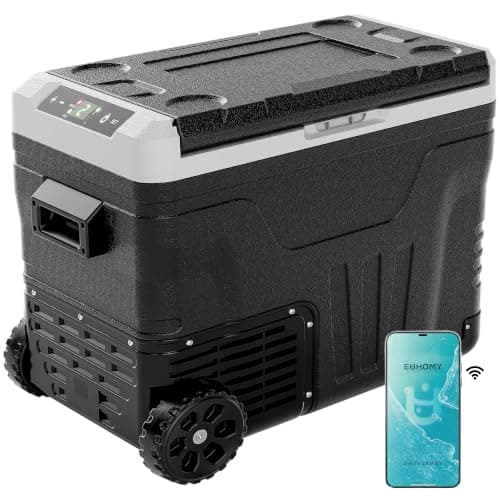
EUHOMY 53QT 12V Refrigerator
53 qt-4°F to 68°F12V/24V/ACCompressor cooling
8.0/10
Fifty-three quarts of genuine refrigeration down to -4°F, which is the size that replaces a cooler entirely rather than supplementing it.
Cooling
9
Power draw
7
Capacity
9
Build quality
7
Value
8
What's good
+A compressor fridge holds a set temperature regardless of ambient heat — a cooler cannot
+Freezer capable, so you can carry meat for a week
+Fifty-three quarts genuinely replaces a large cooler plus its ice
+No ice means no meltwater and no soggy food
What's not
−Needs power, and a night parked with the engine off will flatten a starter battery
−Substantially more expensive than a cooler
−Heavy and bulky
Skip it if…
…you have no second battery or solar. A compressor fridge on a starter battery is a vehicle that will not start.
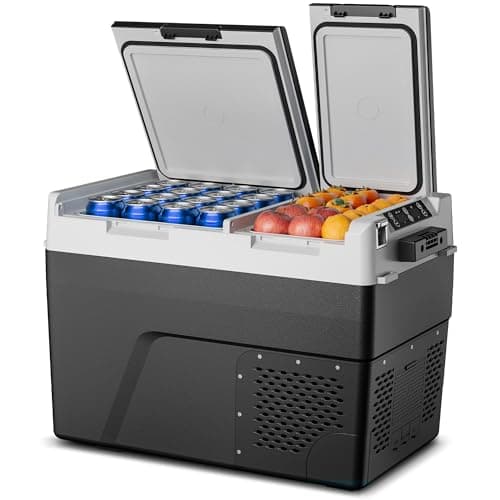
Twenty-seven quarts with freezer capability, for people who need frozen storage more than volume.
Cooling
8
Power draw
7
Capacity
6
Build quality
6
Value
7
What's good
+Freezer capability in a small footprint
+Manageable power draw
+Fits in smaller vehicles
What's not
−Freezing uses more power than refrigerating, so the draw is higher than the size suggests
−Limited capacity
Skip it if…
…you only need things cold. Refrigerating uses considerably less power than freezing, and a fridge-only unit of this size lasts far longer on a battery.
At nineteen quarts the value proposition of a 12V fridge inverts. You are paying $135 and a power budget to replace a $30 cooler and a bag of ice — and after the compressor housing, the usable interior is smaller than the number suggests.
Cooling
8
Power draw
9
Capacity
3
Build quality
7
Value
5
What's good
+Genuine refrigeration in a very small package
+Lowest power draw here
What's not
−The argument for a 12V fridge is that it replaces ice, freeing volume and eliminating meltwater — at 19 quarts there was not much volume to free
−Compressor and insulation eat a significant fraction of the external dimensions, so usable space is well under 19 quarts
−A 20-quart hard cooler plus ice costs about a fifth as much and needs no power plan
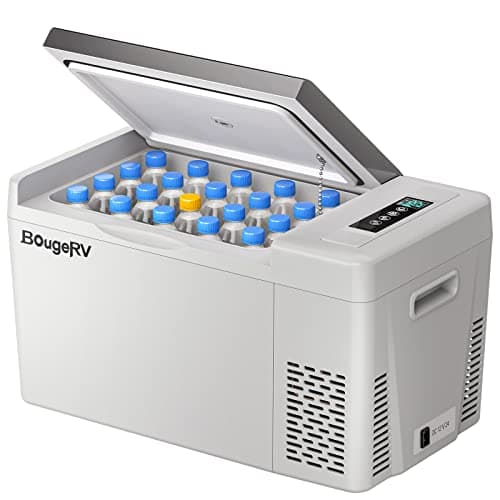
−The 23-quart BougeRV costs marginally more and is meaningfully more useful
Skip it if…
…capacity matters at all. Either go up to 23 quarts and get a genuinely useful fridge, or buy a cooler and accept the ice.
A second deep-cycle battery isolated from the starter battery is the standard solution. A DC- to-DC charger charges it while you drive and prevents the fridge draining the battery you need to start the engine. Without one, a fridge is an engine-running or short-stop proposition.
Use the low-voltage cutoff
Every decent 12V fridge has a battery protection setting with low, medium and high cutoff voltages. On a starter battery, set it to high — it will shut the fridge off early rather than leave you stranded. On a dedicated deep-cycle battery, low or medium lets you use more of the capacity.
Pre-chill at home on mains power
Nearly every 12V fridge also runs on AC. Cool it down overnight at home before the trip, and load it already cold. Pulling a warm fridge full of warm food down to temperature is the single biggest power draw it will ever have.
Insulation cover and shade
An insulated cover reduces run time meaningfully, and keeping the fridge out of direct sun does more than any setting. Ventilation around the compressor matters too — a fridge jammed against a wall works much harder.
Fridge or freezer
Freezing draws substantially more power than refrigerating. If you do not genuinely need frozen storage, running as a fridge extends your battery life considerably. Dual-zone units let you do both and draw accordingly.
How these were picked
I haven't handled these. Here's what I did instead.
Everyone in this category says they tested twenty of these. I haven't tested any, and I say so. What I do instead: read the manufacturer's manual and published specification, compile the numbers that decide the purchase, do the arithmetic in the open, check the live price, and name one product to skip. The scores above are judgments from that research against a published rubric — they are not measurements I took, because I do not have a lab and I am not going to pretend otherwise.
Questions
Frequently asked
How much power does a 12V fridge use?+
Roughly 0.5 to 1 amp-hour per hour in mild conditions once it is cold — about 12 to 24 amp-hours per day — rising sharply in heat or with frequent opening. Freezing draws considerably more than refrigerating.
Can I run a 12V fridge off my starter battery?+
Briefly, and it is a poor idea. Starter batteries are not designed for deep discharge, and running one down overnight damages it and can leave you unable to start the vehicle. Use the fridge's high-voltage cutoff setting if you must.
Is a 12V fridge worth it over a cooler?+
For trips over about three days, or in heat, yes — no ice to buy, no meltwater, more usable volume and a temperature that holds. For a weekend in mild weather, a good cooler with block ice is far cheaper and needs no electrical planning.
What size 12V fridge do I need?+
Around 20 to 25 quarts for two people on a weekend, 45 to 55 for a family or a week. Remember that the compressor and insulation take up part of the external volume, so usable space is less than the quoted figure.
We do not run a testing lab and we do not pretend to. Where a measured number came from a manufacturer's published specification or someone else's lab, we name them and link them. Where we could not verify something, we say so on the page rather than quietly leaving it out. Read the full method.