We earn a commission when you buy through our Amazon links, at no extra cost to you. It never changes the order of the picks, and we say so when the cheaper thing is the better buy. How this works.
Size it to 1.5 times your gross vehicle weight. A 6,000-pound truck wants roughly a 9,000-pound winch; a 5,000-pound Jeep wants around 7,500. The multiplier exists because a winch has to overcome rolling resistance, a slope and suction — not lift the vehicle — and 1.5x covers that with margin.
Going far past it does not make you safer. A winch mounts ahead of the front axle, which is the worst place on a vehicle to add mass for handling and braking, and the current draw at high ratings exceeds what stock charging systems and battery cables were designed for.
The second decision is rope. Synthetic stores far less energy under tension, so a failure drops rather than whips — it is lighter, safer and easier to handle, and it degrades in UV and abrades on rock. Steel resists abrasion and lasts indefinitely, and it is the classic recovery injury.
For most people, most of the time: synthetic. If you winch across sharp rock regularly, steel has a genuine argument and you should wear gloves and use a line damper.
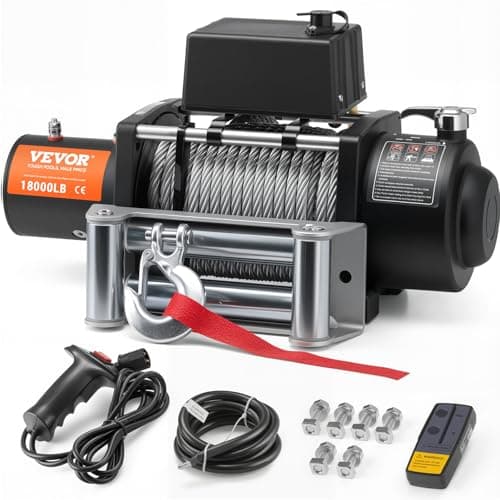
Buying more winch than your vehicle needs is not free. The guideline is 1.5 times gross vehicle weight — for a 6,000 lb truck that is a 9,000 lb winch, and 18,000 lb is double what the rule calls for, in weight hung off your front axle.
#ad · Live prices from the Amazon Creators API, as of October 19, 2026. Where we have no verified live price we show none — a gap beats a number that has rotted.
In detail
The picks, in full
01
Best overall
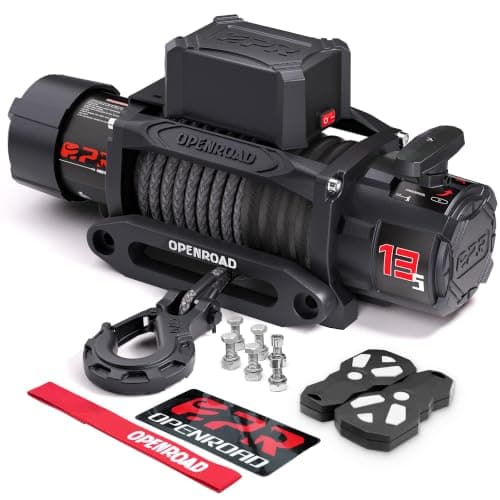
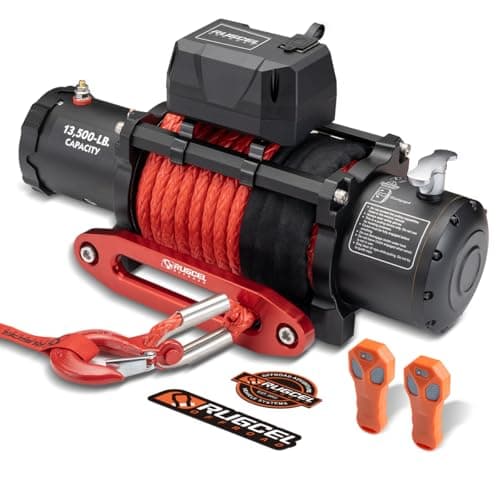
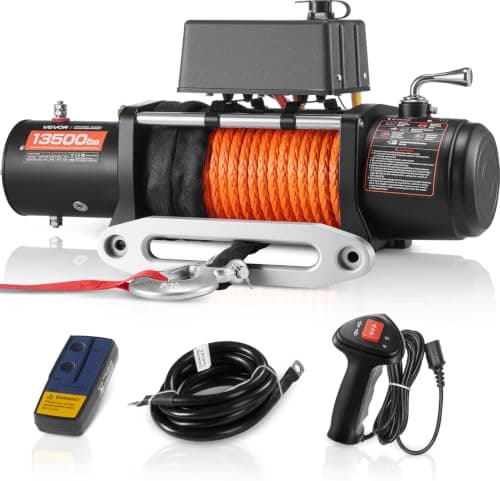
VEVOR 13,500 lb Synthetic Rope Winch
13,500 lb line pullSynthetic ropeAluminum hawse fairleadWireless remote
8.4/10
Synthetic rope and an aluminum fairlead, which is the safer configuration and the one worth paying for.
Line pull
9
Rope safety
9
Build quality
7
Controls
8
Value
9
What's good
+Synthetic rope stores far less energy than steel cable, so a failure drops rather than whips
+Synthetic is lighter and easier to handle, which means you actually spool it properly
+Aluminum hawse fairlead is the correct pairing for synthetic
+13,500 lb suits a full-size truck under the 1.5x GVWR guideline
What's not
−Synthetic rope degrades in UV and needs replacing every few years
−Rope abrades on rock edges where steel would not
−VEVOR's long-term durability record is shorter than the premium brands
Skip it if…
…you winch across rock regularly. Synthetic abrades where steel survives, and that is the one place steel still wins.
Buying more winch than your vehicle needs is not free. The guideline is 1.5 times gross vehicle weight — for a 6,000 lb truck that is a 9,000 lb winch, and 18,000 lb is double what the rule calls for, in weight hung off your front axle.
Line pull
10
Rope safety
4
Build quality
7
Controls
7
Value
5
What's good
+Enormous line pull
+Long cable
What's not
−The 1.5x GVWR guideline exists because a winch has to move a stuck vehicle, not lift it — a 6,000 lb truck needs about 9,000 lb of pull, and anything past that adds weight without capability
−Winch weight sits ahead of the front axle, which is the worst place on a vehicle to add mass for handling and braking
−Current draw at that rating is enormous — most stock charging systems and battery cables are not sized for it
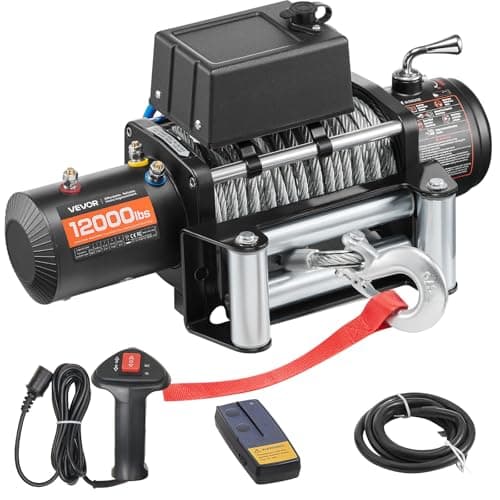
−Steel cable at this rating stores an extremely large amount of energy under tension
Skip it if…
…your vehicle weighs under about 12,000 lb. Size the winch to 1.5x your GVWR and put the difference into a good strap kit and a soft shackle.
A heavy blanket or a purpose-made damper draped over the middle of the line absorbs the energy if the line fails, dropping it rather than letting it whip. This is the single most important habit in winching and the one most often skipped.
Nobody in the danger zone
Nobody stands in line with the cable, in front of the winching vehicle, or between the two vehicles. The danger zone extends roughly one and a half times the line length to either side.
Anchor to rated points only
Rated recovery points, a proper tree saver strap around a tree, or a ground anchor. Never a tow ball, never a trailer hitch pin hole, and never a suspension component. Those are rated for steady towing loads, not shock loads, and they fail as projectiles.
Use a snatch block for heavy pulls
Running the line through a snatch block and back to your vehicle roughly doubles pulling power and halves line speed. It also lets you change the angle of pull, which is often the actual problem.
Spool it properly
Loose wraps on the drum let the line bury itself under load, which damages rope and can jam the winch. Re-spool under light tension periodically, and always after a hard recovery.
Watch the battery
Winching draws hundreds of amps. Run the engine during a pull, and if you winch often, upgrade the battery cables — undersized cables are the most common reason a winch feels weak.
How these were picked
I haven't handled these. Here's what I did instead.
Everyone in this category says they tested twenty of these. I haven't tested any, and I say so. What I do instead: read the manufacturer's manual and published specification, compile the numbers that decide the purchase, do the arithmetic in the open, check the live price, and name one product to skip. The scores above are judgments from that research against a published rubric — they are not measurements I took, because I do not have a lab and I am not going to pretend otherwise.
Questions
Frequently asked
What size winch do I need?+
About 1.5 times your gross vehicle weight. A 6,000 lb truck wants roughly a 9,000 lb winch. Going far beyond that adds weight ahead of the front axle and current draw your electrical system may not support, without adding useful capability.
Synthetic rope or steel cable?+
Synthetic for most people — it stores far less energy so a failure drops rather than whips, and it is much lighter to handle. Steel resists rock abrasion better and does not degrade in UV, which is a genuine advantage in rocky terrain.
Do I need a line damper?+
Yes, every pull. A heavy blanket over the middle of the line absorbs the energy if the line fails and drops it to the ground instead of letting it whip. It is the most important and most frequently skipped winching habit.
Can I winch off a tow ball?+
No. Tow balls are rated for steady towing loads and fail under shock loading — a failed tow ball becomes a high-velocity projectile. Use rated recovery points, a tree saver strap, or a ground anchor.
We do not run a testing lab and we do not pretend to. Where a measured number came from a manufacturer's published specification or someone else's lab, we name them and link them. Where we could not verify something, we say so on the page rather than quietly leaving it out. Read the full method.