The honest part first: GMRS requires an FCC license. It is thirty-five dollars, there is no exam, it lasts ten years, and one license covers your immediate family. There is no good reason not to do it, and plenty of people running GMRS radios have not.
That is the same thing I say on the 4Runner build page, where my own radio installation is photographed and described. This page is the part that page does not cover: what the license actually is, and what to buy once you have one.
What GMRS is
The General Mobile Radio Service is a licensed radio service in the United States, sitting around 462 and 467 MHz. It shares some channels with FRS — the license-free bubble-pack radios — but it permits far more power, external antennas and repeaters, none of which FRS allows.
That is the whole reason GMRS exists and the whole reason FRS radios disappoint people. FRS is power-limited and antenna-limited by rule, which is exactly why the blister pack promising thirty-five miles does not deliver two.
Why there is no test
Because GMRS is a fixed-channel service. You are not building transmitters or choosing frequencies — you are using type-accepted equipment on assigned channels. The amateur service requires an exam because amateur operators design, modify and operate across huge swathes of spectrum, and that genuinely requires knowledge.
The comparison is worth understanding properly rather than guessing at, and it has its own page: GMRS vs ham radio.
The process, in plain terms
Filing is done through the FCC's own licensing system, and the sequence is short:
- Register for an FRN — an FCC Registration Number. It is free and it is just an identity record.
- Apply for the GMRS license under that FRN, choosing the GMRS service.
- Pay the fee. Thirty-five dollars at the time of writing.
- Wait for the grant, which is frequently same-day or next-day, and note your call sign.
Go to the FCC's own site to do this. We are deliberately not linking a deep URL here, for a reason worth stating: fcc.gov does not respond to this build's automated checks, and this site does not publish links it could not verify. Third-party sites that offer to file for you charge a fee for a form you can complete yourself in fifteen minutes.
Midland maintain a plain-language licensing guide that covers the fee, the term and who is covered — it is the clearest summary we could verify.
What the license covers
- You, and your immediate family. Spouse, children, parents, grandparents, siblings and in-laws, under one license and one call sign. No other radio service in the US works this way, and for a family or a hunting camp it is the whole argument.
- Ten years. Then you renew, currently without a further fee at renewal.
- Every GMRS radio you own. The license is attached to the operator, not to a device.
It does not cover your friends. Everyone on a group run needs their own license, or needs to be a family member of somebody who has one. That is the rule as written, and it is the one most commonly ignored.
Your call sign, and using it
You will be issued a call sign. Identify with it periodically during a conversation and at the end of one — that is the requirement, and it takes two seconds. Write it on a strip of tape on the radio; you will not remember it under a stressed situation.
What to buy first
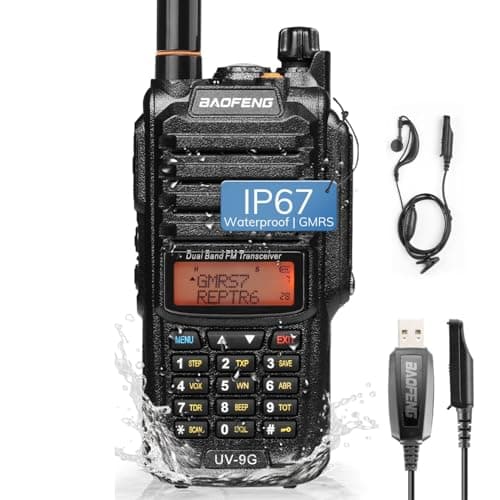
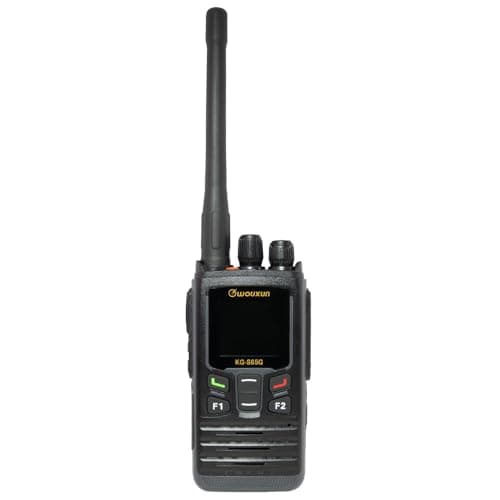
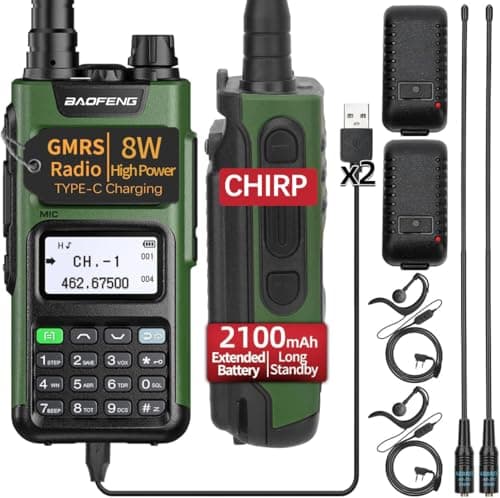
Two handhelds, not one. A single radio is an ornament. A cheap repeater-capable pair costs less than one radio from an established brand and gets you on the air the day the license lands.
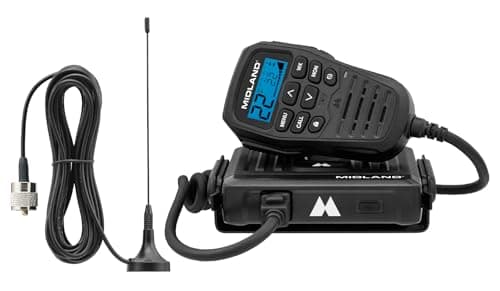
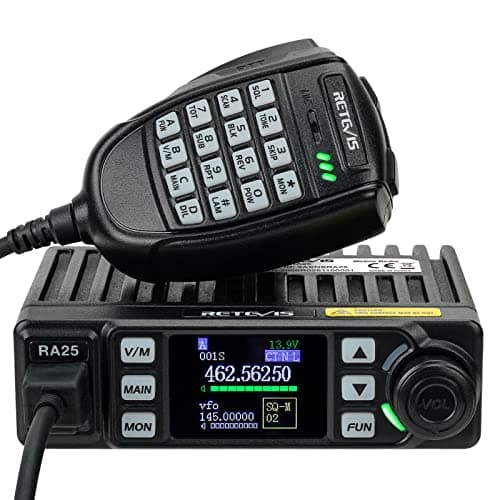
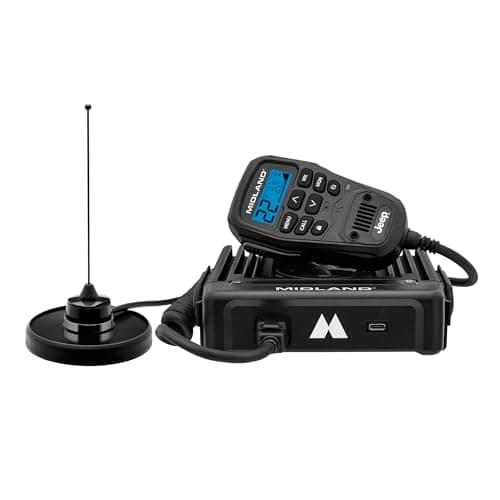
The mobile radio comes second, and when it does, remember that the antenna does more for your range than the wattage does. A 15-watt radio on a roof antenna beats a 50-watt radio on a compromised one every time. The install side of that is on the 4Runner build page, where mine is bolted to a hood-lip mount, and the base station page covers the fixed-station version.
Rules change. Fees, renewal terms and channel rules are all set by the FCC and all have changed before. Verify the current requirements on the FCC's own site before you transmit. Nothing on this site is legal advice.
Buying notes
Buy radios in pairs
The most common first-radio mistake. One radio talks to nobody. Two cheap radios are worth more than one good one every single time, and you can upgrade later once you know what annoys you.
Check repeater capability before you order
Not every GMRS handheld can work a repeater, and repeater access is the single biggest range multiplier available to you. It is a specification worth confirming on the listing, because it varies within the same manufacturer's line. See the repeater page for what that actually buys you.
Type acceptance matters
A radio must be type-accepted for GMRS to be used on GMRS legally. "Dual band" and "GMRS" are not the same claim, and a Baofeng UV-5R — an amateur radio — is not a GMRS radio no matter what frequencies you can program into it. That distinction matters to the FCC even where it does not matter to the antenna.
Antenna before power, always
If you have a hundred dollars, spend it on the antenna and the mount rather than on a bigger radio. This is the most reliably ignored advice in the whole hobby and it is the most reliably true.
What about FRS?
If nobody in the group will get licensed, buy FRS radios and be honest about the range. FRS is genuinely useful for a campsite or a parking lot. It is not useful for a group spread across three miles of trail, and no marketing claim on the box changes that.