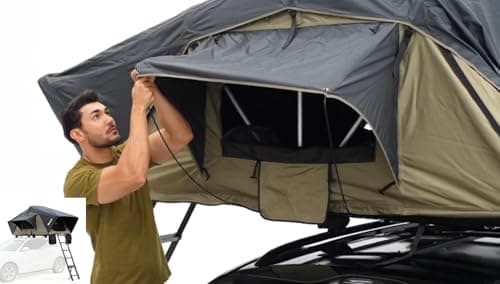
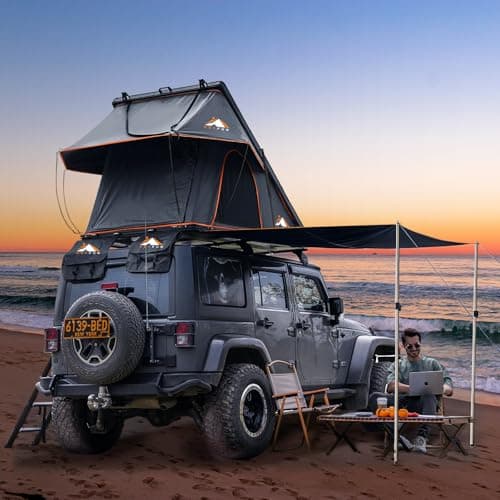
The verdict first: buy a hardshell if you move camp most days — gas struts get it open in under a minute and closed almost as fast, and that difference compounds over a two-week trip. Buy a softshell if you set up for two or three nights at a time, because you get substantially more floor area and a covered annex space for the same weight and less money.
Everything else follows from that. Hardshells are lower and quieter on the highway, heavier for their floor area, and more expensive. Softshells give you more tent per pound, take several minutes at each end, and are the ones people complain about packing away in the rain.
The differences that matter
Setup and pack-down
A gas-strut hardshell pops open in 30 to 60 seconds and closes in about two minutes. A softshell takes 5 to 10 minutes each way, including the cover, the ladder positioning and the fabric. Neither is difficult; the difference only becomes decisive when you do it every single day, or in the dark, or in rain.
Floor area for the weight
Softshells fold out beyond the vehicle's footprint, so a softshell with the same closed size as a hardshell gives you meaningfully more sleeping area. It also creates covered space beneath the overhang, which is genuinely useful for boots, gear and a chair.
Highway profile and fuel
Hardshells sit lower and are shaped to move air, so they cost less fuel and make less noise. A folded softshell is taller and boxier. Over a year of driving this is a real number.
Wet pack-down
A hardshell can be closed wet and the fabric sits inside a sealed shell — but you must open it to dry within a day or two or it will mildew. A softshell packed wet is worse, because the cover traps moisture against fabric that is already folded on itself. Neither should be left wet.
Cost
Softshells are generally cheaper for the same sleeping area, because a hardshell's aluminum or fiberglass shell and gas struts are expensive components. If budget is the constraint, a softshell buys more tent.
Durability
A hardshell's outer surface is aluminum or fiberglass and survives UV, hail and highway debris indefinitely. A softshell's PVC cover is the component that ages, and it is typically the first thing to need replacing after a few years of sun.
The question that settles it
How many nights will you spend in one place? One night at a time, over and over, points firmly at a hardshell. Three nights at a time points at a softshell, and you will enjoy the extra room every evening.
How these were picked
I haven't handled these. Here's what I did instead.
Everyone in this category says they tested twenty of these. I haven't tested any, and I say so. What I do instead: read the manufacturer's manual and published specification, compile the numbers that decide the purchase, do the arithmetic in the open, check the live price, and name one product to skip. The scores above are judgments from that research against a published rubric — they are not measurements I took, because I do not have a lab and I am not going to pretend otherwise.