We earn a commission when you buy through our Amazon links, at no extra cost to you. It never changes the order of the picks, and we say so when the cheaper thing is the better buy. How this works.
Noise Reduction Rating is the standardized measure of how much a hearing protector attenuates sound, and it is the only comparable number in this category. Amplification multiples like "5X" are not measured against any standard and cannot be compared between products.
Two things about NRR are worth knowing. First, it is measured in a laboratory on a perfect fit, and real-world attenuation is meaningfully lower — a common rule of thumb is to derate it substantially for imperfect fit. Second, gunfire is impulse noise well above the threshold at which hearing damage happens instantly rather than cumulatively.
Those two facts together are why over-buying is the correct instinct here, and why doubling up — plugs under muffs — is standard practice indoors or beside a muzzle brake. Combined protection is not additive; you gain roughly five decibels over the better of the two. At these levels, five decibels is a great deal of energy.
Electronic muffs earn their premium for one specific reason: they amplify ambient sound while compressing the gunshot, so you can hold a conversation and hear a range command. Passive muffs with a higher NRR protect at least as well and leave you deaf to everything, which has its own safety cost on a range.
Whichever pair you buy, the ones that get used are the ones that live in the range bag rather than on a shelf at home — which is an argument for a folding frame and for having a dedicated pocket they never leave. What to put in a range bag sets out the rest of the kit in the order worth buying it.
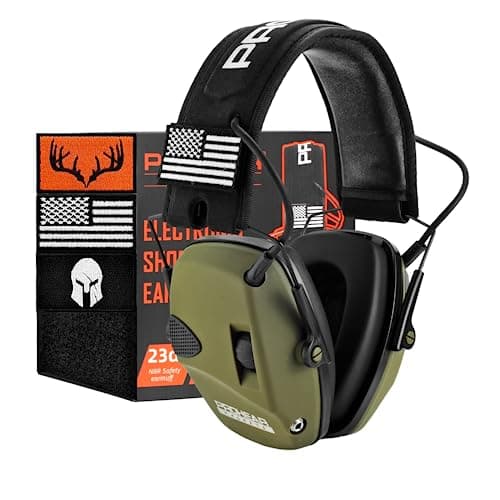
The listing leads with 5X amplification, which is not a standard anybody measures. NRR is the standard, it appears as an afterthought, and 23 dB is the low end for a category where the failure mode is permanent.
#ad · Live prices from the Amazon Creators API, as of October 19, 2026. Where we have no verified live price we show none — a gap beats a number that has rotted.
In detail
The picks, in full
01
Best overall value
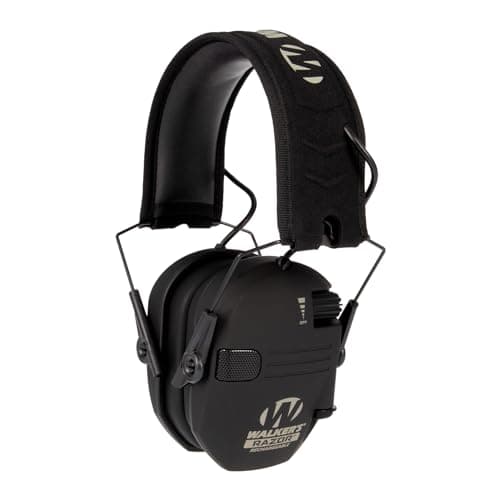
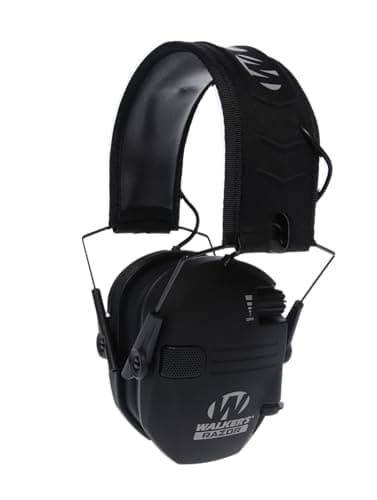
Walker's Razor Slim Electronic Muff
NRR 23 dBElectronic amplificationSlim cup profileFolding
7.6/10
The electronic muff that made the category affordable, and still the one most range bags contain.
Attenuation
6
Amplification
8
Comfort
7
Battery life
7
Value
10
What's good
+Slim cups genuinely clear a rifle stock, which thick passive muffs do not
+Amplification lets you hear range commands and conversation while compressing the shot
+Cheap enough to own several and keep spares for guests
+Folds flat for a range bag
What's not
−NRR 23 is adequate outdoors and marginal indoors or beside a muzzle brake
−Battery compartment is the common failure point
−Headband padding is thin for long sessions
Skip it if…
…you shoot indoors or beside braked rifles. Double up with plugs, or buy higher-NRR protection.
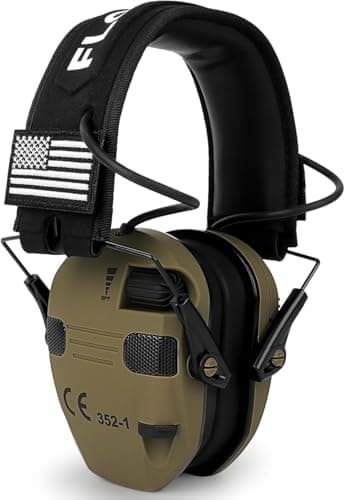
NRR 23 dB5x amplification claimedNo named standard for amplification
5.4/10
The listing leads with 5X amplification, which is not a standard anybody measures. NRR is the standard, it appears as an afterthought, and 23 dB is the low end for a category where the failure mode is permanent.
Attenuation
5
Amplification
5
Comfort
5
Battery life
6
Value
6
What's good
+Cheap
+NRR is at least stated
What's not
−Amplification multiples are not a standardized measurement — no test method produces a comparable '5X' figure, so it cannot be compared between products
−NRR is standardized and is the number that matters, and 23 dB is the low end for gunfire
−Real-world attenuation is meaningfully below the laboratory NRR figure because of imperfect fit, which is why over-buying is correct here
−The Walker's Razor Slim costs a few dollars more with the same NRR and a decade of documented use
Skip it if…
…your hearing matters to you, which it does. Buy on NRR, from a company that makes hearing protection.
A muff's rated NRR assumes a complete seal around the ear. Glasses arms, long hair, hats and a rifle stock bumping the cup all break that seal, and a broken seal loses far more protection than the difference between a 22 and a 25 NRR muff. Thin cushions or slim cups designed to clear a stock are addressing a real problem.
Double up where it matters
Indoors, at a covered range, or beside braked rifles: foam plugs under muffs. Insert the plugs properly — roll, pull the ear up and back, insert, hold while they expand. A badly inserted plug provides a fraction of its rating.
Slim cups for long guns
Thick muff cups get bumped by a rifle stock as you mount the gun, which lifts the cup and breaks the seal at the exact moment the shot goes off. Slim-profile muffs exist for this reason and it is not a cosmetic choice.
Electronic or passive
Electronic for anywhere you need to hear range commands, converse, or listen for game. Passive for maximum attenuation at the lowest cost, with the accepted trade of hearing nothing.
Hearing damage does not heal
Worth stating plainly. Noise-induced hearing loss and tinnitus are permanent. There is no treatment that restores what a single unprotected shot indoors can take, which is why this is the one category on this site where we would say buy more than you think you need.
How these were picked
I haven't handled these. Here's what I did instead.
Everyone in this category says they tested twenty of these. I haven't tested any, and I say so. What I do instead: read the manufacturer's manual and published specification, compile the numbers that decide the purchase, do the arithmetic in the open, check the live price, and name one product to skip. The scores above are judgments from that research against a published rubric — they are not measurements I took, because I do not have a lab and I am not going to pretend otherwise.
Questions
Frequently asked
What NRR do I need for shooting?+
NRR 25 or above for most shooting, and doubling up with plugs under muffs indoors or beside braked rifles. Remember that real-world attenuation is meaningfully below the laboratory rating because of imperfect fit.
Do electronic muffs protect as well as passive?+
At the same NRR, yes — the electronics amplify quiet sound and cut off above a threshold, they do not reduce the physical attenuation. What you are paying for is hearing range commands and conversation between shots.
Does doubling up plugs and muffs add the ratings together?+
No. Combined protection is roughly five decibels better than the higher-rated of the two, not the sum. At impulse-noise levels, though, five decibels is a substantial reduction in energy and worth having indoors.
Why do my muffs seem less effective than the rating?+
Almost always a broken seal. Glasses arms, hair, a hat, or the rifle stock bumping the cup all break the seal, and that costs far more protection than any difference between one muff's rating and another's.
We do not run a testing lab and we do not pretend to. Where a measured number came from a manufacturer's published specification or someone else's lab, we name them and link them. Where we could not verify something, we say so on the page rather than quietly leaving it out. Read the full method.