Section 06 · Shooting Gear
What Makes a Good 3-Gun Rifle
An honest look at the rifle side of the sport: what an 18-inch mid-length gas system buys you, why competition triggers are lighter, what a comp actually does, and why there is not a single buy button on this page.
We earn a commission when you buy through our Amazon links, at no extra cost to you. It never changes the order of the picks, and we say so when the cheaper thing is the better buy. How this works.
I run an Aero-built AR at matches, so this is written from the owner's side of the fence rather than from a catalog. What follows is what the specification lines on a 3-Gun rifle actually do for you on a stage — and, just as usefully, which of them do not matter nearly as much as the forums suggest.
There is nothing to buy on this page. This site does not link, price or recommend firearms, receivers, barrels, triggers or magazines anywhere, and that is not going to change for a page about competition guns. Amazon does not sell them. Buy the gun from a dealer, in person, with your hands on it first. The accessories it needs are ranked on the gear pages linked throughout, and those are the only things here anyone is paid for.
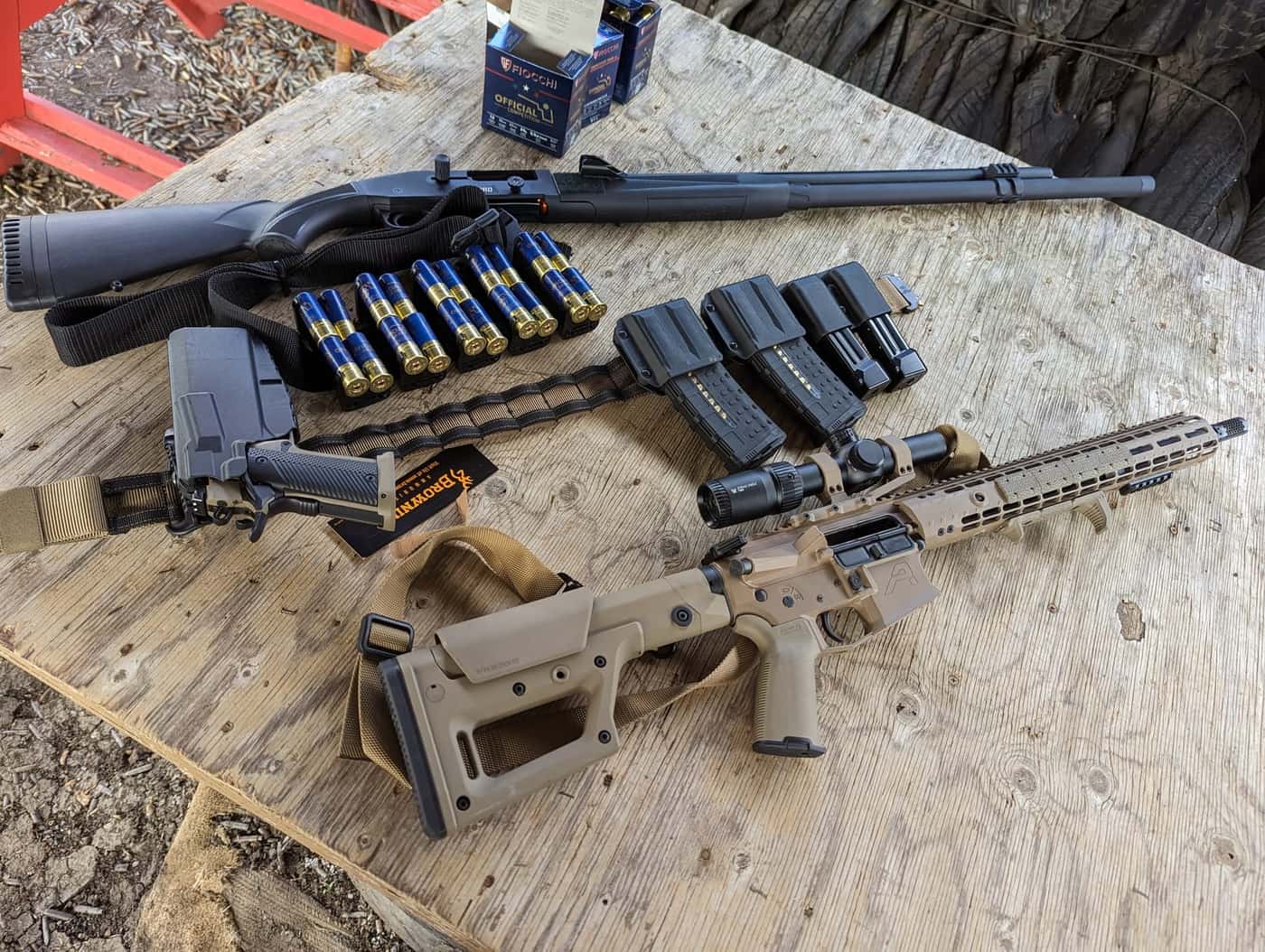
Barrel length: why 18 inches keeps winning
The 3-Gun rifle question that gets asked most is 16 versus 18 inches, and the reason 18 dominates is not velocity. It is the gas system.
A 16-inch AR is usually carbine-length gas. An 18-inch AR is usually mid-length. The longer gas system takes its pressure further down the barrel, where that pressure is lower and has had longer to stabilize. The practical result is a softer, slower unlocking cycle: less violent bolt movement, less muzzle rise, and a sight picture that settles faster between shots. On a stage where you are shooting eight pieces of steel as fast as you can confirm hits, that settling time is the difference.
The trade is weight and length. An 18-inch barrel is further out in front of you, which slows how quickly you can swing the rifle between widely separated targets and makes working around a barricade port marginally more awkward. That is a real cost, and it is why plenty of good shooters run 16 inches. But if you are choosing on paper, 18-inch mid-length is the configuration the sport converged on for a reason that holds up.
Weight, and where it sits
Total weight matters less than distribution. A rifle that is heavy at the muzzle tracks beautifully in recoil and is miserable to hold up while you wait for a target to activate. A rifle that is light at the muzzle is fast to point and bounces more.
Competition rifles generally end up heavier than a general-purpose AR, and the weight arrives whether you plan it or not — a long free-float handguard, a full-size optic, a bipod or a hand stop, and a muzzle device all add up out front. The useful discipline is to add each one deliberately rather than discovering afterwards that your rifle weighs eleven pounds.
Triggers
A lighter, cleaner trigger is the single most cost-effective improvement to how well you shoot a rifle, and it is also the one I am least willing to write specifics about. Trigger weight, reset and sear geometry are things you feel, not things you read, and pull weights quoted secondhand are frequently wrong.
What is worth saying plainly: a factory mil-spec trigger is heavy and gritty by design, almost every drop-in competition trigger is a large improvement over it, and the honest way to choose one is to press a few at a shop or on other people's rifles at a match. People will let you. It is the single easiest favor to ask on a range.
Buy triggers from a dealer or direct from the maker. They are not Amazon-listable, we do not link them, and anyone who does is selling you something that will not arrive.
Muzzle devices and what a comp really does
A compensator redirects gas upward and sideways to counteract muzzle rise. On a 3-Gun rifle that is genuinely useful: flatter tracking means faster confirmed hits on a target array, which is the entire game.
The costs are real and are usually undersold. A comp is loud in a way that a flash hider is not, and it is loud sideways — meaning at the RO standing beside you and the squad behind you. Concussion off an aggressive comp is a legitimate courtesy issue at a club match and one of the better arguments for good hearing protection, which we cover on the eye and ear page. Some clubs have opinions about brakes on indoor or covered bays. Ask.
Where the parts come from
My rifles are built on Aero Precision parts, which is a position I have written about at length in the Aero Precision owner's guide and in the first-build parts walkthrough. The short version is that they run a direct-and-dealer sales model, their catalog covers receivers through handguards and charging handles, and none of it is sold on a marketplace. That is the correct channel for these parts — you get the actual component, with the actual warranty, from a company that knows what it sold you.
If you are building rather than buying complete, those two pages are the practical sequence. This one is about what the finished rifle needs to do.
The optic is a separate decision
Rifle and optic get bought together and should be thought about separately. A 1-6x or 1-8x low-power variable is the default answer for 3-Gun because it gives you a true 1x for close arrays and enough magnification to identify and hit distant steel — and increasingly people run a 45-degree offset dot alongside it so the close targets do not cost anything at all. That is a whole page of its own: best LPVOs for 3-Gun, including the offset mounts, and unlike this page it has things you can actually buy.
Questions
Frequently asked
Why won't you link the rifles you're describing?
Is 16 inches genuinely worse than 18?
What should I upgrade first on a rifle I already own?
Do I need a comp?
Keep reading
Related
- Best LPVOs for 3-Gun (and the offset dot)The optic half of the rifle decision — with things you can actually buy.
- The Aero Precision owner's guideWhat they make, why it is bought direct, and the maintenance bench for it.
- Building a first AR on Aero partsThe practical sequence if you are assembling rather than buying complete.
- Mag pouches & rifle mag retentionWhere the rifle magazines live on a belt, and what retention actually needs to do.
Receipts
Sources
- USPSA — Rifle, Shotgun and Multigun Rules, 2026-03 edition (digital rulebook)
- Aero Precision — product catalog, handguard lines and dealer locator
- Vortex Optics — published optical specifications and warranty
- Magpul — sling specifications
We do not run a testing lab and we do not pretend to. Where a measured number came from a manufacturer's published specification or someone else's lab, we name them and link them. Where we could not verify something, we say so on the page rather than quietly leaving it out. Read the full method.