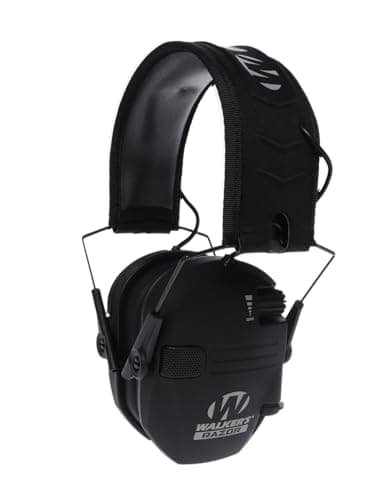
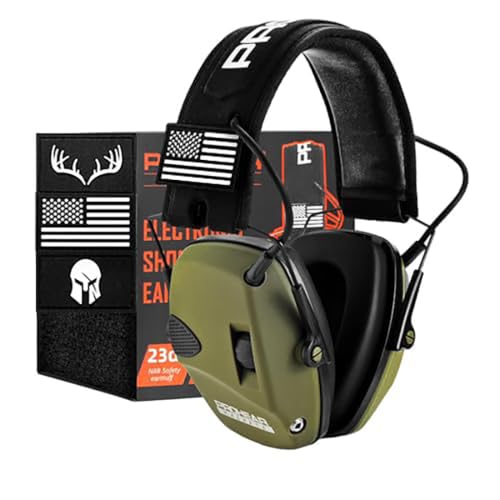
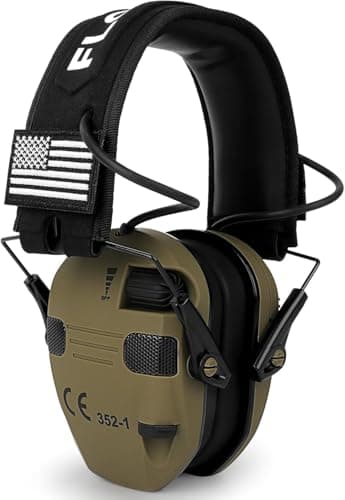
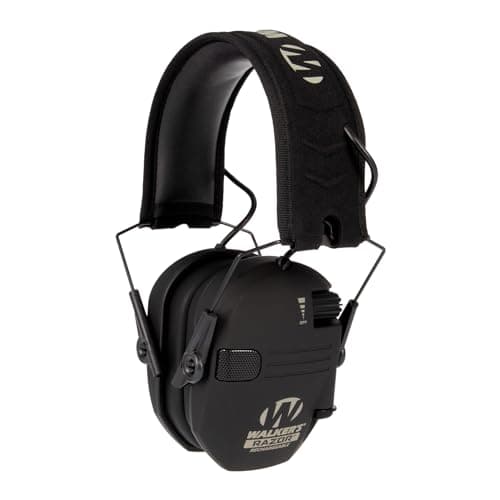
The verdict first: under fifty dollars, buy the Walker's Razor Rechargeable. It is for the outdoor shooter who turns up a few times a month and does not want to think about batteries, and the slim cup means a rifle stock does not knock it off your ear. The budget pick is the PROHEAR electronic muff — the cheapest set on this page carrying the same rated NRR as the Walker's Razor Slim, with a less convincing cushion. Skip the Floriogra 5X: it is sold on an amplification multiple that no test standard defines, which tells you what the listing is competing on.
Prices on this page come from a live lookup with its own date printed under the table. Read the table rather than this paragraph.
NRR is the number. Everything else is marketing.
Noise Reduction Rating is a standardized laboratory figure, so two muffs with an NRR of 23 are making a comparable claim. "5X amplification" is not standardized at all: there is no published test method that produces a comparable multiple, so the number cannot be checked against anything and cannot be compared between products. When a listing leads with amplification instead of NRR, that is the tell.
Two honest qualifications on NRR itself. First, real-world attenuation is meaningfully below the laboratory figure, because the laboratory fit is better than yours — which is the argument for over-buying rather than buying exactly enough. Second, the rating assumes a seal, and the seal happens at the cushion. A cheap muff with a thin cushion that does not sit flat against your head delivers less than its rating says, and this is exactly where the sub-$50 band gives ground to the 3M Peltors in the main roundup.
For what the exposure actually is and why this is not a comfort purchase, OSHA's occupational noise pages are the regulator's own material and are linked in the sources below.
What fifty dollars buys, and what it does not
It buys electronic amplification
All four of these are electronic: ambient sound is amplified through speakers and the gunshot is compressed. That means you hear range commands and conversation with the muffs ON, which is the single reason people keep them on. Passive muffs at this price exist and are quieter-rated, and almost nobody wears them for a full session.
It buys a slim cup, which matters more than it sounds
A thick cup collides with a rifle or shotgun stock when you mount the gun, and the result is a muff pushed off your ear at exactly the moment of the shot. Both Walker's sets here are slim-profile for that reason. It is the specification long-gun shooters should weigh against raw NRR, and it is why the highest-NRR muff on this site is not the recommendation for rifle work — see ear protection for indoor ranges.
It does not buy an indoor-rated seal
An indoor bay bounces the muzzle blast back off concrete, and NRR 21 to 23 is the low end for gunfire even outdoors. Under fifty dollars the honest answer for indoor shooting is to double up: plugs under muffs, which stacks a few more decibels of real attenuation for about a dollar. If you shoot indoors regularly, the band above is a better purchase and that page ranks it.
It does not buy Bluetooth or a long warranty
Both arrive above this band. Neither protects your hearing.
Rechargeable or replaceable batteries?
This is the only genuine fork on the page. Rechargeable means you never buy a cell and never discover a dead one halfway through a session — until the internal pack ages, at which point a flat battery means no amplification at all and there is nothing you can do about it at the range. Swappable AAA cells mean you can fix the problem from a gas station and it means you have to remember to.
Our read: rechargeable if you shoot close to home and charge things habitually, swappable if your range trips are long drives or multi-day. Both Walker's sets on this page are the same muff either way, which makes it a clean choice rather than a compromise.
Buying notes
Buy a spare set, not a better set
At this price the correct second purchase is another pair for whoever you brought with you. A guest without hearing protection is the reason sessions get cut short, and a second set of PROHEARs costs less than one Peltor.
Check the headband padding if you wear them for hours
The listed weak point on the cheap end of this band is thin headband padding, and it is a two-hour problem rather than a twenty-minute one. If your sessions are long, that is worth more attention than two decibels of rating.
The battery door is the part that fails
On both the Walker's Razor Slim and the Howard Leight Impact Sport — the two most common muffs on any range in America — the documented weak point is the battery compartment. Open it gently and do not lever it.
Eye protection is the other half and it is cheaper
A stated ANSI Z87.1+ rating means a documented high-velocity impact test rather than a marketing word, and glasses that carry it start at under twenty-five dollars. Our eye and ear page covers both together.