We earn a commission when you buy through our Amazon links, at no extra cost to you. It never changes the order of the picks, and we say so when the cheaper thing is the better buy. How this works.
Modern optics have multiple anti-reflective coating layers on every air-to-glass surface, and those layers are what make an optic usable in low light. They are also microns thick and removable with the wrong cloth.
The core rule is simple: never wipe a dry lens. Dust on glass is abrasive, and dragging a cloth across it grinds those particles into the coating. Every scratch on a lens started as a piece of grit somebody wiped.
So the order is always the same: blow, then brush, then wipe. Remove what you can without contact, remove what is left with the gentlest possible contact, and only then introduce fluid and a cloth.
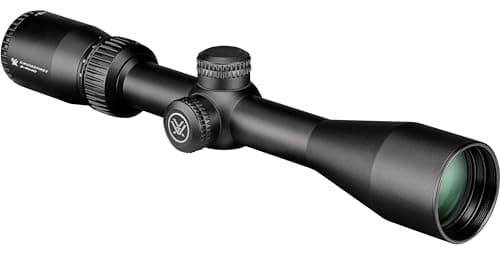
3-9x40 is the magnification range that covers essentially all North American big-game hunting, and the VIP warranty means a broken scope is replaced without argument.
#ad · Live prices from the Amazon Creators API, as of October 19, 2026. Where we have no verified live price we show none — a gap beats a number that has rotted.
In detail
The picks, in full
01
Best overall
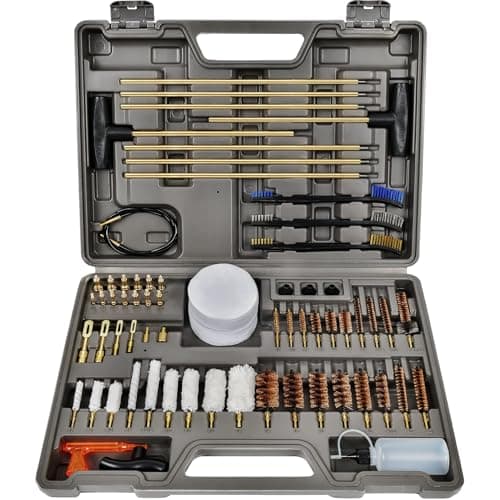
GLORYFIRE Elite Universal Kit
Universal, all calibersReinforced rodsBrass jagsHard case
8.0/10
Reinforced rods, a proper case and jags rather than only slotted tips — the kit that actually covers a mixed collection.
Completeness
9
Bore safety
7
Case quality
9
Value
7
What's good
+Brass jags give better patch contact than slotted tips, which is what actually cleans a bore
+Reinforced rods flex less at the joints than the thin rods in budget kits
+Organized hard case means you can tell what is missing
+Covers rifle, pistol and shotgun in one kit
What's not
−Multi-section rods still have joints, which can trap grit
−Most expensive kit here
Skip it if…
…you own one rifle. A bore snake and a bottle of solvent cost a fraction and do the routine job better.
3-9x40 is the magnification range that covers essentially all North American big-game hunting, and the VIP warranty means a broken scope is replaced without argument.
Glass clarity
8
Low light
8
Turret tracking
8
Durability
9
Value
9
What's good
+Fully multi-coated glass — every air-to-glass surface, which is what determines low-light usability
+3-9x is the most useful hunting range: 3x for timber, 9x for open country
+Vortex VIP warranty is unconditional and transferable
+Nitrogen purged and O-ring sealed, so no internal fogging
What's not
−Second focal plane, so the BDC holdovers are only correct at maximum magnification
−Not a long-range scope — 9x runs out past about 400 yards
Skip it if…
…you shoot past 400 yards. The magnification and the turret travel both run out, and that is a different scope.
Blow the loose dust off. A rubber blower bulb. Not canned air, which can spray propellant onto the lens and whose pressure can drive grit into the coating. Not your breath, which deposits moisture and whatever else.
Brush what remains. A soft lens brush or the brush end of a lens pen, used in light circular strokes from the center outward. This lifts particles rather than dragging them.
Apply fluid to the cloth, not the lens. Fluid on the lens runs to the edge and wicks under the seal into the optic body. One or two drops on a microfiber cloth or a lens tissue.
Wipe from the center outward in a spiral. Light pressure, one direction. Back-and-forth scrubbing moves any remaining particle repeatedly across the same track.
Dry with a clean part of the cloth. Same spiral, same light pressure.
What to use, and what never to
Use
A rubber blower bulb
A soft lens brush or a lens pen
Dedicated optics cleaning fluid, or isopropyl alcohol diluted with distilled water
Clean microfiber cloths, washed without fabric softener
Disposable lens tissue for anything greasy
Never use
Your shirt, a paper towel, or tissue. Wood-pulp paper is abrasive at the scale coatings live at, and a shirt carries grit.
Acetone or any solvent. It will strip coatings and can attack the housing.
Canned air. Propellant residue and pressure that drives grit into the coating.
Saliva. Enzymes and acid, on a coated surface.
Fabric-softened microfiber. The softener leaves a film that smears.
Cleaning less often is the real answer
Every clean is an opportunity to damage the coating, so the best strategy is to keep lenses covered. Flip-up scope caps, binocular objective covers and a lens cloth in a case cost very little and reduce cleaning frequency dramatically.
A little dust on a lens has essentially no effect on the image. Fingerprints and oil do, because they are on the surface light passes through and they scatter it — which is why the real rule is to keep fingers off the glass rather than to clean often.
Storage
Store optics dry and covered, ideally not in a sealed case that traps humidity. If an optic comes in from the cold, let it warm up with the caps ON — condensation forms on the coldest surface, and you want that to be the outside of the cap rather than the lens. Never store an optic in a case with a damp cleaning cloth.
How these were picked
I haven't handled these. Here's what I did instead.
Everyone in this category says they tested twenty of these. I haven't tested any, and I say so. What I do instead: read the manufacturer's manual and published specification, compile the numbers that decide the purchase, do the arithmetic in the open, check the live price, and name one product to skip. The scores above are judgments from that research against a published rubric — they are not measurements I took, because I do not have a lab and I am not going to pretend otherwise.
Questions
Frequently asked
Can I use glass cleaner on a rifle scope?+
No. Household glass cleaners commonly contain ammonia, which attacks optical coatings. Use a dedicated optics fluid, or isopropyl alcohol diluted with distilled water, applied to the cloth rather than the lens.
What is the correct order for cleaning a lens?+
Blow, brush, then wipe. Remove loose dust with a blower bulb, lift what remains with a soft brush, and only then introduce fluid on a cloth. Wiping a dry, dusty lens grinds grit into the coating.
Can I use a microfiber cloth?+
Yes, provided it is clean and has never been washed with fabric softener — softener leaves a film that smears. Keep a dedicated optics cloth and do not use it for anything else.
How often should I clean my scope?+
As rarely as you can. Every clean risks the coating, and a little dust has essentially no effect on the image. Keep caps on, keep fingers off the glass, and clean when there is oil or a fingerprint rather than on a schedule.
What do I do about condensation inside a scope?+
Internal fogging means the gas purge has failed and the seal is compromised — that is a warranty issue, not a cleaning one. Nitrogen or argon purged optics should never fog internally, which is why that phrase is worth looking for when buying.
We do not run a testing lab and we do not pretend to. Where a measured number came from a manufacturer's published specification or someone else's lab, we name them and link them. Where we could not verify something, we say so on the page rather than quietly leaving it out. Read the full method.