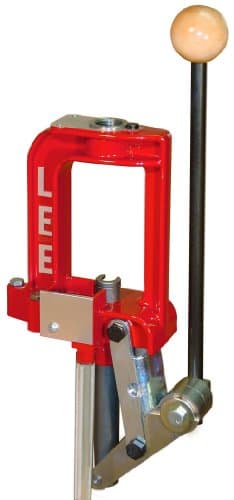
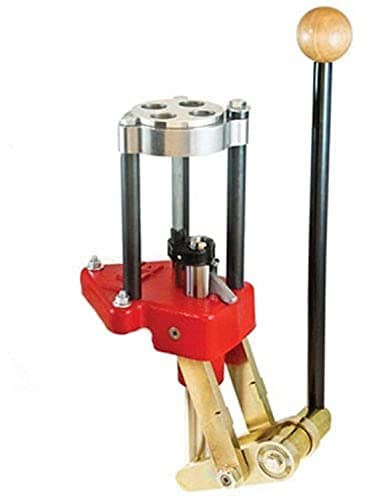
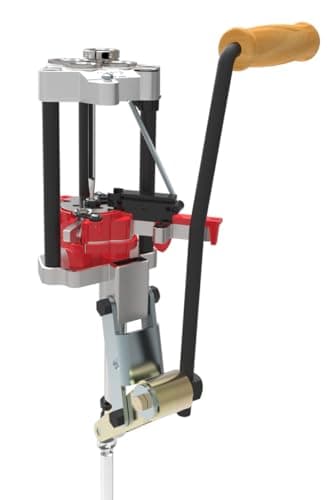
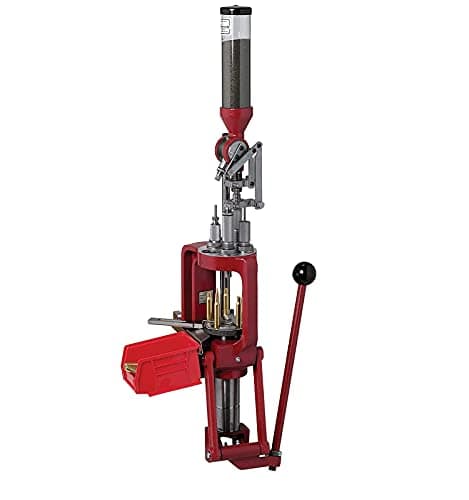
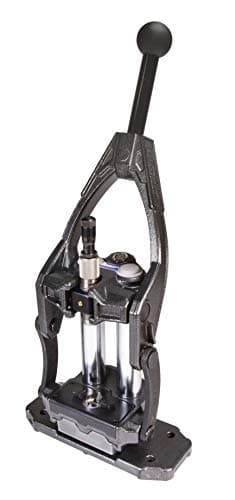
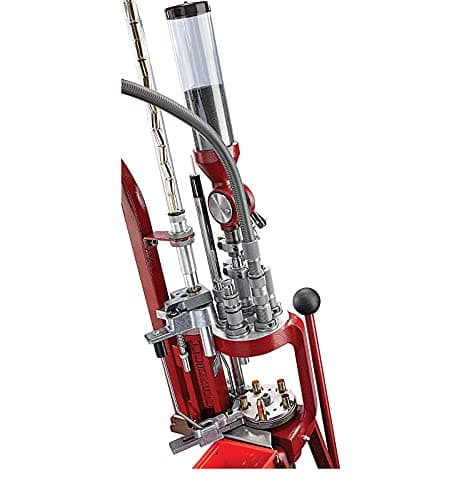
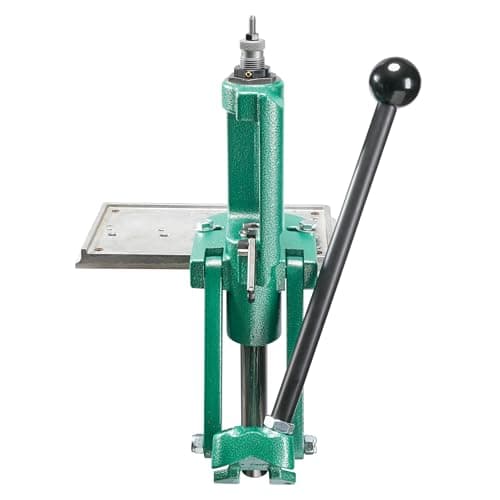
The verdict first. Loading precision rifle: single stage. Loading thousands of pistol rounds: progressive. Loading a few hundred of several things and wondering why your evenings disappear: a turret press, which almost nobody considers and which is the right answer more often than either extreme.
Before anything else, the rule this whole site holds to: we sell and discuss equipment. Load data comes from a current manual published by a company that pressure-tests it — Hodgdon, Sierra, Hornady and others. There is not a charge weight anywhere on this site and there never will be. A number published on a website with no pressure testing and no accountability behind it is worth exactly what you paid for it.
What each press type actually does
Single stage: one operation, one case
One die in the press. You size every case, then change the die, then prime every case, and so on. It is slow, and the slowness is the feature: every case gets the same operation with the same setup, and you look at all of them.
For precision rifle this is not a compromise, it is the correct tool. The operations that matter for accuracy — sizing to a measured shoulder bump, seating to a measured length — are ones you want to perform identically and check as you go.
Turret: all your dies, one at a time
A rotating head holds every die for a cartridge at once. The case stays in the shell holder and the turret indexes between operations. You get most of the speed of a progressive with the single-case simplicity of a single stage, and a removable turret means each cartridge keeps its dies permanently set up.
The reason this is under-recommended is that it wins no arguments. It is not the most precise and it is not the fastest. It is the press that fits how most people actually load, which is a few hundred rounds of two or three cartridges.
Progressive: every station working at once
Pull the handle and a case is sized at one station, primed at another, charged at a third and a bullet seated at a fourth. A finished round drops out with every stroke. Hundreds of rounds an hour is realistic.
What you give up is visibility. Four operations happen simultaneously and you are watching one of them. That is why a case-activated powder drop and a powder-check die are not accessories on a progressive — they are the safety system.
The decision, in one question
How many rounds of what?
- Under 200 rounds a month, rifle, accuracy matters: single stage. Done.
- A few hundred rounds a month across two or three cartridges: turret. This is most people and most people buy the wrong thing here.
- Over 500 rounds a month, mostly pistol or gas gun: progressive. A single stage will make you stop reloading, which is the real failure mode.
- Both problems: two presses. A used single stage costs less than the frustration of doing precision work on a progressive, and they coexist on one bench.
The mistake almost everyone makes
Buying the press for the shooter you intend to become. People who load two hundred rounds a year buy progressives, spend a weekend setting one up, load three hundred rounds badly and conclude that reloading is not for them.
Learn on a single stage. Not because it is more virtuous, but because you can see every operation, and seeing every operation is how you learn what a correctly sized case and a correctly seated bullet look and feel like. Once you know that, a progressive is a machine you supervise. Before you know it, a progressive is a machine that hides your mistakes.
Buying notes
The press is not the expensive part
A press, dies, a scale, a trimmer, calipers, a comparator, a tumbler and the bench to bolt it to is real money before you have loaded a round. Do the arithmetic honestly before you start — the same arithmetic is laid out on why I handload for long range, which is the page that explains why anybody does this at all.
Spend in this order
- Scale. Everything downstream is measured against it, and a bad scale makes a good press pointless.
- Press. The one on this page that matches your volume answer.
- Dies. Cartridge-specific, and where precision genuinely lives.
- Measuring tools. Calipers and a comparator, which the existing bench page ranks.
- Everything else. Tumbler, trimmer, case prep — see the case prep guide.
Frame rigidity is the specification that matters
Cast iron over aluminum, if the press will full-length size large cases. Frame flex is not a theoretical concern on magnum brass — it is the thing that makes a press feel vague at the top of the stroke.
Avoid kits at the start, and avoid the big one entirely
A kit decides for you which scale, which tumbler and which dies you own before you know which parts of the process are your bottleneck. The sixteen-hundred-dollar bundle above is the extreme version of that mistake and it is the skip pick for exactly that reason.
Safety is a process, not a product
A powder-check die on a progressive, a loading block and a light on a single stage, and one rule that never bends: one powder container open on the bench at a time. The double-charge and the wrong-powder mistakes are both prevented by procedure, not by equipment.