Skip to content
Steve's Outpost

Section 06 · Shooting Gear

Can You Zero a Red Dot Without Shooting?

No. You can get very close in your living room, and that is worth doing — but a zero is a statement about where bullets land, and only bullets can make it.

By Stephen V.Updated How we pick
#ad

We earn a commission when you buy through our Amazon links, at no extra cost to you. It never changes the order of the picks, and we say so when the cheaper thing is the better buy. How this works.

The verdict first: no, you cannot zero without shooting — and anyone telling you otherwise is describing bore sighting and calling it something it is not. What you can do, at home, for about twenty-five dollars, is get the optic so close that you confirm the zero with three or four rounds instead of twenty. The tool for that is a cartridge-shaped laser bore sighter, and it is the single best-value item on this page for anyone mounting an optic. This is for the person who has just mounted a dot and does not want to burn half a box of ammunition finding paper.

If you want the live-fire procedure itself rather than the preparation, the zeroing walkthrough is a separate page and it picks up exactly where this one stops.

Why a zero cannot be done dry

A zero is the alignment between your sight line and the path a specific bullet takes from your specific barrel. It depends on things that do not exist until you fire: muzzle velocity, the bullet's drag, how your barrel harmonics settle, how the gun recoils in your grip, and the height of the sight above the bore.

A laser in the chamber knows none of that. It tells you, quite accurately, where the barrel is pointing. The bullet does not travel along where the barrel is pointing — it leaves on that line and then falls away from it, while your sight line crosses it. Those are different geometry problems and no amount of care in the living room collapses them into one.

What bore sighting is genuinely good for

  1. Getting on paper at all. This is the real win. A freshly mounted optic can easily be two feet off at 25 yards, which means your first shots miss the target entirely and you learn nothing from them. Bore sighting gets you inside the paper.
  2. Saving ammunition and bench time. Three to five rounds to a confirmed zero instead of fifteen to twenty-five. At current prices the tool pays for itself the first time.
  3. Catching a mounting mistake before the range. If the laser will not come close with the adjustment near the middle of its range, something is wrong — wrong-height rings, a canted mount, a rail that is not what you think it is. Far better to find that at home.
  4. Checking a rifle that has been knocked. Not a zero confirmation, but a quick sanity check that nothing has moved a long way.

What the other "no shooting" methods are actually worth

Mechanical bore sighting through the barrel. Pull the bolt, rest the rifle solidly, look down the bore at a distinct object a hundred yards away, then without moving the rifle adjust the optic onto the same object. Free, needs no tools, and roughly as good as a laser. Does not work on a semi-auto you cannot see through, which is most of them.

Dry fire with a laser training system. Excellent for what it is for — presentation, trigger control, transitions, and confirming your dot is where your eye expects it when the gun comes up. It is not a zero and it does not try to be. For a pistol dot in particular this is where the real improvement comes from, and it is why the training system is on this page. Our dry-fire gear page covers the rest of that setup.

Copying someone else's settings. Worthless. Zero is specific to your gun, your optic, your mount and your ammunition.

"Factory zeroed" claims on a packaged optic-and-mount combination. Treat these as a bore sight at best. They mean the optic was centered mechanically, not that it is zeroed on your gun.

The honest fastest route, start to finish

  1. Mount it properly and torque it. To the published inch-pound figure, with a wrench that reads inch-pounds. Everything downstream is wasted if the optic moves. Heights, cant and torque are covered here.
  2. Bore sight at home. Laser in the chamber, gun supported so it cannot move, target at a known distance — 25 yards is plenty and a garage wall at 10 yards is enough to get close. Adjust the dot to the laser, not the laser to the dot.
  3. Confirm with the ammunition you will actually use. At the range, one round at 25 yards from a supported position. Look at where it hit, not at the group you do not have yet.
  4. Adjust, then shoot three. Move the dot by the measured distance from the point of aim, then fire a three-round group to confirm. Adjusting off a single shot is how people chase their own noise around a target.
  5. Write it down. Distance, ammunition, date. A zero you cannot reproduce is not much of a zero — the DOPE card page is the cheapest upgrade on this site.

Safety, since this involves pointing guns indoors

A bore sighting laser goes in an unloaded gun, in a room with no ammunition in it, pointed at a backstop you would accept if the gun did fire. Check the chamber, check it again, and take the magazine out of the room. The failure mode here is not a ruined zero.

The short answer

Quick picks

#ProductBest forScorePrice
01
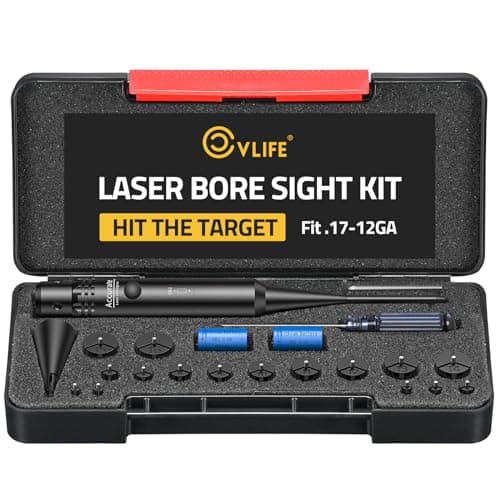
CVLIFE CVLIFE Laser Bore Sight Kit, .17 to 12GA
CVLIFE Laser Bore Sight Kit, .17 to 12GA

A cartridge-shaped laser that drops into the chamber and shows you roughly where the barrel is pointing. It gets you on paper in a few rounds instead of twenty, which is the entire claim worth making for one.

Best bore sighter for the money
7.8
$23.99Amazon (affiliate link)
02
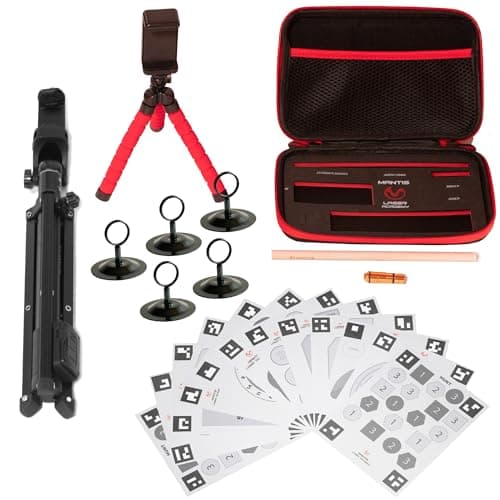
Mantis Laser Academy Training Kit for 9mm
Laser Academy Training Kit for 9mm

The single best thing you can buy to shoot a 2011 better, and it is not a part for the gun. Guided drills, real feedback, no ammunition.

Best dry-fire system for a pistol dot
9.0
$159.00Amazon (affiliate link)
03
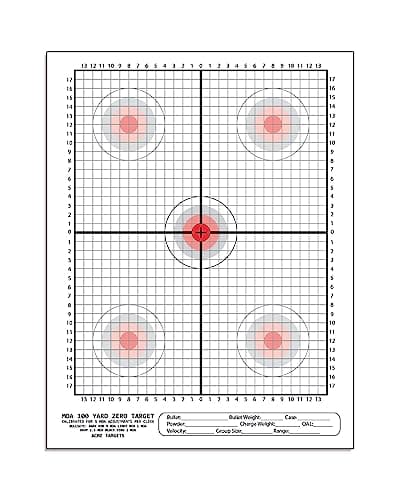
Generic 100-Yard Zero Target, Calibrated for 1/4 MOA per Click
100-Yard Zero Target, Calibrated for 1/4 MOA per Click

A grid printed in clicks rather than inches. You measure the offset, read the click count straight off the paper, and stop doing arithmetic on a bench in the wind.

Best target for the range trip that finishes the job
8.0
$7.62Amazon (affiliate link)
04
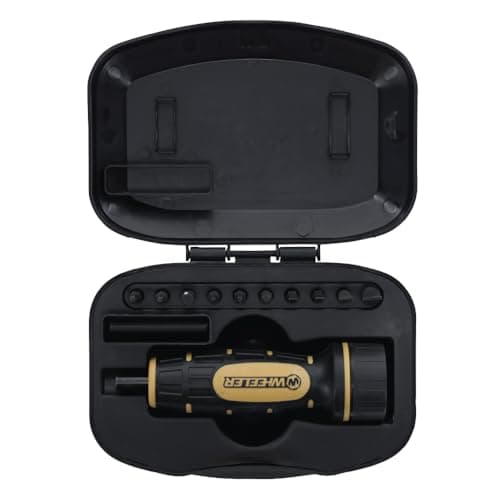
Wheeler Firearms Accurizing Torque Wrench, Inch-Pounds
Firearms Accurizing Torque Wrench, Inch-Pounds

Ring screws have a torque specification for a reason, and guessing it is how tubes get crushed and zeros get lost. Sixty-six dollars against a thousand-dollar scope.

The tool that stops the zero moving again
8.8
$54.46Amazon (affiliate link)

#ad · Live prices from the Amazon Creators API, as of October 19, 2026. Where we have no verified live price we show none — a gap beats a number that has rotted.

In detail

The picks, in full

01
CVLIFE CVLIFE Laser Bore Sight Kit, .17 to 12GA

Best bore sighter for the money

CVLIFE Laser Bore Sight Kit, .17 to 12GA

Fits .17 through 12 gaugeAdapter set includedBattery poweredArbor style
7.8/10

A cartridge-shaped laser that drops into the chamber and shows you roughly where the barrel is pointing. It gets you on paper in a few rounds instead of twenty, which is the entire claim worth making for one.

Time saved
9
Caliber coverage
9
Accuracy of alignment
6
Build quality
6
Value
9

What's good

  • Gets a fresh scope on paper at 25 yards before you have burned a single expensive round
  • One kit covers every rifle and shotgun in the safe rather than one bore diameter
  • Small enough to live in the range bag, which is where it is actually useful

What's not

  • A bore sighter is an alignment tool, not a zero — you still have to shoot the rifle
  • Cheap arbors can sit slightly off-axis, so treat the result as a starting point

Skip it if…

…you already own a bolt gun you can look down. Removing the bolt and eyeballing the target through the bore does the same job for free on any rifle where that is possible.

$23.99Amazon (affiliate link)

Price as of October 19, 2026. Prices move — Amazon's is the one that counts.

#ad · we may earn a commission from this link to CVLIFE Laser Bore Sight Kit, .17 to 12GA

02
Mantis Laser Academy Training Kit for 9mm

Best dry-fire system for a pistol dot

Laser Academy Training Kit for 9mm

9mm laser training cartridge includedApp-based scoring, no subscriptionGuided drills with real-time feedbackTarget set included
9.0/10

The single best thing you can buy to shoot a 2011 better, and it is not a part for the gun. Guided drills, real feedback, no ammunition.

Fit for purpose
10
Build quality
8
Usefulness
10
Value
8

What's good

  • Free app with no subscription, which is genuinely rare in this category
  • Scored drills turn dry fire from a chore into something you can measure and beat
  • Cheaper than about four range trips, and you can do it any evening

What's not

  • A hundred and fifty-nine dollars before you have fired a round
  • Laser cartridges are caliber-specific — this one is 9mm
  • Dry fire builds trigger control and does nothing for recoil management

Skip it if…

…you will not do it. Dry-fire gear only works if you use it, and most of it ends up in a drawer.

$159.00Amazon (affiliate link)

Price as of October 19, 2026. Prices move — Amazon's is the one that counts.

#ad · we may earn a commission from this link to Laser Academy Training Kit for 9mm

03
Generic 100-Yard Zero Target, Calibrated for 1/4 MOA per Click

Best target for the range trip that finishes the job

100-Yard Zero Target, Calibrated for 1/4 MOA per Click

100-yard calibration1/4 MOA click grid1in squaresPaper
8.0/10

A grid printed in clicks rather than inches. You measure the offset, read the click count straight off the paper, and stop doing arithmetic on a bench in the wind.

Ease of use
9
Accuracy of grid
9
Visibility
6
Versatility
6
Value
10

What's good

  • Removes the single most common zeroing error, which is arithmetic under time pressure
  • Grid in clicks means you dial what you measured instead of converting twice
  • Costs less than the three rounds you would waste getting it wrong

What's not

  • Calibrated for 1/4 MOA scopes — a 1/8 MOA target scope or a MIL scope needs its own grid
  • Plain paper is hard to see at 100 yards without a spotter

Skip it if…

…your scope adjusts in MIL. Buy a MIL grid instead; mixing rulers is the one mistake that actually matters here, and our MOA versus MRAD page explains why.

$7.62Amazon (affiliate link)

Price as of October 19, 2026. Prices move — Amazon's is the one that counts.

#ad · we may earn a commission from this link to 100-Yard Zero Target, Calibrated for 1/4 MOA per Click

04
Wheeler Firearms Accurizing Torque Wrench, Inch-Pounds

The tool that stops the zero moving again

Firearms Accurizing Torque Wrench, Inch-Pounds

Inch-pound torque wrenchInterchangeable bits includedStorage caseManual (non-digital)
8.8/10

Ring screws have a torque specification for a reason, and guessing it is how tubes get crushed and zeros get lost. Sixty-six dollars against a thousand-dollar scope.

Fit and finish
8
Holding zero
10
Ease of install
9
Value
8

What's good

  • Removes the single most common cause of a scope that will not hold zero
  • The bit set covers ring screws, base screws and action screws
  • Cheaper than one warranty return's worth of aggravation

What's not

  • Sixty-six dollars for a tool you use for ten minutes a year
  • Manual wrenches need occasional calibration checks
  • The bits are adequate rather than excellent

Skip it if…

…you mount one scope a decade. Borrow one, or ask the shop to torque it — but do not guess.

$54.46Amazon (affiliate link)

Price as of October 19, 2026. Prices move — Amazon's is the one that counts.

#ad · we may earn a commission from this link to Firearms Accurizing Torque Wrench, Inch-Pounds

Buying notes

Chamber-cartridge lasers are caliber-specific, mostly

A cartridge-shaped bore sighter has to fit your chamber. Multi-caliber kits with adapters cover a useful spread; a single-caliber unit is cheaper and simpler if you have one gun. Check the stated caliber range on the listing before ordering.

Battery contact is the usual failure

Cheap bore sighters mostly fail at the battery stack rather than the laser. Take the batteries out between uses, and if the beam is intermittent, clean the contacts before concluding the unit is dead.

Do not adjust at ten yards and expect a hundred-yard zero

The closer your bore-sighting distance, the more a small angular error is magnified downrange. Ten yards gets you on paper at a hundred; it does not get you zeroed at a hundred. Use the longest distance you can set up safely.

A torque wrench is not optional on this list

It is the least exciting item here and the one that actually keeps the zero. A scope or dot that shifts under recoil undoes every step above it, and "tight" is not a specification.
How these were picked

I haven't handled these. Here's what I did instead.

Everyone in this category says they tested twenty of these. I haven't tested any, and I say so. What I do instead: read the manufacturer's manual and published specification, compile the numbers that decide the purchase, do the arithmetic in the open, check the live price, and name one product to skip. The scores above are judgments from that research against a published rubric — they are not measurements I took, because I do not have a lab and I am not going to pretend otherwise.

Questions

Frequently asked

Can you zero a red dot without firing a shot?
No. You can bore sight it, which aligns the optic with where the barrel points and gets you on paper — but a zero is a statement about where bullets actually land, and that depends on velocity, bullet drop, sight height over bore and how the gun recoils in your hands. Those only exist once you fire. Bore sighting turns a twenty-round zeroing session into a three-round one, which is the honest benefit.
How accurate is a laser bore sighter?
Good enough to put your first shot on a target at 25 to 100 yards, which is what it is for. It is not good enough to be a zero, and the error it leaves grows with distance. Treat it as a starting point you then confirm with ammunition.
Is dry fire useful for a new red dot?
Very — just not for zeroing. Dry fire with a laser training system is the fastest way to get the dot appearing where your eye expects it on presentation, which is the actual skill a pistol dot demands. It teaches you to find the dot without hunting for it. It tells you nothing about where rounds land.
What distance should I zero a red dot at?
For a pistol dot, 15 to 25 yards covers the realistic range of use. For a rifle dot without magnification, 50 yards is the common and sensible choice because it keeps the trajectory inside a useful band out to a couple of hundred. Pick one, write it down, and do not change it casually — the procedure is here.
Does a factory-mounted optic need zeroing?
Yes. A packaged optic-and-mount combination is mechanically centered at best, which is a bore sight, not a zero. It also says nothing about your ammunition. Confirm it with live fire before you trust it with anything.

Keep reading

Receipts

Sources

We do not run a testing lab and we do not pretend to. Where a measured number came from a manufacturer's published specification or someone else's lab, we name them and link them. Where we could not verify something, we say so on the page rather than quietly leaving it out. Read the full method.