Skip to content
Steve's Outpost

Section 07 · The Garage

Vehicle Recovery Gear, Bought on the Ratings

Every item here carries a number. The number is the product — and the piece with no number printed on it is the piece that hurts somebody.

By Stephen V.Updated How we pick
#ad

We earn a commission when you buy through our Amazon links, at no extra cost to you. It never changes the order of the picks, and we say so when the cheaper thing is the better buy. How this works.

Recovery gear is the one category on this site where the wrong purchase can put somebody in hospital. So this page is organized around a single idea: every component carries a stated rating, and the lowest rating in the chain is the rating of the whole recovery. A 40,000-pound rope connected with an unrated hook is a hook-rated recovery. Nothing about the rope changes that.

The second idea follows from the first. Recovery is an energy problem. A kinetic rope stretches, stores a great deal of energy and returns it — which is the whole point, and also the hazard. If a shackle, a mounting point or a hook releases while that energy is stored, it leaves in one direction very quickly and it does not care what is in the way.

Everything below is chosen on that basis, and one product is here specifically to be skipped.

The recovery point is the part people get wrong

Not the rope. The attachment. A tow ball is a threaded steel sphere designed to take a downward, static load, and there is a well-known failure mode where it shears under a horizontal shock load and becomes a projectile with a nut on it. A bumper bracket bolted through sheet metal is not a recovery point either, no matter how solid it feels when you pull on it with your hands.

The two correct answers are frame-mounted rated recovery points, or a rated shackle mount in a factory receiver hitch. The second costs very little and takes thirty seconds, which is why it is on the list below.

Kinetic rope versus a snatch strap versus a tow strap

A tow strap has minimal stretch and is for towing a vehicle that rolls freely. A snatch strap or kinetic rope is designed to stretch — commonly around 20 to 30 percent, and this product's listing states 30 — so the recovering vehicle can roll into it and pull the stuck vehicle out on the rebound rather than on a dead jerk.

Using the wrong one is the second most common mistake in this category. A non-stretch tow strap used for a snatch recovery delivers the entire shock to the attachment points at once. A kinetic rope used for ordinary towing is unpleasant, springy and hard to control.

Synthetic over steel, and why

Steel D-ring shackles are strong and cheap and there is nothing wrong with the metallurgy. The argument for synthetic soft shackles is entirely about what happens when something in the chain fails: steel flies, synthetic drops. On a trail with people standing around watching — which is every recovery — that is not a small difference.

The trade-off is real and worth stating. Synthetic is vulnerable to abrasion and to sharp edges, and a soft shackle that has been sawing across a bumper lip can be half cut through and still look fine. Protect the edges, inspect before you load it.

The damper nobody buys

A line damper is a weighted blanket you drape over the middle of a loaded line. If the line or a fitting lets go, the damper absorbs energy and drives the failure into the ground rather than across the clearing. It costs less than almost anything else in a kit and it is the item most often missing from one.

The short answer

Quick picks

#ProductBest forScorePrice
01
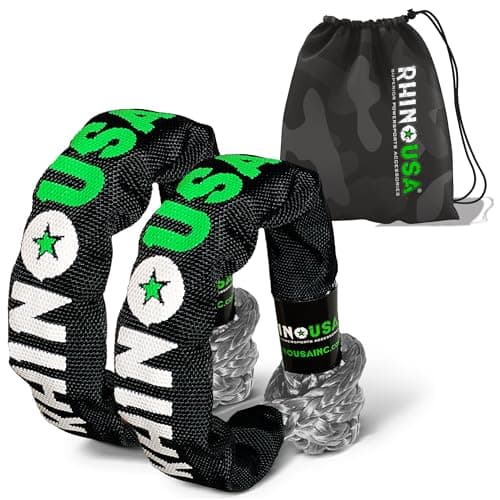
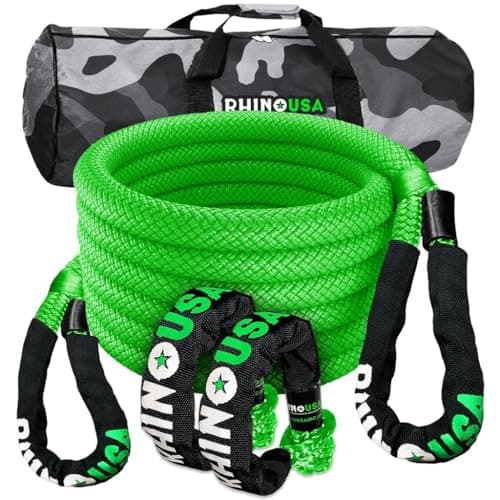
Rhino USA Kinetic Rope Recovery Kit, 7/8 in x 30 ft with Soft Shackles
Kinetic Rope Recovery Kit, 7/8 in x 30 ft with Soft Shackles

Rope plus the shackles to connect it, from a brand that publishes its ratings — which removes the most common way people assemble an unsafe recovery.

Best overall recovery kit
8.0
$179.90Amazon (affiliate link)
02
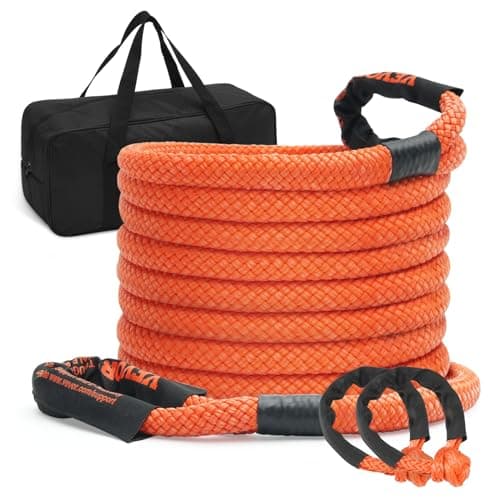
VEVOR Kinetic Recovery Rope, 7/8 in x 30 ft, 30,580 lb
Kinetic Recovery Rope, 7/8 in x 30 ft, 30,580 lb

A stated 30,580 lb rope with two 41,750 lb soft shackles and a published 30 percent elasticity figure, which is more specification than most budget listings give you.

Best budget kinetic rope
7.8
$54.80Amazon (affiliate link)
03
Rhino USA Synthetic Soft Shackle Rope, 3/8 in, 31,400 lb (2-pack)
Synthetic Soft Shackle Rope, 3/8 in, 31,400 lb (2-pack)

A stated 31,400 lb synthetic shackle that weighs a few ounces and, critically, does not become a projectile if something in the chain lets go.

Best soft shackles
8.5
$39.90Amazon (affiliate link)
04
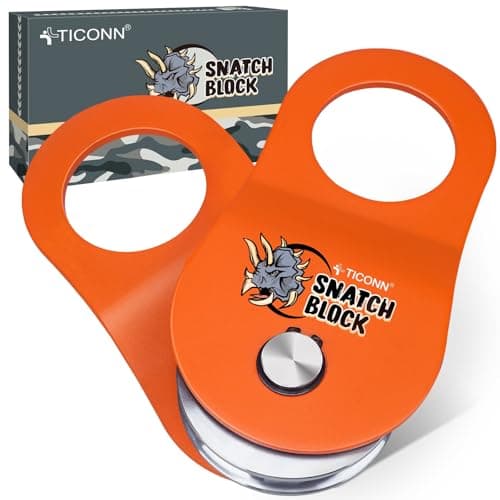
TICONN 10-Ton Snatch Block, 22,000 lb Winch Pulley
10-Ton Snatch Block, 22,000 lb Winch Pulley

The cheapest way to make a winch stronger: run the line through a block and back, and you roughly double pulling force at the cost of half the speed.

Best snatch block
8.5
$26.78Amazon (affiliate link)
05
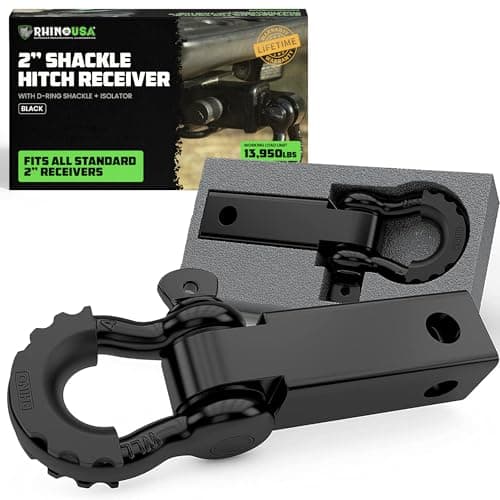
Rhino USA Shackle Hitch Receiver for 2 in Receivers
Shackle Hitch Receiver for 2 in Receivers

The correct answer to 'where do I attach at the back' — a rated shackle mount in the receiver, instead of the tow ball that everybody reaches for and nobody should.

Best rear recovery point
8.5
$47.20Amazon (affiliate link)
06
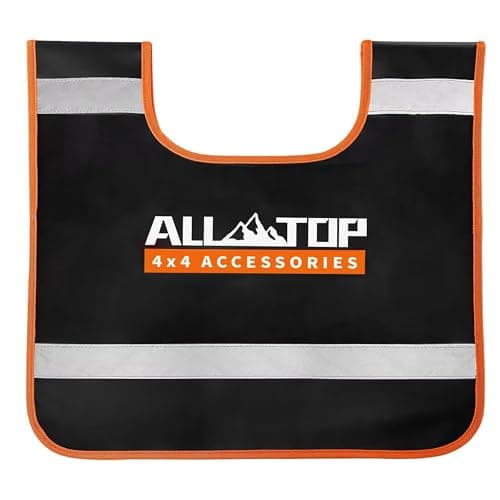
ALL-TOP Winch Cable Damper with Reflective Strip
Winch Cable Damper with Reflective Strip

A weighted blanket over the line so that if something breaks, the energy goes into the ground instead of across the trail. Cheap insurance, rarely bought.

Best line damper
7.8
$36.99Amazon (affiliate link)
07
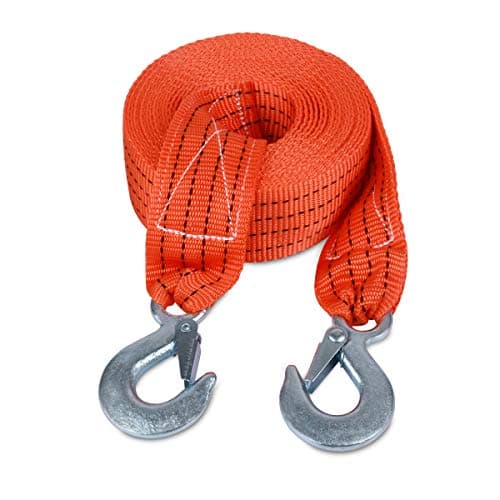
JCHL Tow Strap with Hooks, 2 in x 20 ft, 10,000 lb
Tow Strap with Hooks, 2 in x 20 ft, 10,000 lb

A cheap strap that does its stated job for a flat-ground tow, but the steel hooks sewn into each end are the reason it should not be in a recovery kit.

Skip this one
5.0
$11.39Amazon (affiliate link)

#ad · Live prices from the Amazon Creators API, as of Sep 5, 2026. Where we have no verified live price we show none — a gap beats a number that has rotted.

In detail

The picks, in full

01
Rhino USA Kinetic Rope Recovery Kit, 7/8 in x 30 ft with Soft Shackles

Best overall recovery kit

Kinetic Rope Recovery Kit, 7/8 in x 30 ft with Soft Shackles

7/8 in x 30 ft kinetic ropeSoft shackles includedNylon kinetic constructionStorage bag
8.0/10

Rope plus the shackles to connect it, from a brand that publishes its ratings — which removes the most common way people assemble an unsafe recovery.

Rated strength
9
Safety
9
Versatility
8
Value
6

What's good

  • Buying rope and shackles together stops the classic mistake of a rated rope connected with unrated hardware
  • Kinetic nylon stretches and returns energy, so a rolling recovery does the work instead of a sudden shock load
  • Rhino USA publishes load ratings for its recovery products, which a surprising number of sellers do not

What's not

  • Costs two to three times a budget rope of the same nominal size
  • Kinetic rope has a finite service life — stretch is what wears it out, and it is not always visible
  • 30 feet is short for a deep bog recovery where you cannot get the second vehicle close

Skip it if…

you have no rated recovery points on your vehicle. The rope is not the weak link in that setup; the tow ball or the bumper is, and no rope fixes it.

$179.90See it on Amazon (affiliate link)

Price as of Sep 5, 2026. Prices move — Amazon's is the one that counts.

#ad · we may earn a commission from this link to Kinetic Rope Recovery Kit, 7/8 in x 30 ft with Soft Shackles

02
VEVOR Kinetic Recovery Rope, 7/8 in x 30 ft, 30,580 lb

Best budget kinetic rope

Kinetic Recovery Rope, 7/8 in x 30 ft, 30,580 lb

7/8 in x 30 ft30,580 lb stated strength2 soft shackles, 41,750 lb stated30 percent stated elasticity
7.8/10

A stated 30,580 lb rope with two 41,750 lb soft shackles and a published 30 percent elasticity figure, which is more specification than most budget listings give you.

Rated strength
7
Safety
7
Versatility
8
Value
9

What's good

  • States a breaking strength, an elasticity figure and shackle ratings — three numbers the cheapest listings omit entirely
  • Shackles rated well above the rope, which is the correct way round for a recovery chain
  • Same working format as kits costing three times as much

What's not

  • Stated strength is a manufacturer figure with no third-party certification named
  • 30,580 lb is a lower rating than the premium ropes at the same diameter, which suggests different nylon or construction
  • No published service-life guidance, so you are judging wear by eye

Skip it if…

you are recovering something heavy and often. A rope you use monthly is worth buying from a maker that documents its testing and its retirement criteria.

$54.80See it on Amazon (affiliate link)

$69.9922% off

Price as of Sep 5, 2026. Prices move — Amazon's is the one that counts.

#ad · we may earn a commission from this link to Kinetic Recovery Rope, 7/8 in x 30 ft, 30,580 lb

03
Rhino USA Synthetic Soft Shackle Rope, 3/8 in, 31,400 lb (2-pack)

Best soft shackles

Synthetic Soft Shackle Rope, 3/8 in, 31,400 lb (2-pack)

3/8 in synthetic31,400 lb stated strength2-packSoft shackle format
8.5/10

A stated 31,400 lb synthetic shackle that weighs a few ounces and, critically, does not become a projectile if something in the chain lets go.

Rated strength
9
Safety
10
Versatility
8
Value
7

What's good

  • Synthetic fails by dropping rather than by flying, which is the entire safety argument against steel D-rings
  • Light enough to leave permanently attached to a recovery point without it clanging
  • Fits through recovery points that a steel bow shackle will not clear

What's not

  • Synthetic fibers are damaged by abrasion against sharp edges, so anywhere they pass over metal needs protection
  • UV and grit degrade them over years in a way steel does not
  • Costs more than a pair of steel shackles of a comparable rating

Skip it if…

the shackle will drag across a sharp bumper edge every time. Protect the edge or use steel there — a soft shackle cut halfway through still looks fine.

$39.90See it on Amazon (affiliate link)

Price as of Sep 5, 2026. Prices move — Amazon's is the one that counts.

#ad · we may earn a commission from this link to Synthetic Soft Shackle Rope, 3/8 in, 31,400 lb (2-pack)

04
TICONN 10-Ton Snatch Block, 22,000 lb Winch Pulley

Best snatch block

10-Ton Snatch Block, 22,000 lb Winch Pulley

10-ton rating22,000 lb stated capacityWinch line pulleySide plates open for rigging
8.5/10

The cheapest way to make a winch stronger: run the line through a block and back, and you roughly double pulling force at the cost of half the speed.

Rated strength
9
Safety
8
Versatility
9
Value
8

What's good

  • Nearly doubles effective winch pull without buying a bigger winch
  • Lets you redirect a pull around an obstacle, which is often the difference between a recovery and a stuck vehicle
  • Spreads load across two line legs, reducing strain on the winch rope itself

What's not

  • Heavy, and it is one more thing to store and to keep from rattling
  • Sheave diameter matters for synthetic winch line; a block sized for steel cable will shorten synthetic rope life
  • Doubling the line halves your winching speed, which on a long pull is a real cost

Skip it if…

you do not have a winch. A snatch block does nothing on its own, and recovery boards will get you unstuck more often than a winch will.

$26.78See it on Amazon (affiliate link)

$29.7610% off

Price as of Sep 5, 2026. Prices move — Amazon's is the one that counts.

#ad · we may earn a commission from this link to 10-Ton Snatch Block, 22,000 lb Winch Pulley

05
Rhino USA Shackle Hitch Receiver for 2 in Receivers

Best rear recovery point

Shackle Hitch Receiver for 2 in Receivers

Fits 2 in receiversShackle mount formatSteel constructionPin included
8.5/10

The correct answer to 'where do I attach at the back' — a rated shackle mount in the receiver, instead of the tow ball that everybody reaches for and nobody should.

Rated strength
9
Safety
10
Versatility
7
Value
8

What's good

  • Turns a factory receiver, which is rated and engineered, into a proper rated recovery point
  • Costs a fraction of adding recovery hooks to a bumper and requires no fabrication
  • Removes the single most dangerous habit in vehicle recovery: strapping to a tow ball

What's not

  • Only helps at the end of the vehicle that has a receiver
  • Adds an object to walk into in a dark car park if you leave it fitted
  • The receiver's own tongue-weight and towing ratings still govern; the mount does not upgrade the vehicle

Skip it if…

your vehicle has no receiver hitch. Fit rated recovery points instead — the frame, not the bumper skin.

$47.20See it on Amazon (affiliate link)

Price as of Sep 5, 2026. Prices move — Amazon's is the one that counts.

#ad · we may earn a commission from this link to Shackle Hitch Receiver for 2 in Receivers

06
ALL-TOP Winch Cable Damper with Reflective Strip

Best line damper

Winch Cable Damper with Reflective Strip

Vinyl constructionReflective stripDrapes over line or ropeSingle unit
7.8/10

A weighted blanket over the line so that if something breaks, the energy goes into the ground instead of across the trail. Cheap insurance, rarely bought.

Rated strength
6
Safety
10
Versatility
6
Value
9

What's good

  • Absorbs energy from a failed line, which is the whole point and the reason recovery professionals never work without one
  • Reflective strip makes the line visible to anyone walking past a night recovery
  • Costs less than almost any other item in a recovery kit

What's not

  • Does nothing if you leave it in the truck, which is what most people do
  • Vinyl is less durable than a canvas damper with a weighted pocket
  • One damper covers one line; a double-line pull wants two

Skip it if…

you never recover with a winch or a kinetic rope under load. A static tow on pavement does not need one.

$36.99See it on Amazon (affiliate link)

Price as of Sep 5, 2026. Prices move — Amazon's is the one that counts.

#ad · we may earn a commission from this link to Winch Cable Damper with Reflective Strip

07
JCHL Tow Strap with Hooks, 2 in x 20 ft, 10,000 lb

Skip this one

Tow Strap with Hooks, 2 in x 20 ft, 10,000 lb

2 in x 20 ft10,000 lb stated break strengthSteel hooks both endsPolyester webbing
5.0/10

A cheap strap that does its stated job for a flat-ground tow, but the steel hooks sewn into each end are the reason it should not be in a recovery kit.

Rated strength
4
Safety
3
Versatility
6
Value
7

What's good

  • Genuinely inexpensive and adequate for towing a dead vehicle across a flat surface
  • States a break strength, which some strap listings do not
  • Hooks make it fast to connect where there is a suitable eye

What's not

  • Hooks can slip off under a shifting load and then become a projectile on a stretched strap
  • The hooks' own rating is not stated, so the weakest part of the chain is the undocumented part
  • 10,000 lb break strength gives very little margin once you add the shock load of a stuck vehicle

Skip it if…

you are recovering rather than towing. Buy a strap with sewn loops and connect it with rated shackles — the extra cost is trivial next to what a released hook does.

$11.39See it on Amazon (affiliate link)

$14.9924% off

Price as of Sep 5, 2026. Prices move — Amazon's is the one that counts.

#ad · we may earn a commission from this link to Tow Strap with Hooks, 2 in x 20 ft, 10,000 lb

Building a kit that is actually consistent

Match the rope to the vehicle, not to the biggest number

Kinetic rope diameter should suit the weight of the vehicle being recovered. Over-sizing is not free: a rope too stiff for the vehicle does not stretch properly, and you lose the kinetic effect that makes the technique work — you are back to a dead jerk with a very strong rope.

Rate the connections above the rope

Shackles should be rated comfortably above the rope's stated strength, so the rope remains the designed weak point. That is deliberate: rope failing under load is far more survivable than hardware failing under load.

Recovery boards before a winch, every time

The cheapest recovery in existence needs no second vehicle, no anchor and no training beyond "do not spin the tires". If you are building a kit from nothing, traction boards and a shovel come before rope and long before a winch. That page lives in the overlanding section, and it belongs earlier in your spending than anything here.

Inspect, and retire

Kinetic rope wears out through the thing it is designed to do. Look for glazing, stiffness, cuts and any section that has lost its stretch. Synthetic shackles: look for cut fibers and fuzz at the load-bearing points. There is no hour meter on any of this, which means the inspection is the only control you have.

Rules that do not change

  • Nobody stands in line with a loaded rope, on either side. Nobody.
  • A damper goes on every loaded line, every time.
  • No tow balls, no bumper brackets, no tie-down loops. Rated points only.
  • Recover in the direction the vehicle went in. Reversing the geometry to save time is how things get bent.
  • If the rating is not printed on it, it does not go in the kit.
How these were picked

I haven't handled these. Here's what I did instead.

Everyone in this category says they tested twenty of these. I haven't tested any, and I say so. What I do instead: read the manufacturer's manual and published specification, compile the numbers that decide the purchase, do the arithmetic in the open, check the live price, and name one product to skip. The scores above are judgments from that research against a published rubric — they are not measurements I took, because I do not have a lab and I am not going to pretend otherwise.

Questions

Frequently asked

Can I use a tow ball as a recovery point?
No. A tow ball is designed for a static, downward load. Under a horizontal shock load it can shear and become a projectile. Use frame-mounted rated recovery points or a rated shackle mount in the receiver.
Kinetic rope or snatch strap?
Both work on the same principle — stretch, store energy, return it. Rope generally stretches more, packs smaller and is easier to handle; strap is cheaper. What matters far more is that whichever you use is a stretching product, not a non-stretch tow strap.
Why soft shackles instead of steel D-rings?
Failure mode. Steel becomes a projectile; synthetic drops to the ground. Synthetic is also lighter and fits through recovery points that a bow shackle will not clear. The trade is that synthetic is vulnerable to abrasion and sharp edges.
Does a snatch block really double my winch pull?
Roughly, yes — running the line through a block and back to the vehicle divides the load across two line legs, at the cost of halving winching speed. It also lets you redirect a pull around an obstacle, which is often the more useful capability.
What is the first thing to buy?
Traction boards and a shovel, then a rated recovery point. Rope, shackles and a block come after that. Most stuck vehicles are recovered without a second vehicle ever being involved.

Keep reading

Receipts

Sources

We do not run a testing lab and we do not pretend to. Where a measured number came from a manufacturer's published specification or someone else's lab, we name them and link them. Where we could not verify something, we say so on the page rather than quietly leaving it out. Read the full method.