We earn a commission when you buy through our Amazon links, at no extra cost to you. It never changes the order of the picks, and we say so when the cheaper thing is the better buy. How this works.
Most people buy a fish finder to find fish and end up using it to find structure, which is the more valuable capability by a wide margin. Depth changes, weed edges, drop-offs and hard bottom are what hold fish predictably. Individual fish move; a break line does not.
That is why display style matters so much. Units that render returns as cartoon fish icons are interpreting the sonar for you, and interpreting it badly — suspended debris, thermoclines and weed all get drawn as fish. A raw sonar view looks harder to read for a week and then tells you far more, because you can see the difference between a hard bottom return and a soft one.
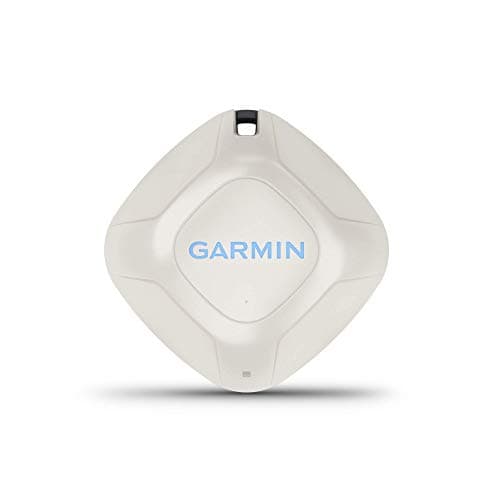
For bank, kayak and ice fishing, castable sonar has quietly become the sensible answer: nothing to mount, nothing to wire, and your phone is the screen.
Where the unit goes decides as much as which unit you buy. If it is going on a paddle platform rather than a boat, our kayak roundup is the page, and for what happens after a good day, the fillet knife page covers the one tool that genuinely changes the job.
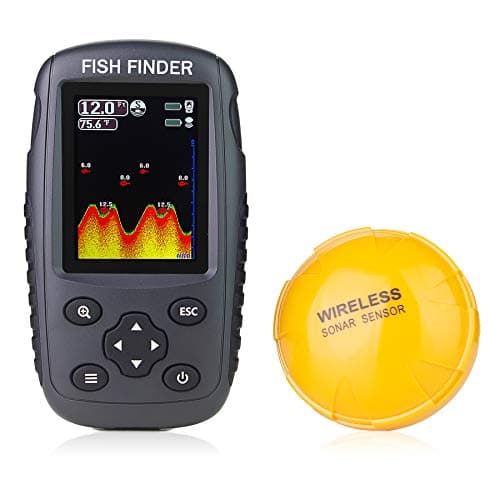
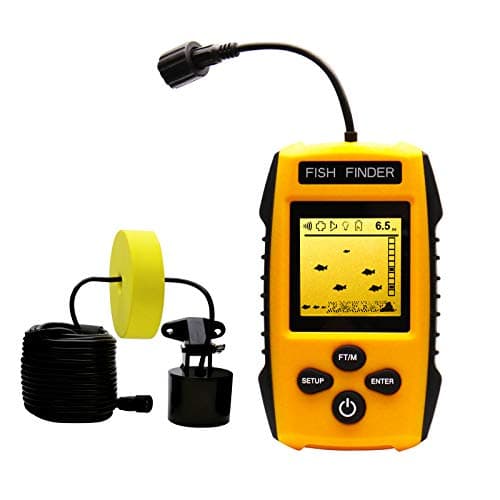
These render everything as cartoon fish icons at estimated depths. That display style hides the raw sonar return, which is the only information that lets you tell a fish from a weed clump — so the device is confidently wrong rather than usefully uncertain.
#ad · Live prices from the Amazon Creators API, as of October 19, 2026. Where we have no verified live price we show none — a gap beats a number that has rotted.
These render everything as cartoon fish icons at estimated depths. That display style hides the raw sonar return, which is the only information that lets you tell a fish from a weed clump — so the device is confidently wrong rather than usefully uncertain.
Sonar clarity
3
Ease of use
7
Battery life
6
Portability
8
Value
5
What's good
+Very cheap
+Gives a depth reading, which is genuinely useful
What's not
−Fish-icon displays are an interpretation layer over the sonar, and a poor one — suspended debris, thermoclines and weed all render as fish
−Raw sonar returns are what let an angler distinguish those, and this hides them
−No named manufacturer and no documented sonar frequency or cone angle
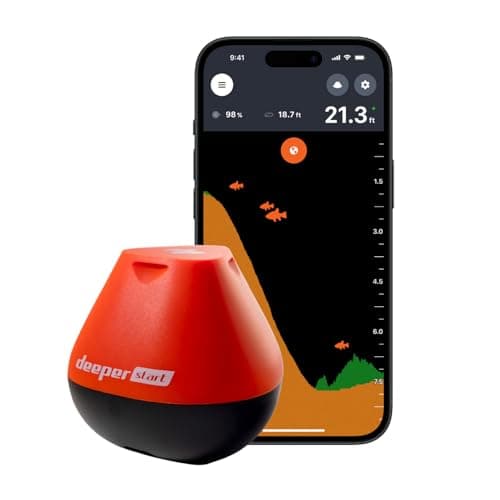
−The Deeper START costs more and gives you an actual sonar image from a company that makes sonar
Skip it if…
…you want to learn to read sonar. Buy something that shows you the return, not a cartoon of it.
A thick, bright bottom return means hard bottom — rock, gravel, hard sand. A thin, weak return means soft bottom — mud, silt. That distinction finds you more fish than any fish icon, because most species relate to hard bottom and to the transitions between the two.
Arches mean fish, and only sometimes
A classic arch forms when a fish passes through the whole sonar cone. If it passes through the edge, or if you are stationary, you get a line or a blob instead. Both are fish. Ignore anyone who says only arches count.
Cone angle changes what you see
A wide cone covers more water with less detail; a narrow cone gives sharper returns over a smaller area. Wide cones are better for searching in shallow water, narrow for detail in deep water. Most castables use a fixed cone, so check it matches your typical depth.
Frequency
Lower frequencies (around 50kHz) penetrate deeper with less detail. Higher frequencies (200 kHz and up) give more detail at shallower depth. For most freshwater fishing, higher is correct.
Castable versus mounted
Castable units are for bank, dock, kayak and ice fishing — no installation, portable between boats, limited by Bluetooth or Wi-Fi range. Mounted units give you a bigger screen, GPS chartplotting and better transducers, and they need a boat and a battery. If you do not own a boat, castable is not a compromise; it is the correct product.
How these were picked
I haven't handled these. Here's what I did instead.
Everyone in this category says they tested twenty of these. I haven't tested any, and I say so. What I do instead: read the manufacturer's manual and published specification, compile the numbers that decide the purchase, do the arithmetic in the open, check the live price, and name one product to skip. The scores above are judgments from that research against a published rubric — they are not measurements I took, because I do not have a lab and I am not going to pretend otherwise.
Questions
Frequently asked
Do castable fish finders actually work?+
Yes, within their limits. They give genuine depth, bottom contour and fish returns from shore, a dock or a kayak. What they cannot do is match a mounted transducer with a large screen and proper chartplotting.
What is the most useful thing a fish finder shows?+
Bottom structure and hardness. Depth changes, weed edges and the transition from hard to soft bottom hold fish predictably, whereas individual fish move. Learning to read the bottom return is worth more than any fish-detection feature.
Are fish icons on a fish finder accurate?+
Not very. Fish-ID modes interpret sonar returns and routinely draw debris, thermoclines and weed as fish. Raw sonar view is harder to read for the first week and considerably more informative after that.
Do I need GPS on a fish finder?+
Only if you fish the same water repeatedly and want to build or reuse maps, or if you need to return to a spot precisely. For casual bank fishing it adds cost for a capability you will not use.
We do not run a testing lab and we do not pretend to. Where a measured number came from a manufacturer's published specification or someone else's lab, we name them and link them. Where we could not verify something, we say so on the page rather than quietly leaving it out. Read the full method.