Vehicle Trauma and First-Aid Kits: Start With the Tourniquet
A first-aid kit and a trauma kit are different objects that do different jobs, and one item in the second one is being counterfeited at scale. That is where this page starts, because getting it wrong is the only mistake here that gets somebody killed.
We earn a commission when you buy through our Amazon links, at no extra cost to you. It never changes the order of the picks, and we say so when the cheaper thing is the better buy. How this works.
There is a med kit in the back of my 4Runner, on the MOLLE panel over the rear quarter glass, where I can see it and reach it with the hatch open. That is the extent of my first-hand claim on this page: I carry one, I have never had to open it in anger, and I am not going to review the contents of a bag as though I have. What follows is research, and it says so, because the alternative on a subject like this one is worse than useless.
The kit in my own truck, on the panel with the hatch open. The mounting is the part of this photograph worth copying — see the 4Runner build for how the panel went in.
Start here: the counterfeit tourniquet problem is real
If you take one thing from this page, take this. Counterfeit C-A-T tourniquets are a documented, industrial-scale problem, and a counterfeit tourniquet is worse than no tourniquet at all.
This is not internet folklore. North American Rescue, who manufacture the C-A-T, have published about counterfeits flooding the market and reaching first responders and medical providers, where they are failing when they are needed. The problem was serious enough that the US International Trade Commission issued a General Exclusion Order, which lets Customs and Border Protection seize imported items resembling C-A-T tourniquets at the border. NAR's own guidance is short and it is the most useful line in the whole subject: genuine C-A-Ts are made in the United States.
Why "worse than nothing" rather than "not as good": a tourniquet is a single-point-of-failure tool used exactly once, under time pressure, on somebody who is bleeding out. A fake that snaps, slips, or whose windlass strips is not a degraded outcome — it is a total one, discovered at the worst possible moment, having consumed the minutes you had. If you knew you had nothing, you would be improvising from the first second instead of the ninetieth.
How to reduce your risk on this one item
Nobody can verify a specific listing for you from a distance, and this page is not going to pretend otherwise or point a finger at a seller we have not investigated. What we can give you is the set of checks that stack the odds:
Buy from the manufacturer's own branded listing. North American Rescue for the C-A-T; TacMed Solutions for the SOF. Both picks below are those listings. A tourniquet sold by an anonymous storefront is not a bargain, it is an unknown.
Price is a signal. A genuine C-A-T costs what a genuine C-A-T costs. A "C-A-T" at a third of that price is telling you something about itself, and the multi-packs at pocket-money prices are telling you loudly.
Read the brand field, not the title. Anyone can put "CAT Gen 7" in a product title. The brand field, the storefront and the packaging are harder to fake convincingly.
Buy the tourniquet separately from the kit. Bundled budget trauma kits advertise "includes CAT tourniquet" constantly, and in most of them the tourniquet has no named manufacturer anywhere in the listing. Buy the kit for its consumables if you like it; buy the tourniquet from the people who make it.
If you cannot tell, do not buy it. An authorized dealer, or North American Rescue and TacMed Solutions directly, will cost you a few dollars more and remove the question entirely.
What we have deliberately not done on this page: we have not linked a single budget or unbranded tourniquet, at any price, and we have not linked the bundled kits whose tourniquet has no named maker — even though several of them are perfectly good value for the dressings inside. Where authenticity cannot be reasonably established from a listing, we do not put a buy button on it. That rule costs this page money and it is the correct rule.
A first-aid kit and a trauma kit are not the same object
This is the confusion the whole category is built on, and clearing it up decides what you buy.
A first-aid kit handles the injuries you will actually have. Cuts, scrapes, blisters, splinters, sunburn, a headache, a bee sting, a rolled ankle. Its contents are adhesive bandages, antiseptic, gauze pads, tape, tweezers and tablets, and it is measured in piece counts because that is a reasonable way to measure adhesive bandages. You will open this kit dozens of times.
A trauma kit — an IFAK, an Individual First Aid Kit — handles the injury that kills somebody in ten minutes. Its contents are a tourniquet, hemostatic or plain gauze for packing, a pressure dressing, chest seals, gloves and shears. It is measured in capability, not pieces. You will very probably never open it, and that is the point.
A 300-piece first-aid kit has no bleeding-control capability at all, no matter what the box says. A compact IFAK has nothing for a blister. Neither is a criticism of either. Most vehicles want one of each, and the honest budget split is that the first-aid kit is cheap and the trauma kit is where the money and the verification go.
What belongs in a vehicle trauma kit
Kit level only — what to carry, not how to use it. The how is a course, and the course is the point of the next section.
A genuine tourniquet, and ideally two. One is a single use on a single limb. Vehicles carry more than one person.
Gauze for packing. Plain compressed gauze at minimum; hemostatic gauze if you have been shown how to pack a wound. This covers the injuries a limb tourniquet cannot reach.
A pressure dressing. An emergency trauma dressing or a 6-inch Israeli bandage — the same tool under two names.
Vented chest seals, in a pair. Penetrating injuries tend to arrive in twos, and budget kits routinely ship one.
Nitrile gloves. The item most often missing when a kit is opened, and nitrile rather than latex because latex allergies are common.
Trauma shears. Everything above is useless while the injury is under a boot and a pair of jeans.
A marker and a light. Time of application written down, and something to see by. Both are free and both get forgotten.
What does not belong in a vehicle trauma kit: anything with a shelf life you will not check, anything requiring a skill you do not have, and a piece count.
A vehicle has one advantage over everything else you might carry this in — it has room and it does not care about weight. Use it. Carry the full-size dressings rather than the pocket versions, and carry two of the consumables you would only carry one of on a belt.
The training note, and it is not a disclaimer
A tourniquet without training is incomplete. Not useless — a bystander with a genuine tourniquet and no training has still saved lives — but incomplete in a way that is cheap and easy to fix.
The fix is Stop the Bleed, run by the American College of Surgeons. Courses are short, they are taught by certified instructors, and by the program's own account more than five million people have completed one across 168 countries. It teaches three basic actions to control severe bleeding. It is the single highest-value thing on this entire page and it is not a product.
If you buy a kit and never take a course, you have bought a comfort object. If you take a course and buy nothing, you are more use at a roadside than most people with a full IFAK. The order matters, and every part of this site's incentive structure points the other way, so it is worth saying plainly.
Practice with consumables you have bought to practice with — gauze is cheap — and never with the sealed items in your carry kit. This page is not going to teach you a technique, because a page cannot, and anybody who tells you otherwise is selling something.
Mounting: the decision that makes the kit work
A trauma kit under a seat, in a drawer, or at the bottom of a duffel is a trauma kit you do not have. This is not a small point — it is most of the value of the whole purchase.
A MOLLE panel and a med kit are a natural pairing, which is why so many vehicle builds end up there. A rigid panel over the rear quarter glass, on a seatback, or on the back of a cargo platform gives you a mounting surface at eye level that is visible the moment the door or hatch is open. That is where mine hangs, and the 4Runner build page shows the panel going in.
Buy a rip-away pouch. The MOLLE base stays on the panel, the kit comes away in your hand. You will be walking away from the vehicle with it.
Mount the tourniquet outside the kit. In its own holder, on the same panel. A tourniquet inside a zipped pouch inside a mounted kit is thirty seconds away; in a holder it is two.
Mount it where a stranger would find it. The person opening your kit may not be you — that is the entire premise of public-access bleeding control kits, and it applies to a vehicle too.
Do not mount it where the sun lives. Heat and UV are what age adhesives and packaging. A rear quarter panel is shaded most of the day; a dashboard is not.
Tell the people who ride with you where it is. Free, takes five seconds, and it is the difference between a kit and a kit somebody can find.
The range crossover, briefly
If you shoot, this is the same kit and the same argument. A tourniquet and pressure dressing belong in the range bag for exactly the reasons they belong in the truck, and they are on the match-day gear checklist for that reason. If you hunt alone, the case is stronger still — see the hunting gear checklist. One kit that moves between the truck, the range bag and the pack is better than three kits you have not inventoried.
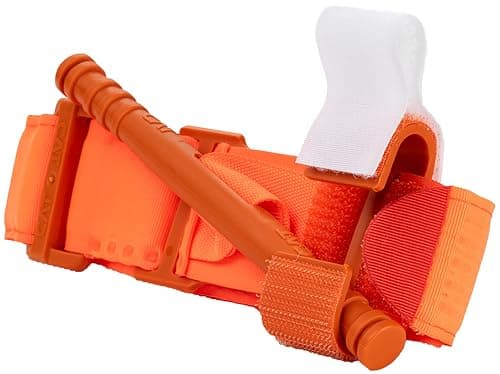
The tourniquet the fakes are copies of, bought from the manufacturer's own listing. On this one item, and only this one, the seller matters as much as the product.
The other tourniquet with a real manufacturer behind it and a real listing to buy it from. Metal windlass, and the current generation of the SOFTT-W lineage.
Built for a vehicle rather than a belt, in a rip-away MOLLE pouch, and the listing names North American Rescue as the tourniquet source rather than leaving it anonymous.
The kit design that hangs in schools and airports, in a single-casualty size. Flat, sealed, and made to be used by whoever finds it rather than by whoever packed it.
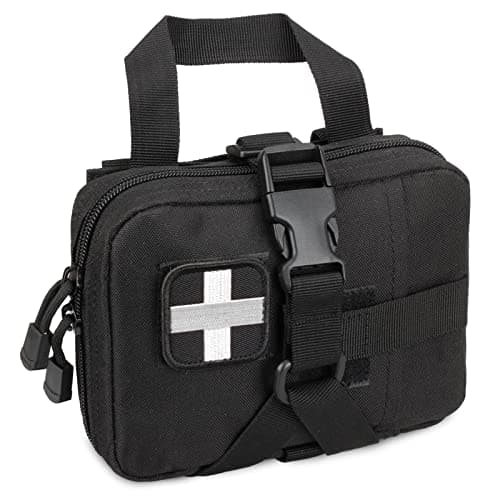
An empty rip-away pouch for people stocking their own. Fifteen dollars is the right amount to spend on the bag when the contents are the expensive part.
Compressed gauze, an emergency trauma dressing, petrolatum gauze, gloves and tape, for the price of a tank of nothing. The cheapest way to upgrade a household kit.
Sold in twos because penetrating injuries usually come in twos. Vented, from the manufacturer, and one of the few kit items with a genuinely standard answer.
Plain sterile compressed gauze, five to a box, so you can restock a kit and still have some to practice with. The least glamorous and most-used thing in the bag.
A sterile dressing with a pressure bar and a built-in closure, in the size that covers most of what a vehicle kit will meet. Simple enough to use correctly on the first try.
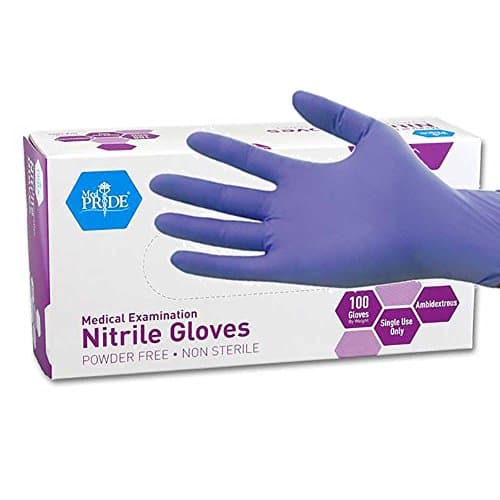
Nine dollars for a hundred pairs, so the four in your kit can be replaced whenever you feel like checking them. Nitrile, because latex allergies are common and consequential.
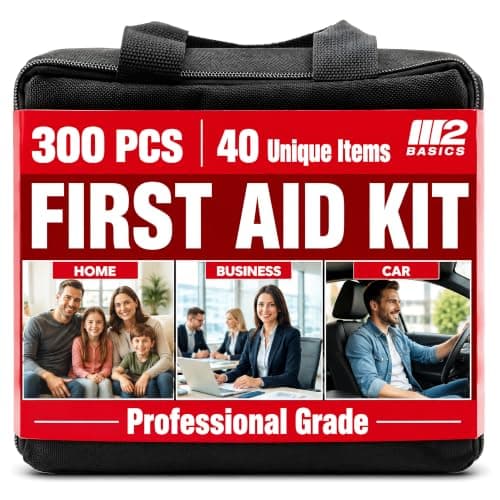
The other half of the answer. Three hundred pieces of the boring things you will actually use — and a clear-eyed reminder that a piece count is not a capability.
#ad · Live prices from the Amazon Creators API, as of October 19, 2026. Where we have no verified live price we show none — a gap beats a number that has rotted.
In detail
The picks, in full
01
Best overall
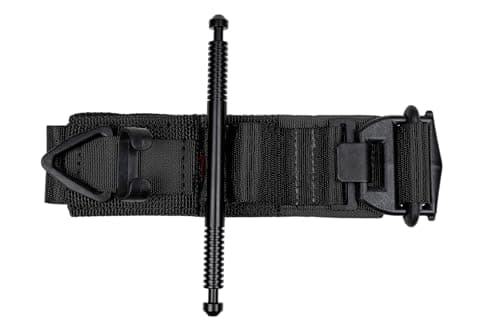
North American Rescue C-A-T Combat Application Tourniquet, Gen 7
C-A-T Gen 7Windlass tourniquetOne-handed applicationMade in the USA
8.8/10
The tourniquet the fakes are copies of, bought from the manufacturer's own listing. On this one item, and only this one, the seller matters as much as the product.
Authenticity confidence
10
Ease of application
8
Build quality
9
Training availability
10
Value
7
What's good
+North American Rescue is the manufacturer, so this is the listing to buy from rather than a reseller's
+The C-A-T is the pattern most training courses teach on, which matters more than any feature
+Single-routing buckle on the Gen 7 is the version currently in service
+Genuine C-A-Ts are made in the United States — a counterfeit is by definition an import
What's not
−Costs three to five times what the fakes on the same search page do, and that gap is the whole problem
−A windlass tourniquet is not intuitive; without training you will apply it slowly and possibly badly
Skip it if…
…you are not going to take a bleeding-control course. That is not a sales line — an untrained tourniquet is the least useful expensive thing you can put in a vehicle.
Price as of October 19, 2026. Prices move — Amazon's is the one that counts.
#ad · we may earn a commission from this link to North American Rescue C-A-T Combat Application Tourniquet, Gen 7
02
Best alternative
TacMed Solutions SOF Tourniquet (Generation 5)
SOF Tourniquet Gen 5Metal windlassBuckle routingTacMed Solutions
8.0/10
The other tourniquet with a real manufacturer behind it and a real listing to buy it from. Metal windlass, and the current generation of the SOFTT-W lineage.
Authenticity confidence
9
Ease of application
8
Build quality
9
Training availability
6
Value
8
What's good
+Sold under the manufacturer's own name, which is the authenticity test that matters
+Metal windlass rather than reinforced polymer, which some people prefer on principle
+Wide band spreads pressure, and the current generation is the one in service
+Genuine competition for the C-A-T rather than a copy of it
What's not
−Fewer courses teach on it than on the C-A-T, so your training may not match your kit
−Routing differs from the C-A-T — carrying one of each is a way to be slow with both
Skip it if…
…your course taught the C-A-T. Carry what you trained on. Mixing patterns in one kit is a genuinely bad idea under stress.
MOLLE-compatibleIncludes a C-A-T tourniquetHyFin Vent chest sealsGauze and emergency trauma dressing
8.4/10
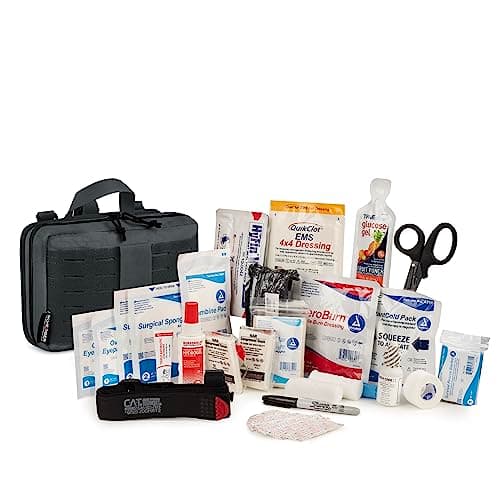
A stocked trauma kit from the company that makes the tourniquet inside it. That is the shortest path to a kit whose contents you do not have to audit.
Contents quality
10
Authenticity confidence
10
Mounting
8
Completeness
8
Value
6
What's good
+The tourniquet is a genuine C-A-T because the manufacturer assembled the kit
+Contents are the standard bleeding-control set rather than a padded piece count
+MOLLE backing mounts straight to a vehicle panel, a seatback or a pack
+One purchase instead of assembling the same thing from eight listings
What's not
−Costs more than three budget kits that appear to contain the same list
−Compact by design — it is one person's trauma kit, not a family first-aid kit
−Nothing in it treats a headache, a splinter or a burn
Skip it if…
…what you actually want is a first-aid kit. This kit does not do bandaids, and a household kit does not do bleeding control. Most vehicles need one of each.
90+ itemsRip-away MOLLE pouchListing states an NAR tourniquetIncludes a CPR mask
8.2/10
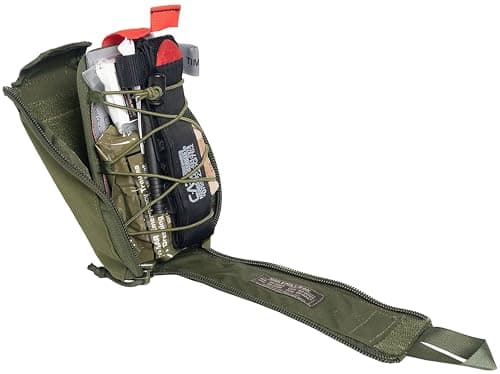
Built for a vehicle rather than a belt, in a rip-away MOLLE pouch, and the listing names North American Rescue as the tourniquet source rather than leaving it anonymous.
Contents quality
8
Authenticity confidence
8
Mounting
9
Completeness
9
Value
7
What's good
+Rip-away backing means the pouch stays mounted and the kit leaves with you
+Broader contents than a pure bleeding-control kit, which suits a vehicle better than a duty belt
+The listing names the tourniquet's maker — the specification to look for in any bundled kit
+Sized to hang on a cargo panel rather than fill a drawer
What's not
−More expensive than assembling the consumables yourself, which is what you pay for convenience
−A kit this size takes a real inventory pass before you can say you know what is in it
Skip it if…
…the listing you land on has changed its contents. Bundled kits get re-specced quietly. Read the current contents list and confirm the tourniquet is still named before you order.
Price as of October 19, 2026. Prices move — Amazon's is the one that counts.
#ad · we may earn a commission from this link to Scherber Vehicle IFAK Trauma Kit (Intermediate)
05
Best glovebox kit
North American Rescue Public Access Individual Bleeding Control Kit
Single-casualty bleeding controlPublic-access designVacuum-sealed contentsNorth American Rescue assembled
7.6/10
The kit design that hangs in schools and airports, in a single-casualty size. Flat, sealed, and made to be used by whoever finds it rather than by whoever packed it.
Contents quality
9
Authenticity confidence
10
Mounting
5
Completeness
7
Value
7
What's good
+Sealed packaging means the contents are still sterile and still there in three years
+Designed to be opened by a stranger under stress, which is the honest use case for a vehicle kit
+Flat enough for a glovebox or a seatback pocket
+Same manufacturer as the tourniquet inside it
What's not
−Opening it to inspect it defeats the sealed packaging
−One casualty only
−No first-aid consumables at all — this is bleeding control and nothing else
Skip it if…
…you want a kit you will open and repack regularly. Sealed kits reward being left alone; if you like to know your kit by feel, buy a pouch and stock it yourself.
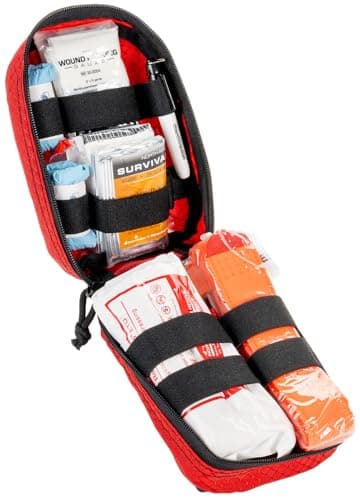
An empty rip-away pouch for people stocking their own. Fifteen dollars is the right amount to spend on the bag when the contents are the expensive part.
Mounting
9
Organization
8
Build quality
6
Value
9
What's good
+Rip-away backing is the specification that matters on a vehicle panel — the base stays, the kit goes
+Elastic loops inside mean the contents stay where you put them instead of pooling in the bottom
+Cheap enough to buy two and put one in each vehicle
+Stocking it yourself is how you learn what is in it
What's not
−Empty — everything inside is a separate purchase, and it adds up past the price of a stocked kit
−Budget hardware; the hook-and-loop backing will loosen with repeated pulls
Skip it if…
…you would rather buy a kit and be done. A self-stocked pouch is better for people who will maintain it and worse for everyone else.
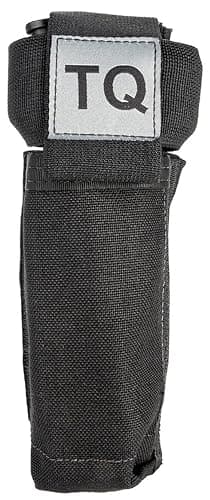
North American Rescue C-A-T Tourniquet Holder (Black)
Fits C-A-T Gen 6 and Gen 7MOLLE connectorsBelt compatibleOpen-top
8.0/10
A tourniquet inside a zipped kit is thirty seconds away. In its own holder on the panel it is two. That difference is the entire argument for this.
Access speed
9
Mounting
9
Build quality
8
Value
6
What's good
+Puts the one time-critical item where it can be reached without opening anything
+MOLLE connectors mount it beside the kit on the same panel
+Made by the tourniquet's manufacturer, so the fit is not a guess
+Keeps the tourniquet out of the light and the dust, which matters over years
What's not
−Costs almost as much as the tourniquet it holds
−Only fits the C-A-T — a SOF tourniquet needs its own holder
Skip it if…
…the kit itself is already mounted somewhere you can reach in seconds. This solves an access problem; if you do not have that problem, it is thirty dollars of nylon.
Price as of October 19, 2026. Prices move — Amazon's is the one that counts.
#ad · we may earn a commission from this link to North American Rescue C-A-T Tourniquet Holder (Black)
08
Best minimal add-on
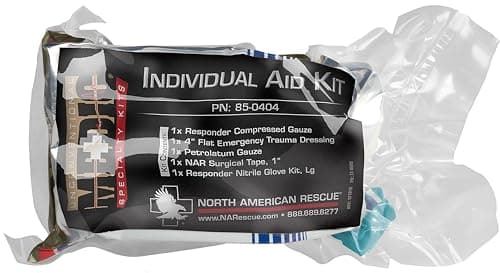
North American Rescue Individual Aid Kit (compact)
Compressed gauzeEmergency trauma dressingPetrolatum gauzeGloves and surgical tape
7.8/10
Compressed gauze, an emergency trauma dressing, petrolatum gauze, gloves and tape, for the price of a tank of nothing. The cheapest way to upgrade a household kit.
Contents quality
8
Completeness
5
Size
9
Value
9
What's good
+Turns a boo-boo kit into something that can handle a real laceration
+NAR-assembled contents at a price that makes buying two easy
+Small enough to drop into a glovebox, a pack or a range bag
+No tourniquet in it, so nothing to verify
What's not
−No tourniquet, no chest seal — this supplements a trauma kit rather than replacing one
−Stock on this listing is intermittent
Skip it if…
…you were expecting bleeding-control capability. This is dressings and gloves; the tourniquet is a separate, deliberate purchase.
Price as of October 19, 2026. Prices move — Amazon's is the one that counts.
#ad · we may earn a commission from this link to North American Rescue Individual Aid Kit (compact)
09
Best chest seals
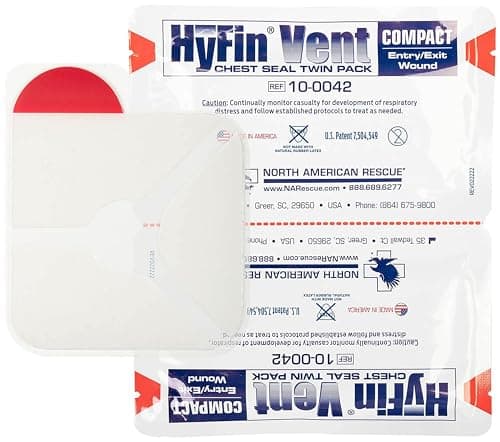
North American Rescue HyFin Vent Chest Seal (Twin Pack)
VentedTwin packAggressive adhesiveNorth American Rescue
8.3/10
Sold in twos because penetrating injuries usually come in twos. Vented, from the manufacturer, and one of the few kit items with a genuinely standard answer.
Contents quality
9
Authenticity confidence
10
Shelf life
6
Value
8
What's good
+A twin pack is the correct quantity and cheap kits routinely ship one
+Vented is the current standard for this item
+Adhesive designed for skin that is not clean and dry, which is the only skin you will meet
+Manufacturer listing, same as the tourniquets
What's not
−Has a shelf life — the adhesive is what expires, and it does
−Requires training to use correctly, like everything else in a trauma kit
Skip it if…
…your kit already includes vented seals from a named maker. Duplicating them is money that would be better spent on a course.
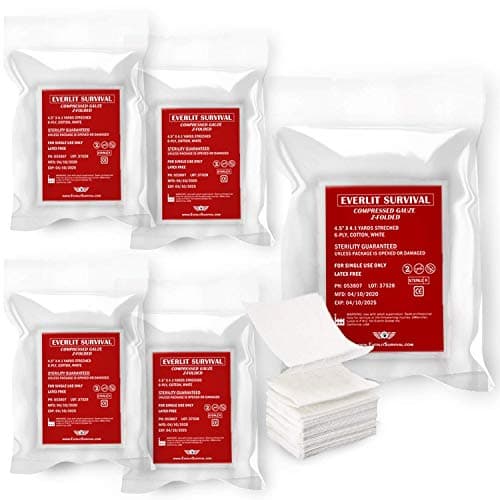
Plain sterile compressed gauze, five to a box, so you can restock a kit and still have some to practice with. The least glamorous and most-used thing in the bag.
Contents quality
7
Packaging
8
Quantity
9
Value
9
What's good
+Cheap enough to open one and learn what packing a wound actually feels like
+Z-fold is the format that comes out of the packet in a usable strip
+Compressed packaging takes a fraction of the space of rolled gauze
+No active ingredient means no shelf-life anxiety beyond sterility
What's not
−No hemostatic agent — this is volume, not chemistry
−Budget packaging; check the seals when they arrive
Skip it if…
…you are stocking a kit you will never train with. Gauze is the training consumable; if you are not going to practice, spend the money on the course instead.
Price as of October 19, 2026. Prices move — Amazon's is the one that counts.
#ad · we may earn a commission from this link to Everlit Z-Folded Compressed Sterile Gauze (5 Pack)
12
Best pressure dressing
Israeli Compression Bandage, 6 in
6 in widthIntegrated pressure barSterileSelf-closing bandage
8.3/10
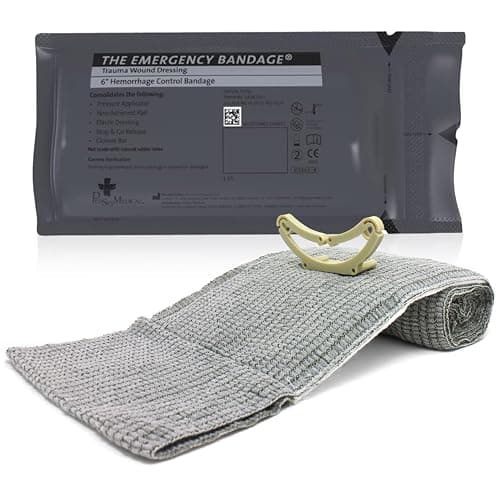
A sterile dressing with a pressure bar and a built-in closure, in the size that covers most of what a vehicle kit will meet. Simple enough to use correctly on the first try.
Ease of use
9
Contents quality
7
Size choice
8
Value
9
What's good
+The one trauma item that is close to self-explanatory under stress
+Applies pressure and dresses the wound in a single wrap
+6 inches suits a limb or a torso — the 4-inch is the one people regret buying
+Cheap enough to carry two
What's not
−Generic listing rather than a named manufacturer, which is acceptable here and is not on a tourniquet
−Sterile packaging means one use — no practicing with your carry stock
Skip it if…
…your kit already contains an emergency trauma dressing. This is the same tool under a different name.
MedPride Powder-Free Nitrile Exam Gloves (Box of 100)
NitrilePowder-free100 per boxExam grade
8.8/10
Nine dollars for a hundred pairs, so the four in your kit can be replaced whenever you feel like checking them. Nitrile, because latex allergies are common and consequential.
Material
9
Quantity
10
Durability
6
Value
10
What's good
+Nitrile avoids the latex allergy problem entirely, in the responder and the patient
+A box at home means the pairs in the kit get rotated instead of perishing in place
+Powder-free is the correct specification and costs nothing extra
+Gloves are the item most likely to be missing when the kit is opened
What's not
−Gloves in a hot vehicle degrade — check and replace the kit pairs annually
−Sizing runs small; a glove you cannot get on quickly is a glove you will skip
Skip it if…
…you need them for chemical handling. Exam gloves are a barrier for blood, not a rating for solvents.
Price as of October 19, 2026. Prices move — Amazon's is the one that counts.
#ad · we may earn a commission from this link to MedPride Powder-Free Nitrile Exam Gloves (Box of 100)
15
Best everyday first-aid kit
M2 BASICS 300-Piece First Aid Kit
300 piecesSoft caseAdhesive bandages and dressingsAntiseptic wipes
6.3/10
The other half of the answer. Three hundred pieces of the boring things you will actually use — and a clear-eyed reminder that a piece count is not a capability.
Everyday coverage
8
Trauma capability
1
Packaging
7
Value
9
What's good
+Covers the injuries a vehicle kit actually sees: cuts, blisters, burns, splinters, headaches
+Cheap, so it can live in the truck permanently and be raided without guilt
+Soft case squashes into the space a hard case will not
+No tourniquet in it, which is a feature — nothing here needs verifying
What's not
−The piece count is mostly adhesive bandages, as it always is
−Nothing in it addresses serious bleeding, and it does not pretend to
Skip it if…
…you think a 300-piece count means trauma capability. It does not, and reading a piece count that way is the single most common mistake in this category.
The course, first. Stop the Bleed costs a couple of hours. Nothing below outperforms it.
A genuine tourniquet, from the manufacturer's listing. Two if the vehicle carries passengers.
A holder for it, mounted where you can reach it. Access is the capability.
Gauze, a pressure dressing, chest seals, gloves and shears. Either as a stocked kit from a manufacturer, or bought individually into a rip-away pouch.
A separate, cheap first-aid kit. This is the one you will actually open, and it should not be the same bag.
Stocked kit or self-assembled?
Buy a stocked kit from a manufacturer if you want the contents verified for you and you are not going to maintain it item by item. The trade is money: assembling the same list costs less and takes an evening.
Assemble your own if you will actually maintain it, because stocking a pouch yourself is how you learn what is in it and where. A kit you packed is a kit you can work in the dark; a kit that arrived sealed is a kit you will be reading labels in.
The one thing that does not change either way: the tourniquet comes from the manufacturer, separately, whatever else you do.
Expiry, heat and the annual check
A vehicle is a hostile place to store medical supplies. Summer heat and UV degrade adhesives, which is what chest seals and dressings depend on, and sterile packaging fails quietly rather than visibly.
Pick a date you will remember — the same day you check the smoke alarms is a good one — and go through the kit once a year. Replace anything past its date, replace the gloves regardless because they perish faster than anything else in there, and put the kit back where it lives. Ten minutes a year.
What we will not link, and why
There are budget trauma kits on Amazon right now, at attractive prices, advertising a "CAT Gen 7" tourniquet with no manufacturer named anywhere in the listing. Some of those kits contain perfectly serviceable gauze and dressings and are decent value for them.
We are not linking them, and the reason is narrow and specific: we cannot establish the provenance of the tourniquet inside them from the listing, this is the one item where that matters absolutely, and putting a buy button on it would be us monetizing a risk we have just spent a thousand words describing. We are not saying any particular kit contains a counterfeit — we have tested nothing and we are not accusing anyone. We are saying we cannot tell, and that on this item, not being able to tell is a good enough reason to walk away.
How these were picked
I haven't handled these. Here's what I did instead.
Everyone in this category says they tested twenty of these. I haven't tested any, and I say so. What I do instead: read the manufacturer's manual and published specification, compile the numbers that decide the purchase, do the arithmetic in the open, check the live price, and name one product to skip. The scores above are judgments from that research against a published rubric — they are not measurements I took, because I do not have a lab and I am not going to pretend otherwise.
Questions
Frequently asked
Is the counterfeit tourniquet thing actually a real problem?+
Yes, and it is documented rather than rumored. North American Rescue, who make the C-A-T, have published about counterfeits reaching first responders and failing in use, and the US International Trade Commission issued a General Exclusion Order that lets Customs seize imported items resembling C-A-T tourniquets. NAR's clearest guidance is that genuine C-A-Ts are made in the United States.
How do I know a tourniquet listing is genuine?+
You cannot be certain from a listing alone, and anybody who tells you they can is guessing. What you can do: buy from the manufacturer's own branded listing, treat a low price as a warning rather than a win, check the brand field rather than the title, and never accept a tourniquet bundled into a budget kit as your verified one. If you want certainty, buy direct from North American Rescue or TacMed Solutions, or from an authorized dealer.
What is the difference between a first-aid kit and an IFAK?+
A first-aid kit handles the injuries you will actually get — cuts, blisters, splinters, headaches — and is measured in piece counts. An IFAK or trauma kit handles the injury that kills somebody in ten minutes, and holds a tourniquet, gauze for packing, a pressure dressing, chest seals, gloves and shears. A 300-piece first-aid kit has zero bleeding-control capability. Most vehicles want one of each.
Do I really need training, or can I just carry it?+
Carry it either way — a genuine tourniquet in untrained hands has still saved lives. But it is incomplete without training, and the fix is cheap: a Stop the Bleed course from the American College of Surgeons is a couple of hours and teaches three basic actions to control severe bleeding. If you have to choose between the course and the kit, take the course.
Where should the kit go in the vehicle?+
Somewhere visible and reachable the moment a door or hatch is open — not in a drawer, not under a seat, not at the bottom of a duffel. A MOLLE panel is the natural mount, in a rip-away pouch so the base stays and the kit leaves with you, with the tourniquet in its own holder outside the pouch. Keep it out of direct sun; heat and UV are what age the adhesives.
Is one tourniquet enough?+
For one person, on one limb, once. A vehicle usually carries more than one person, and a tourniquet is a single-use item in an emergency. Two is the sensible number in a vehicle kit, and it is the cheapest capability upgrade on this page.
We do not run a testing lab and we do not pretend to. Where a measured number came from a manufacturer's published specification or someone else's lab, we name them and link them. Where we could not verify something, we say so on the page rather than quietly leaving it out. Read the full method.