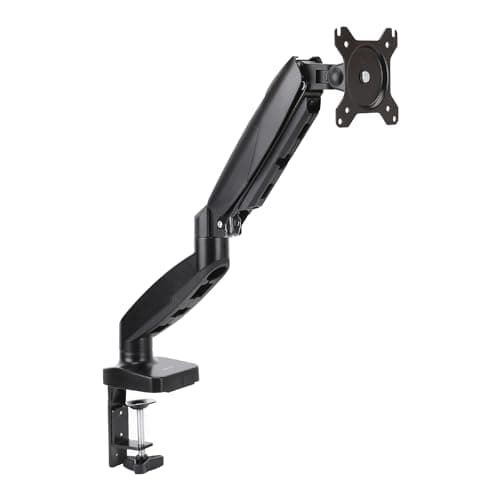
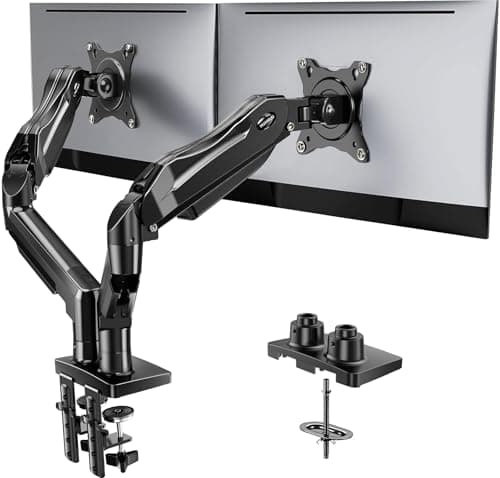
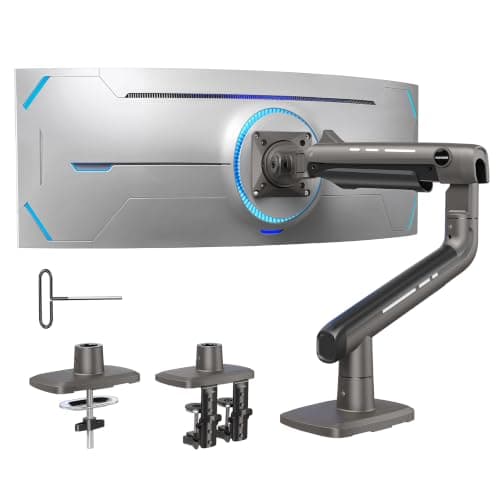
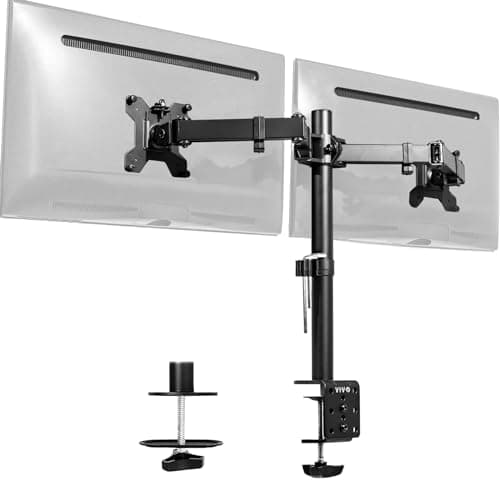
A monitor arm is the rare desk purchase where the specification does all the work. Get the weight range and the mounting right and almost any arm in this list is fine. Get either wrong and the best arm on the market sags, drifts, or does not fit your desk at all.
Four checks, in order, before price enters the conversation.
1. Does your monitor have VESA holes?
A great many consumer monitors do not. The pattern is a square of four threaded holes on the back, typically 75 by 75 or 100 by 100 millimeters. If your monitor has none, an arm is not a purchase you can make without an adapter bracket, and adapters add their own weight and their own compromises.
2. Is your monitor inside the arm's stated weight range?
This is the number people read as a maximum when it is a range. An arm rated 4.4 to 19.8 pounds has a minimum for a reason: a gas spring set for a heavier load will push a light monitor upward and it will drift up on its own. Too heavy and it sags, and sag is the early symptom of a mount that eventually lets go.
Weigh the monitor without its stand. Manufacturer figures usually include the stand, which is often a third of the total.
3. Can your desk take the mount?
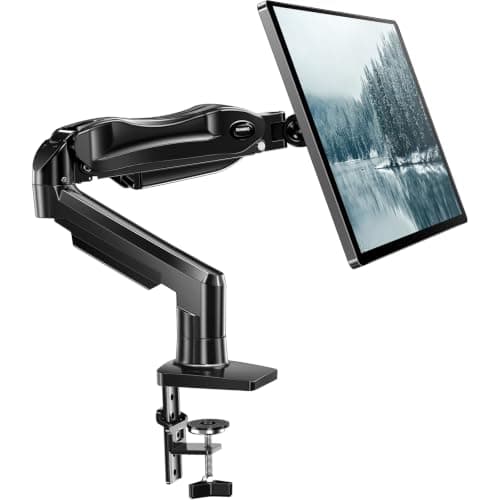
Two options on most arms. A C-clamp grips the desk edge and needs clear access underneath — a cable tray or a drawer in the wrong place rules it out. A grommet mount goes through a hole in the desk, which is stronger and requires either an existing hole or a willingness to drill one.
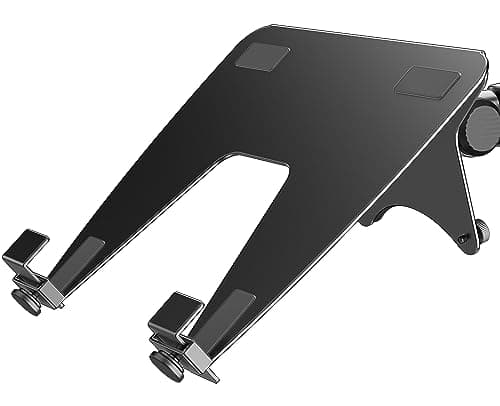
Both concentrate a great deal of leverage at one point. A thin, hollow-core or glass desk is a genuine constraint, and it is the reason the last product on this list exists at all.
4. Gas spring or mechanical?
A gas spring arm moves with one hand and stays where you put it — buy this if you have a standing desk or share the workstation. A mechanical arm holds position indefinitely with no pressure to lose, but you loosen a knob to move it. Mechanical is cheaper, and if the monitor is set once and never touched, that is a perfectly rational purchase.
What an arm is actually for
Two things, and it is worth being honest about which one you want. The ergonomic one: getting the top of the screen roughly at eye level, at arm's length, which a factory stand often cannot reach. And the practical one: recovering the desk area the stand's base was occupying, which on a small desk is a real amount of usable space.
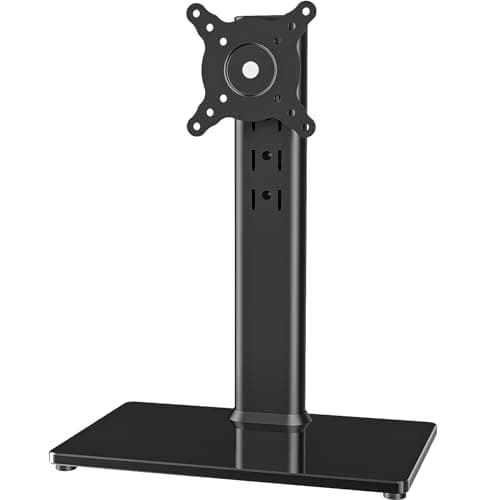
That second reason is why a free-standing weighted stand sits at the bottom of this list. It is a fine object. It just gives the desk space straight back.
Choosing between single, dual and heavy-duty
Single arm
The default, and the right answer for one monitor up to about 32 inches. Two independent single arms on separate clamps are often better than one dual arm, because the load is spread across two points on the desk instead of concentrated at one.
Dual arm
One base, two screens, one hole in the desk. Cleaner, and it is the correct choice if desk edge space is tight. Be honest about the load: two monitors on a single clamp is a lot of leverage, and a thin desk will flex visibly before anything fails.
Heavy-duty and ultrawide
Past about 34 inches, the ordinary arms run out. A 38 or 49 inch panel needs both the stated capacity and the structural stiffness, and this is where the aluminum arms with dual clamps justify their price. Under-specifying here does not fail immediately — it sags over weeks, which is worse, because you stop noticing.
Setting it up so it stays right
- Set the tension with the monitor mounted. Every gas spring arm needs adjusting to the actual load. Out of the box it is set for something else.
- Top of the screen roughly at eye level, tilted back a few degrees, at about arm's length. Then adjust from there — that is a starting point, not a rule.
- Route the cables through the arm's channels while it is unloaded. Doing it afterwards means unmounting the monitor, and you will not bother.
- Re-check the clamp after a week. Clamps settle into a desk surface, and a quarter turn at day seven prevents a slow lean.
- Leave slack for full travel. A cable that is exactly long enough at the current height is a cable that unplugs itself the first time you stand up.