Section 06 · Shooting Gear
What Makes a Good 3-Gun Shotgun
The shotgun is where matches are won and lost, and almost all of it happens at the loading port rather than at the muzzle. Editorial only — there is nothing for sale on this page.
We earn a commission when you buy through our Amazon links, at no extra cost to you. It never changes the order of the picks, and we say so when the cheaper thing is the better buy. How this works.
If you want to know where a 3-Gun match is actually decided, stand behind the shotgun stage and watch people load. The shooting takes a couple of seconds. The loading takes longer than that, several times over, and the gap between a competent loader and a novice is enormous — far bigger than the gap between their rifles, their optics or their pistols.
There is nothing to buy on this page. This site does not link, price or recommend firearms, receivers, barrels, triggers or magazines anywhere, and that is not going to change for a page about competition guns. Amazon does not sell them. Buy the gun from a dealer, in person, with your hands on it first. The accessories it needs are ranked on the gear pages linked throughout, and those are the only things here anyone is paid for.
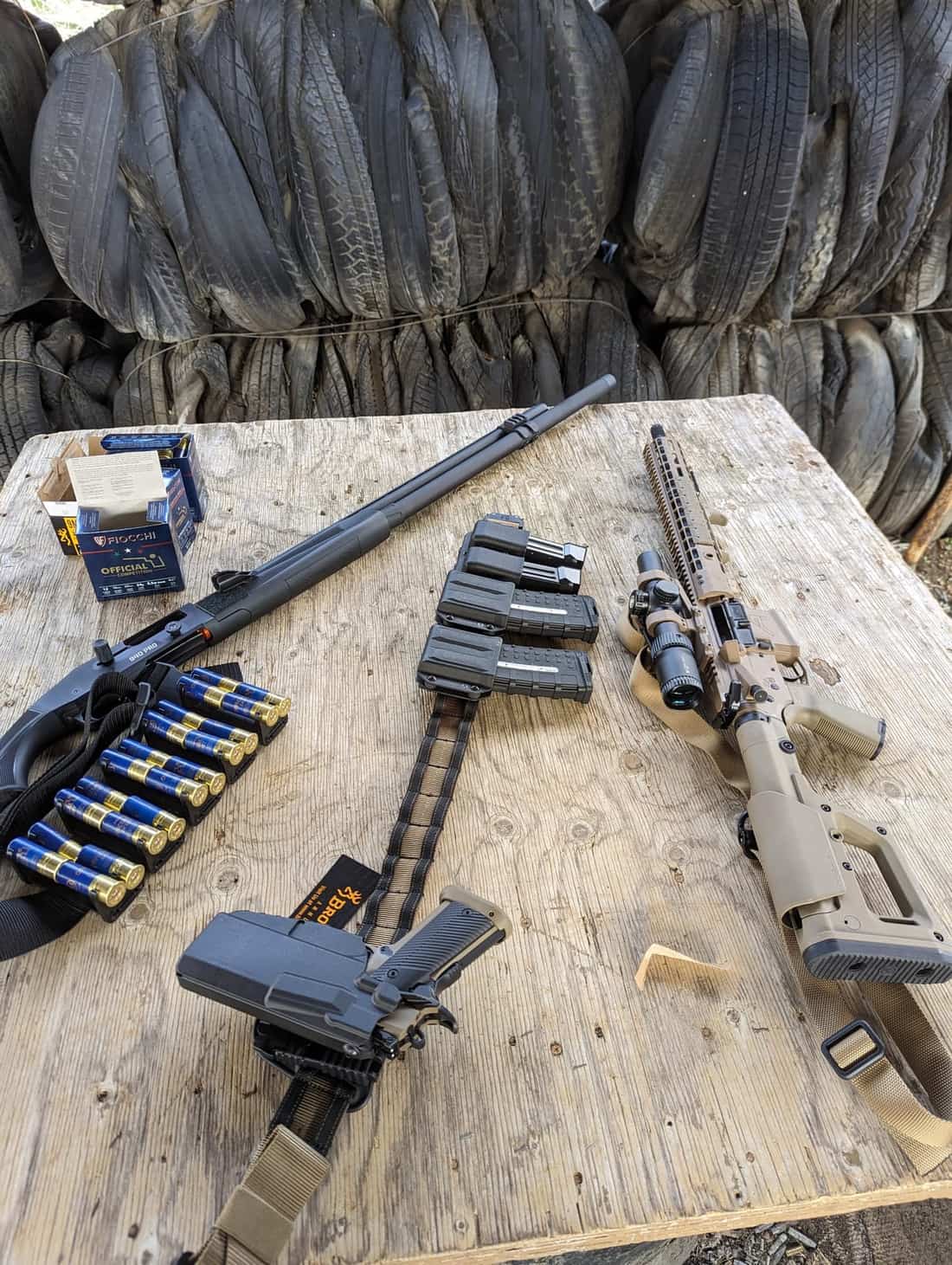
Why semi-autos dominate
A pump gun will get you round a club match, and if that is what you own, shoot it. But every serious 3-Gun shotgun is a semi-auto, for two reasons that compound each other.
The first is obvious: the gun cycles itself, so your support hand is free the instant the shot breaks. On a stage where you are firing, moving and loading in an overlapping rhythm, not having to work an action is worth a lot.
The second is less obvious and matters more: you can load a semi-auto while you are doing something else. Competitive shotgun technique is essentially the art of never having an empty gun and never standing still to fix that. The gun feeding itself is what makes that possible.
Loading-port work, explained
"Loading port work" is the phrase you will hear constantly, and it means exactly what it says: modifying the area around the shotgun's loading port so that shells go in faster and your thumb survives the day. It is the single most common modification to a 3-Gun shotgun and it typically covers three things.
- Opening or beveling the port. The factory loading port on most shotguns is sized for someone calmly loading two shells for birds. Competition loading pushes four shells at speed, at an angle, without looking. A wider, chamfered port gives your hand somewhere to go.
- Removing the sharp edges. The factory port edge will shred the pad of your loading thumb over a match day. This is not a comfort issue by stage five, it is a bleeding issue, and people wrap their thumbs in tape because of it.
- The shell lifter and follower. Competition lifters give you a smoother ramp into the magazine tube, and a high-visibility follower lets you and the RO see the gun's state at a glance.
This is gunsmithing. It is metal removal on a firearm, and while plenty of people do it themselves, the failure mode of getting it wrong is a shotgun that does not feed reliably — the exact opposite of the goal. If you are not confident, this is money well spent at a smith who does them regularly. Either way it is not something this site links a part for, because the part is a firearm component.
The other half of the loading equation is entirely accessory, entirely Amazon-listable, and covered properly on the shell caddies and quad loaders page — including the load-two versus load-four technique question, which you should settle before you buy any caddy at all.
The three tiers people actually shoot
The Benelli M2 tier
The Benelli M2 is the reference point for competition shotguns and has been for a long time. It runs an inertia-driven action rather than a gas system, which means fewer parts in the gas path to foul and a gun that stays running when it is filthy. It is also light, which people either love or find snappy.
It is expensive, and the competition-configured variants are more expensive again. The aftermarket around it is the deepest in the sport, which is a real ownership advantage — whatever you want done to it, somebody makes the part and somebody has done it a hundred times. Specifications by variant are on Benelli's own site, and that is the only place I would trust them from.
The Beretta 1301 tier
The 1301 Competition is the other gun you will see everywhere, and it is gas-operated rather than inertia. That gives it noticeably softer felt recoil than an inertia gun of similar weight — the gas system spreads the impulse out — at the cost of a gas system that needs cleaning. Beretta's marketing has long emphasized cycling speed on this platform.
Gas versus inertia is the genuine fork in this decision, and it is a preference rather than a hierarchy. Softer recoil and more maintenance, or harder recoil and less. Shoot both if you can. Current specifications live at Beretta USA.
The budget tier — Stoeger M3K and friends
The Stoeger M3K is the honest budget answer, and the reason it works is not a coincidence: Stoeger is part of the same group as Benelli and the M3K runs an inertia system of the same family. You are getting the operating principle of the expensive gun without the expensive gun, and giving up fit, finish, trigger and some of the factory refinement to get there. It is a very common first competition shotgun and it is a genuinely defensible purchase rather than a compromise you will regret. Specifications are at Stoeger Industries.
I run a Mossberg 940 Pro, which sits in the same practical conversation — a gas-operated semi-auto sold in competition-oriented configurations at a price well under the Benelli/Beretta tier. Their published specifications are at Mossberg.
What I am deliberately not doing is publishing weights, capacities, barrel lengths or prices for any of these from memory. They vary by variant and model year, they are the numbers most often quoted wrongly on affiliate pages, and every manufacturer above publishes them. Go and read the actual product page for the actual variant.
Buy it from a dealer, and handle it first
More than with a rifle or a pistol, shotgun fit is personal. Length of pull, comb height and how the gun points for you determine whether you can shoot it fast, and none of that comes across in a specification table. Go to a shop. Mount it. Mount the other one. Buy the one that comes up on target without you correcting it.
Two things that go on the gun rather than being the gun. The optic: red dots for shotguns ranks dots on shotgun criteria instead of rifle ones. And the thing that moves all of it around a match — the match cart and how to stage gear, which matters more on shotgun-heavy stages than anywhere else.
Questions
Frequently asked
Gas or inertia?
Do I need loading-port work to be competitive?
Is a pump gun a non-starter?
Why is there no price comparison on this page?
Keep reading
Related
- Shell caddies & quad loadersThe monetized half of the shotgun problem — plus load-two versus load-four.
- 3-Gun & tactical games: getting startedDivisions, costs and how to find your first match.
- Best gun cleaning kitsGas guns need this more than inertia guns do. Ranked, with live prices.
- Eye & ear protection for competitionMuff profile matters most on the shotgun stage, where the stock meets the cup.
Receipts
Sources
- USPSA — Rifle, Shotgun and Multigun Rules, 2026-03 edition (digital rulebook)
- Benelli USA — shotgun specifications
- Beretta USA — shotgun specifications
- Stoeger Industries — shotgun specifications
- O.F. Mossberg & Sons — shotgun specifications
We do not run a testing lab and we do not pretend to. Where a measured number came from a manufacturer's published specification or someone else's lab, we name them and link them. Where we could not verify something, we say so on the page rather than quietly leaving it out. Read the full method.