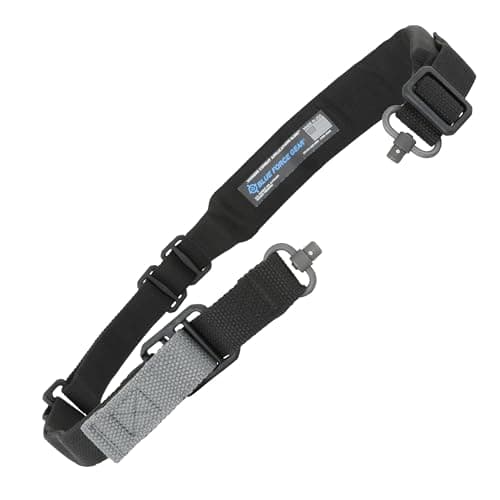
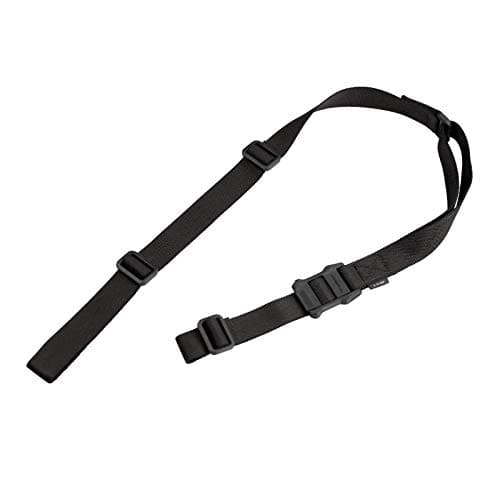
The short answer: look at the front and the rear of your rifle and identify which of four attachment points you have — a swivel stud, a QD socket, an M-LOK or Picatinny slot, or nothing but a loop. Then buy a sling whose hardware matches. If you do not yet know, buy the Magpul MS1, because its webbing takes several different attachment kits without replacing the sling, which makes it the lowest-risk order for someone mounting their first one. If your rifle already has push-button QD sockets, buy the Blue Force Gear Vickers and skip the rest of this page.
Which sling to buy in the first place is a different question, and our sling roundup answers it. If you have not decided between one attachment point and two, that argument is here.
Step 1: identify what the rifle has
Swivel studs
A small metal post with a hole through it, set into the forend and the butt of a wooden or synthetic stock. If you have these, you have the classic hunting rifle arrangement and the cheapest, widest choice of slings — you need a pair of swivels, which are the little spring-loaded clips that clamp onto the studs.
QD sockets
A round recess about half an inch across, usually in the side of the stock or in the handguard, that a push-button swivel locks into. If you have these, use them. QD is the best of the four: the sling comes off in seconds and goes back on in exactly the same place.
M-LOK or Picatinny slots
Common on modern rifle handguards. Both take a dedicated sling mount that bolts into the rail or slot, and that mount then presents either a loop or a QD socket. Buy the mount for the system you have — M-LOK hardware does not fit Picatinny and the reverse is also true.
Nothing
Plenty of rifles arrive with no sling provision of any kind. That is the case this page gets the most questions about, and it is covered below.
Step 2: what to do if the rifle has no swivels
You have four honest options, in the order we would try them.
- A loop-only sling at the rear and a handguard mount at the front. If the buttstock has a gap between the stock body and the buffer tube, or a visible slot at the toe, a loop of webbing threads through it. This is how most adjustable AR stocks are designed to take a sling, and it needs no hardware at all.
- A rail or M-LOK sling mount. If the handguard has slots, this is the cleanest front solution and it is reversible — nothing is drilled, nothing is permanent.
- An end-plate or receiver-mounted attachment. On an AR-pattern rifle, the plate between the receiver and the buffer tube is available with a sling loop built in. It requires taking the buffer tube off, which is more involved than the other options but is a standard job.
- Have swivel studs fitted. On a wooden or synthetic hunting stock a gunsmith can install studs correctly in minutes. Do not do this yourself on a stock you care about: the front stud on a bolt rifle has to miss the barrel channel and clear the bedding, and a drill in the wrong place is not undoable.
Step 3: fit it, then load it
Two things people skip. First, the sling should be adjusted so that with it over your shoulder and your hands off the rifle, the rifle sits where you want it rather than where gravity leaves it — on a two-point that means cinching the slider until the butt is roughly at your hip. Second, once it is on, hang on it. Put your weight into the sling, pull against both attachment points, and watch the hardware. Anything that is going to open or slip will usually do it the first time it is loaded, which you want to happen in your living room rather than on a hillside.
If the attachment point has a screw — a rail mount, an end plate, a swivel stud base — it gets the same treatment as a scope ring: torque it to the manufacturer's figure and check it again after the first outing. Our scope mounting page makes the same argument about the hardware above the receiver.
The hardware we do not link, and why
We link no swivel studs, QD sockets, rail mounts, end plates or loop adapters on this page, deliberately. Sling hardware is model-specific: a stud for a wooden bolt-rifle stock, an M-LOK QD mount and an AR end plate are three different parts, and the one you need depends on a rifle we cannot see. None of them has been resolved into this site's registry against a verified live listing either. Buy the part from the maker of your handguard or stock, or from a brand whose listing names your system on the box, and match the thread or slot standard exactly rather than approximately.
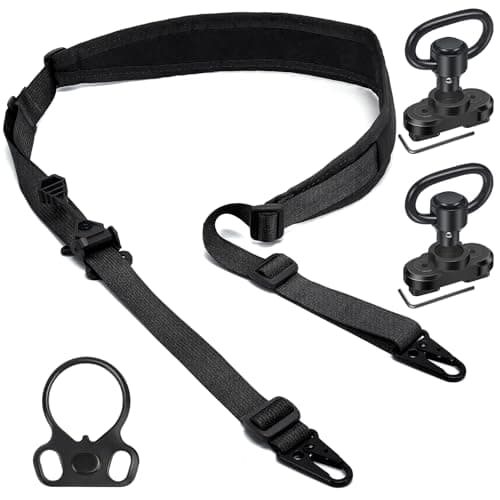
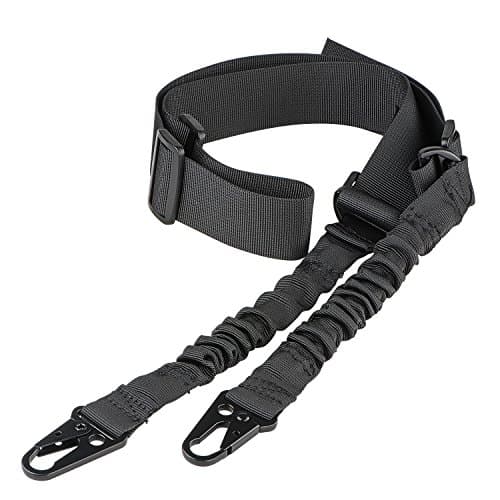
What we can do is tell you which slings come with which hardware, which is what the picks below are. Two of them include QD swivels; one is modular and takes several kinds; one is on the page as the hardware pattern to avoid.
Buying notes
Count the hardware before you compare prices
A sling that needs swivels you do not own is not cheaper than a sling that includes them. This is the single most common way a sling purchase costs more than expected, and it is why the WarBull above is on the page.
Polymer hardware does not mar a finish
Metal hooks and metal swivels rub bluing and anodizing, and they rattle. On a hunting rifle that noise is a real disadvantage. Magpul's hardware is polymer specifically for this reason.
QD is worth it if you will use it
The point of push-button QD is removing the sling without tools: for a gun case, for a bench session, for shooting off a bag. If you will never take the sling off, QD sockets are money and complexity you do not need.
Do not drill your own stock
Worth repeating because it is irreversible. A front swivel stud on a bolt rifle has to clear the barrel channel and the bedding. A gunsmith charges very little for this and gets it right the first time.