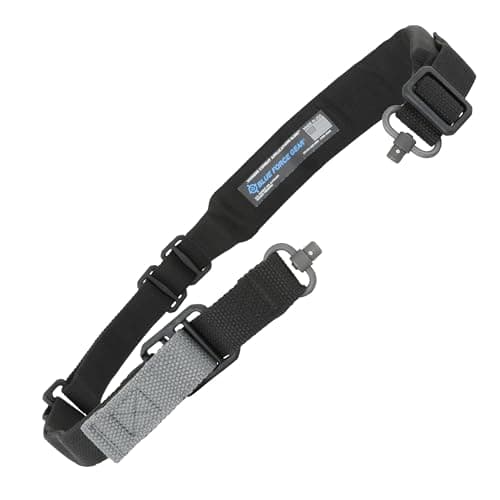
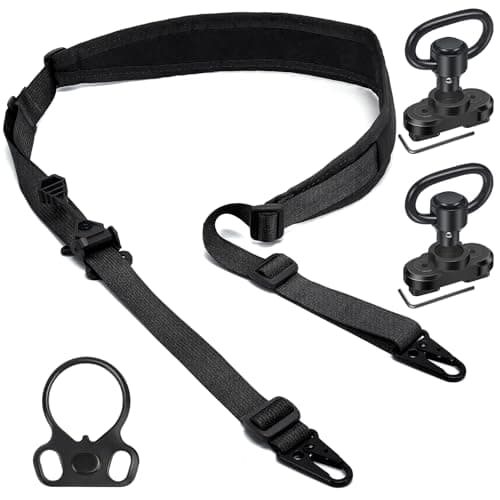
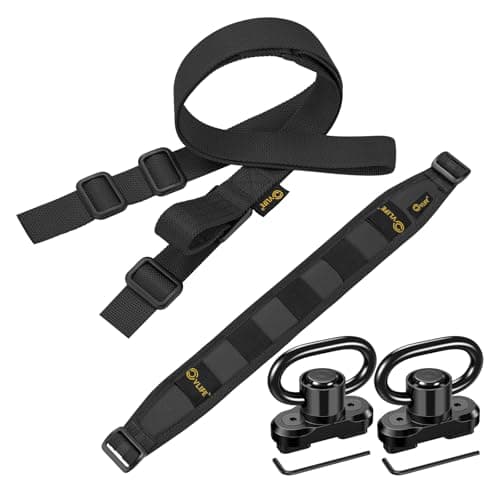
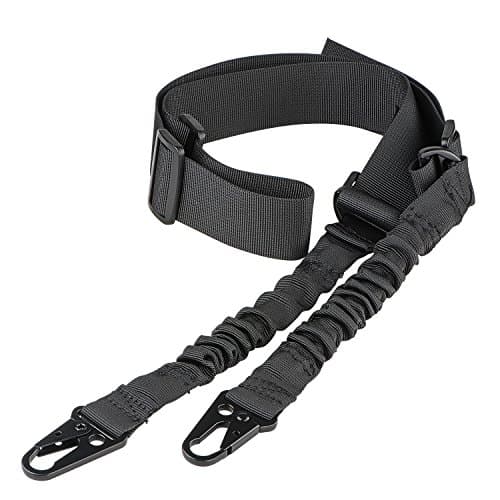
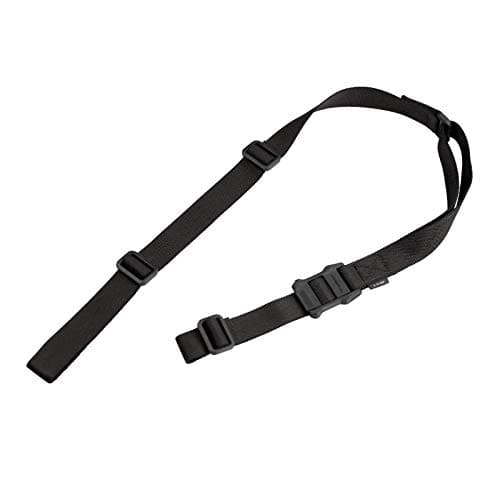
The verdict first: buy a two-point sling. For most people that means the Magpul MS1 Two-Point Quick-Adjust — it is for the shooter with one general-purpose rifle who wants to carry it hands-free, loosen the sling to shoot, and cinch it back down to move. A single point sling is a specialist tool for working in and around vehicles and doorways with a short carbine, and if that is not what you do, it will cost you more in comfort and in muzzle discipline than it returns. If your rifle is heavy or your days are long, buy the Blue Force Gear Vickers Padded QD instead and stop reading.
If you already know you want a two-point sling and you are here to pick one, our rifle sling roundup ranks the category properly and is the page you want — this one argues about the type, not the model. If you have narrowed it to the two slings most people end up choosing between, the MS1 against the Vickers is its own page.
What the two types actually are
A two-point sling attaches at two places on the rifle, normally near the front of the handguard and at the rear of the stock. The rifle hangs diagonally across your body, muzzle down, held against you by the webbing. That geometry is what lets the sling also become a shooting aid: cinch it short and it pulls the rifle into your shoulder.
A single point sling attaches at one place, usually a plate behind the receiver, and the rifle hangs straight down from that point. There is no second attachment to control where the rifle goes, so it pivots freely. That freedom is the entire argument for and against it.
You will also see three-point slings, which are a two-point sling with an extra loop, and convertible slings that can be run as either. Three-point designs are largely a 1990s answer to a problem that modern quick-adjust two-points solved better, and they tangle. Convertibles are a real category, and we do not have one verified into this site's registry — see the gap note below.
The four things that decide it
1. Where the muzzle goes when you let go
This is the one that matters most and gets discussed least. Release a two-point sling and the rifle stays where the webbing puts it: across your chest or around your back, muzzle pointed down and roughly where you left it. Release a single point and the rifle swings from one pivot, which means the muzzle moves through an arc that includes your own legs and feet. People manage this by holding the rifle, which rather defeats the point of a sling.
On a short carbine, worn high, by someone who does this constantly, it is manageable. On a hunting rifle on a hillside it is not.
2. Whether the sling helps you shoot
A quick-adjust two-point is a shooting accessory as much as a carry strap. Cinch it down and it loads tension between your support arm and your shoulder, which steadies the rifle in a way that is genuinely measurable on a target. A single point cannot do this at all — there is nothing to tension against. If you shoot from field positions, that alone ends the argument. Our shooting rests page covers the bench version of the same problem.
3. Weight across your body
Two attachment points spread a rifle's weight across your torso. One point concentrates it at your neck and one shoulder. For an hour it is irrelevant. For a day of walking it is the difference between a sling you use and a sling you take off, and the heavier the rifle the earlier that happens. This is also why padding matters more as weight goes up — see the Vickers.
4. Transitions and tight spaces
Here is the honest case FOR a single point. If you need to move a rifle from one shoulder to the other instantly, work it around a doorway, or get in and out of a vehicle seat repeatedly, a single point is faster and does not bind. That is a real set of needs. It is also a narrow one, and it is the reason single points are common in one world and almost absent from hunting.
So who should buy a single point?
Someone with a short-barreled carbine or a pistol-caliber carbine, used at close range, who is in and out of vehicles or confined spaces and does not shoot it from supported field positions. If you read that and thought "that is not me", you want a two-point.
A fair middle path exists: a convertible sling that runs as a two-point and converts to single point when you need it. If that is the answer for you, buy one — but buy it from a maker whose listing names the conversion mechanism, and be aware that a convertible is heavier and has more hardware to snag than either of the designs it imitates.
The gap on this page, stated plainly
We link no single-point sling, deliberately. Every sling verified into this site's registry against a live listing is a two-point, and we are not going to hand-write a listing for a product category we have not checked just to make the page look symmetrical. The verdict above does not depend on it: it rests on geometry that is the same for every single-point sling ever made. If you want one, buy from a maker you recognize, get a bungee version rather than fixed webbing, and expect to hold the rifle more than you thought.
Whatever you buy, the attachment hardware is half the purchase and the part people get wrong — how to attach a sling to your specific rifle is its own page.
Buying notes
Quick-adjust is the feature, not the attachment type
Of everything on a sling specification sheet, the one-hand adjustment slider is the feature that changes how you use the rifle. A two-point without quick-adjust is a carry strap. All four slings above have it, which is why they are the four slings above.
Width: 1.25in is the practical default
Narrower cuts in under load, wider catches on gear and does not feed through hardware as cleanly. Padding is the better answer to pressure than width, which is the whole design of the Vickers.
Closed loops or QD swivels, never an open hook
The one piece of sling hardware that fails in a way that matters is an open spring gate. It can be pressed open by a pack strap or a branch, and once it is open nothing is holding the rifle. That is why the last entry above is a skip rather than a budget pick.
Check the rear attachment before you order
Front attachment is usually easy; the rear is where slings fail to fit. Look at the back of your stock and work out which of the three options you have before you choose a sling — our mounting page walks through it.