We earn a commission when you buy through our Amazon links, at no extra cost to you. It never changes the order of the picks, and we say so when the cheaper thing is the better buy. How this works.
A sling has one job with two conflicting requirements. Walking, you want it short and tight so the rifle stays against your body and does not swing into things. Shooting, you want it long enough to get the rifle up and, if you use it, to loop your support arm into for stability.
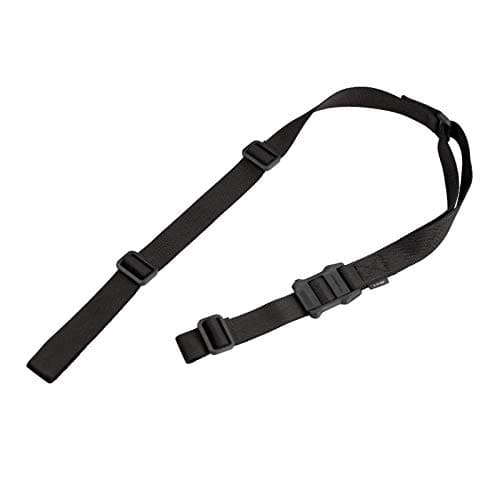
A quick-adjust sling does both with one hand and without looking. That is the entire feature and it is worth paying for. Everything else — padding, webbing width, color — is comfort.
The safety question is hardware. Open metal snap hooks can be worked open by webbing twisting under load, by a pack strap, or by a branch, and once open there is nothing retaining them. Closed loops and push-button QD swivels do not have that failure mode, and the price difference is a few dollars.
Three sling questions this ranking deliberately leaves to their own pages. If you have not settled on the sling TYPE yet, single point against two point argues it out and explains why almost everyone wants two. If you have narrowed it to the two slings most people choose between, the MS1 against the Vickers is a page of its own. And if the problem is that the sling will not fit the rifle, how to attach a sling covers swivel studs, QD sockets, M-LOK and the rifle that has no provision at all.
Open metal snap hooks are the problem. They can be worked open by the sling twisting under load or by pressure against a pack, and a sling that releases while you are moving drops the rifle.
#ad · Live prices from the Amazon Creators API, as of October 19, 2026. Where we have no verified live price we show none — a gap beats a number that has rotted.
Open metal snap hooks are the problem. They can be worked open by the sling twisting under load or by pressure against a pack, and a sling that releases while you are moving drops the rifle.
Adjustability
4
Hardware safety
3
Comfort
5
Value
6
What's good
+Very cheap
+Simple length adjustment
What's not
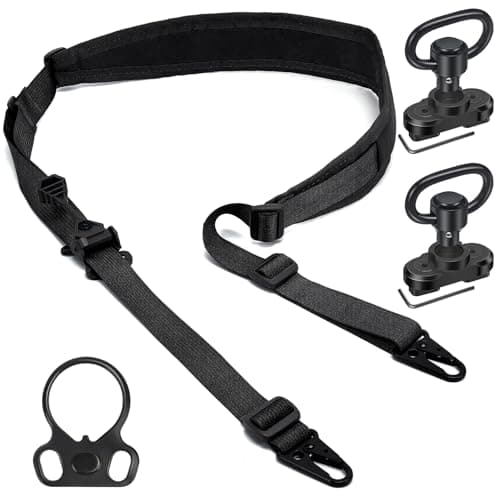
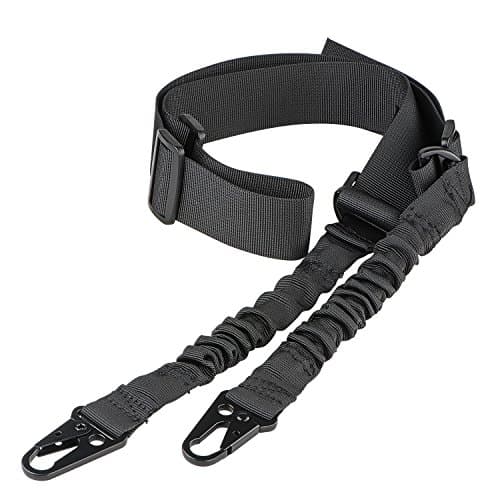
−Open snap hooks (HK-style) have a spring gate that can be depressed by webbing, a pack strap or a branch, and once it opens there is nothing retaining it
−Metal hooks also mar a rifle's finish and rattle audibly, which matters when hunting
−Length adjuster is not a quick-adjust — you cannot loosen it to shoot and cinch it to move
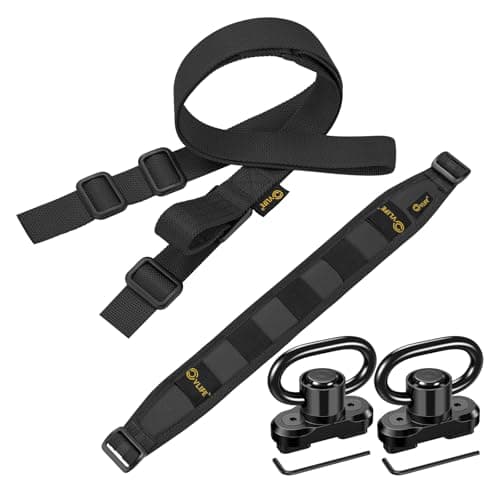
−The CVLIFE quick-adjust sling from the same company costs eight dollars more and has neither problem
Skip it if…
…the sling is bearing the weight of a rifle you care about. Buy a sling with a closed loop or a QD swivel.
Two-point attaches at the front and rear and is the right answer for almost everyone — it carries the rifle securely and supports a shooting loop. One-point attaches at a single point behind the receiver, is fast to transition between shoulders, and lets the rifle swing into you when you move. Three-point is a legacy design that mostly gets in the way.
Attachment hardware
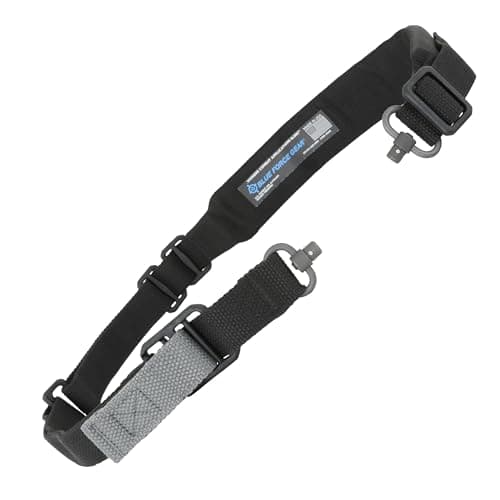
Push-button QD swivels are the cleanest solution if your rifle has QD sockets — secure, and removable in seconds without tools. Loops of webbing around a sling stud or a rail attachment are the simplest and cannot fail open. Open snap hooks are the one to avoid.
Padding, if the rifle is heavy
A 1.25-inch unpadded strap is fine on a light carbine and cuts into your shoulder on a heavy hunting rifle carried all day. Padding adds bulk and it is worth it above about eight pounds.
The loop, if you shoot from it
A traditional shooting loop around the support arm removes a great deal of wobble in kneeling and sitting positions, and it is a genuinely learnable skill that costs nothing. It needs a sling long enough and adjustable enough to set up quickly, which is another argument for quick-adjust.
Noise
Metal hardware rattles. For hunting, that matters. Polymer hardware, or taped and tucked metal, is quieter, and it is the reason Magpul's polymer sliders have the following they do.
How these were picked
I haven't handled these. Here's what I did instead.
Everyone in this category says they tested twenty of these. I haven't tested any, and I say so. What I do instead: read the manufacturer's manual and published specification, compile the numbers that decide the purchase, do the arithmetic in the open, check the live price, and name one product to skip. The scores above are judgments from that research against a published rubric — they are not measurements I took, because I do not have a lab and I am not going to pretend otherwise.
Questions
Frequently asked
One-point or two-point sling?+
Two-point for nearly everyone. It carries the rifle securely against the body, supports a shooting loop, and does not let the rifle swing when you move. One-point is faster for shoulder transitions and worse at everything else.
Why does quick-adjust matter?+
Because the length you want walking is not the length you want shooting. A quick-adjust slider lets you go between them one-handed without looking, which is the difference between using the sling and fighting it.
Are metal sling hooks dangerous?+
Open snap hooks can be worked open by webbing twisting, a pack strap or a branch, and once open nothing retains them. Closed webbing loops and push-button QD swivels do not have that failure mode and cost the same.
Do I need QD swivels?+
Only if your rifle has QD sockets. They are convenient — sling off in seconds without tools — but a simple webbing loop through a sling stud is just as secure and works on anything.
We do not run a testing lab and we do not pretend to. Where a measured number came from a manufacturer's published specification or someone else's lab, we name them and link them. Where we could not verify something, we say so on the page rather than quietly leaving it out. Read the full method.