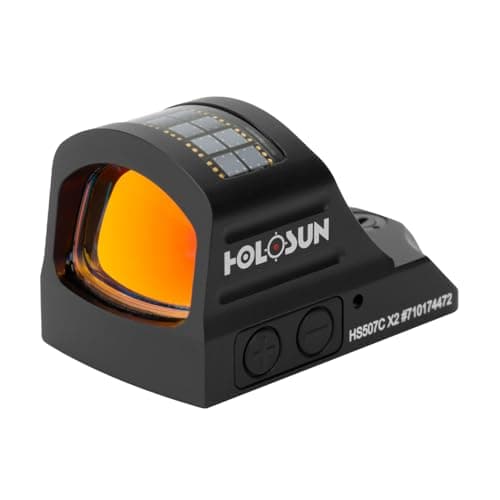
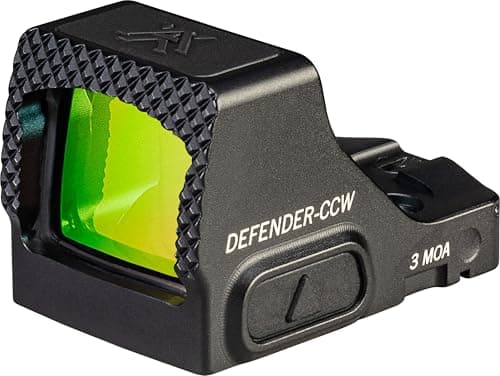
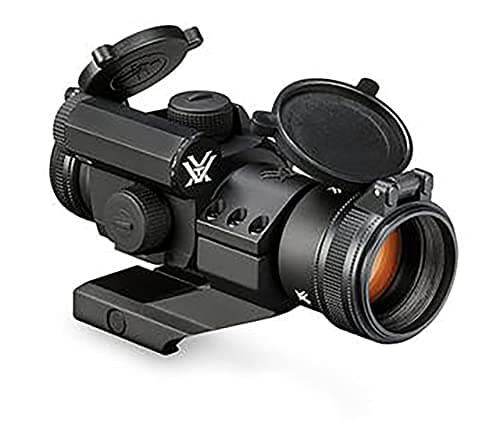
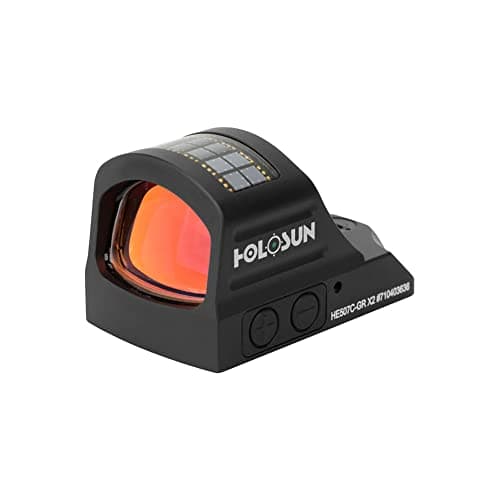
The verdict first: buy red unless you have a specific reason not to — the Holosun HS507C-X2 in red is the same optic as the green model for less money, and for most eyes the difference in use is small. Buy green if a red dot looks to you like a comet, a starburst or a smeared line rather than a dot: the green HE507C-GR-X2 is the direct swap and it is frequently the fix. If you want to stop thinking about it, the Vortex StrikeFire II gives you both colors in one sight and a switch.
Why green looks brighter — the actual reason
The human eye is not equally sensitive across the visible spectrum. In daylight vision, sensitivity peaks in the green part of the spectrum, around 555 nanometers, and falls away toward both ends. A red emitter sits out near 630 nanometers, a long way down that curve.
The practical consequence: a green dot and a red dot putting out the same amount of light will not look the same to you. The green one will look brighter, which means you can run it at a lower setting for the same apparent brightness, which — on the same optic — generally means better battery life at the setting you actually use.
That is the whole physical argument for green, and it is real. Everything after this point is about whether it is worth the price difference.
Where green genuinely wins
- Astigmatism. This is the big one. A red dot that reads as a smear is your cornea distorting a point source, and for a lot of people a green emitter comes through noticeably cleaner. It is not a cure and it does not work for everyone, but it is the cheapest thing to try after getting your eyes checked. The full astigmatism page is here — and it is not medical advice, as that page says in those words.
- Very bright conditions. Against snow, white sand or a hard overcast sky, a red dot can wash out before it reaches its brightest setting. Green has more headroom there.
- Low light on a budget optic. A cheap red emitter at its lowest setting can still be too bright and bloom; green at the same nominal output is easier to tune down to a crisp point.
Where red wins, or where it makes no difference
- Price. Green emitters cost more to make, and the same optic in green is routinely twenty to forty dollars more. If red works for your eye, that is money for ammunition.
- Green foliage. The common objection, and it is largely overstated — a dot bright enough to use does not disappear into leaves. It is worth a thought if you hunt in heavy green timber and run your brightness low.
- Night vision compatibility. If you ever use the optic with image intensification, red is the conventional choice and models with night-vision settings are overwhelmingly red.
- Availability and choice. Red is the default, so the red catalog in any given price bracket is simply larger. More footprints, more reticles, more sizes.
What about gold, amber and "multi-color" dots?
"Gold dot" is a marketing name for an amber or yellow-shifted emitter, sold on the same logic as green: a wavelength closer to the eye's sensitivity peak than red. The reasoning is sound and the real-world difference from green is small.
We link no gold or amber emitter sight on this page, because none has been resolved into this site's registry against a verified live listing — and we would rather leave the gap than hand-write a listing we have not checked. Multi-color sights are a different thing and are worth considering: the StrikeFire II on this page switches between red and green, which is the cheapest way to find out which your eye prefers.
How to decide in five minutes, for free
Go to a shop that will let you look through both, or borrow from someone at the range. Look at a red dot and a green dot at a low brightness setting against a plain wall, with your corrective lenses on if you wear them. If both look like round dots, buy red and keep the money. If the red one has a tail, a flare or a double image and the green one does not, you have your answer and it is worth the premium.
One thing worth separating out: if both look smeared, the problem is not the color and a different optic will not fix it. That is the point at which a prism sight with an etched reticle, or a low-power variable, becomes the honest recommendation — the red dot against the LPVO is covered here.
Buying notes
Footprint before color
What your slide or rail is cut for eliminates most of the market before you get to pick a color. Sort the footprint out first, then see what is available in green within it — on some footprints the answer is "not much".
Battery life figures are not comparable across colors
Manufacturers quote runtime at a stated setting, and the setting you actually use for the same apparent brightness is lower on a green dot than a red one. Compare runtime at a brightness you would use, not at the number on the box.
Green does not mean enclosed
Color and housing are separate decisions and people conflate them. If the gun lives in weather you want an enclosed emitter, in whichever color — that argument is here.
Turn it down
The single most common self-inflicted problem with any dot, in either color, is running it far brighter than conditions need. Excess brightness is what makes a dot bloom, flare and look bigger than its stated size.