Skip to content
Steve's Outpost

Section 06 · Shooting Gear

What Size Red Dot Do You Need?

Every red dot box has an MOA number on it and almost nobody explains what it means for your shooting. It is an angle, it is easy arithmetic, and it decides how fast and how precisely you can shoot.

By Stephen V.Updated How we pick
#ad

We earn a commission when you buy through our Amazon links, at no extra cost to you. It never changes the order of the picks, and we say so when the cheaper thing is the better buy. How this works.

The short answer: 3 MOA is the right default for a pistol — fast enough to find under pressure and small enough to aim with at any realistic pistol distance. Go to 2 MOA if the gun is for competition or precision work, and to 6 MOA or larger if it is for speed inside ten yards or for a shotgun swinging at something moving. If you genuinely cannot decide, buy a circle-dot reticle like the Holosun HS507C-X2: a 2 MOA dot inside a 32 MOA ring gives you both references in one window and you can switch either off.

What MOA actually means here

MOA is minute of angle — one sixtieth of a degree. At 100 yards one MOA subtends 1.047 inches, which everyone rounds to one inch because the difference does not matter at a shooting range. Angles grow with distance, so a dot of a given MOA size covers a proportionally bigger area the further out you look.

That is the whole calculation. Here is what each common dot size covers, rounded:

Dot sizeAt 10 ydAt 25 ydAt 50 ydAt 100 yd
2 MOA0.2 in0.5 in1.0 in2.1 in
2.5 MOA0.3 in0.7 in1.3 in2.6 in
3 MOA0.3 in0.8 in1.6 in3.1 in
4 MOA0.4 in1.0 in2.1 in4.2 in
6 MOA0.6 in1.6 in3.1 in6.3 in
32 MOA circle3.4 in8.4 in16.8 in33.5 in

Read that table once and most of the internet's arguing stops. At 10 yards a 6 MOA dot covers six tenths of an inch — it is not hiding anything you were going to hit. At 100 yards it covers over six inches, which hides most of a target's scoring area.

The real trade is acquisition speed, not precision

A bigger dot is easier to find. That is not a feeling, it is why it exists: more emitted area means your eye picks it up with less searching when the gun comes up and your head is not perfectly behind the optic. Under a timer, or on a bird, that difference is measurable in a way that half an inch of coverage at 25 yards is not.

A smaller dot is easier to aim with, and — the part people miss — easier to see crisply if your eyes are good. It also shows you your own wobble, which is useful information and occasionally discouraging.

So the honest framing is: buy the smallest dot you can find fast, for the kind of shooting you actually do.

By what the gun is for

  • Carry pistol: 3 MOA. This is the industry default for a reason. It covers under an inch at 25 yards, which is far finer than defensive accuracy demands, and it is quick to pick up from an imperfect presentation. 6 MOA is a defensible choice if your practice is all close and fast.
  • Competition pistol: 2 to 2.5 MOA, or a circle-dot. You are shooting partial targets at distance against a timer, and you want both. Big-window optics with a small dot exist specifically for this.
  • General-purpose rifle or carbine: 2 MOA. At 100 yards that is two inches. Anything bigger starts covering targets you can otherwise hit.
  • Shotgun: 4 MOA or larger, or a circle-dot. Speed on a moving target, and the dot's size is irrelevant against a shot pattern — except for turkey and slugs, where you want the small dot inside the ring. The shotgun page goes through that properly.
  • Concealed carry on a small slide: 3 MOA, and check the footprint first. Compact slides are usually cut for a small footprint and no adapter makes a small footprint bigger. The footprint constrains your choice more than the dot size does.

If the dot looks like a smear rather than a dot

Then dot size is the wrong variable and you are solving the wrong problem. A red dot that appears as a comet, a starburst or a smeared line is the classic presentation of uncorrected astigmatism, and buying a smaller dot will make it worse rather than better. A larger dot, a green emitter or a different reticle shape frequently helps. The astigmatism page explains why and what actually works, and the red-against-green comparison is here. Neither page is medical advice and both say so.

What to check before you buy, in this order

  1. Footprint. What your slide or rail is cut for. This eliminates most of the market before dot size is even relevant.
  2. Open or enclosed emitter. Weather and pocket lint, not optics. Covered in full here.
  3. Dot size. The table above.
  4. Brightness range and auto behavior. Whether it is usable against snow and against a dark treeline, and whether it wakes up when you pick the gun up.

The short answer

Quick picks

#ProductBest forScorePrice
01
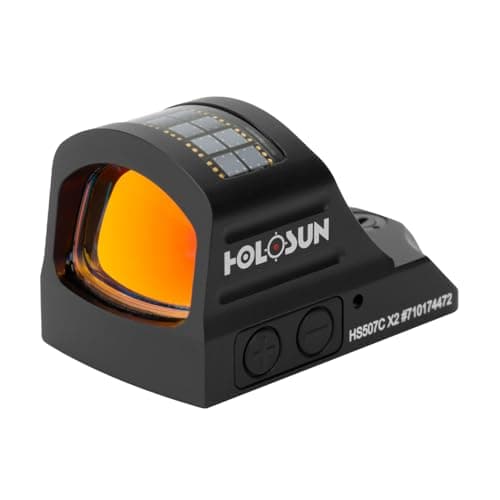
Holosun HS507C-X2, 2 MOA Dot + 32 MOA Circle
HS507C-X2, 2 MOA Dot + 32 MOA Circle

A 2 MOA dot inside a 32 MOA circle, so you get the fast reference and the precise one in the same window and can turn either off. It is the honest answer to this whole question.

Best if you genuinely cannot decide
8.8
$232.99Amazon (affiliate link)
02
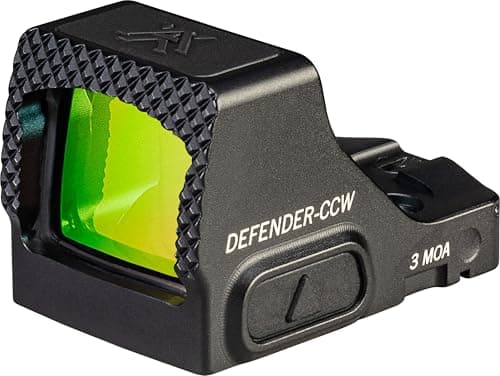
Vortex Defender-CCW Micro Red Dot, 3 MOA Green
Defender-CCW Micro Red Dot, 3 MOA Green

The Defender line is Vortex's serious pistol answer, and the CCW is the small one. It uses the Shield RMSc footprint, which is what compact slides are cut for.

Best 3 MOA — the default for a carry pistol
8.4
$249.00Amazon (affiliate link)
03
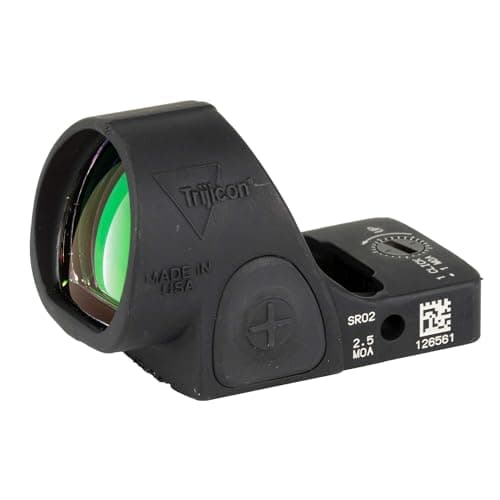
Trijicon SRO, 2.5 MOA, Adjustable LED
SRO, 2.5 MOA, Adjustable LED

A far bigger window than the RMR on the same family of mount. Competition shooters love it; it is the wrong optic to carry.

Best small dot for competition
8.2
$559.99Amazon (affiliate link)
04
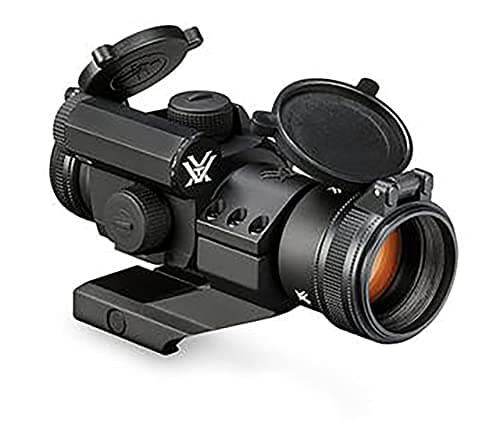
Vortex StrikeFire II Red Dot, 4 MOA Red/Green
StrikeFire II Red Dot, 4 MOA Red/Green

A 4 MOA dot in red or green. Twice the dot size of everything else here, which is exactly right for speed and wrong for precision.

Best big dot for close and fast
7.6
$159.99Amazon (affiliate link)

#ad · Live prices from the Amazon Creators API, as of October 19, 2026. Where we have no verified live price we show none — a gap beats a number that has rotted.

In detail

The picks, in full

01
Holosun HS507C-X2, 2 MOA Dot + 32 MOA Circle

Best if you genuinely cannot decide

HS507C-X2, 2 MOA Dot + 32 MOA Circle

2 MOA dot with 32 MOA circleOpen reflexSolar failsafeShake AwakeAluminum housing
8.8/10

A 2 MOA dot inside a 32 MOA circle, so you get the fast reference and the precise one in the same window and can turn either off. It is the honest answer to this whole question.

Dot clarity
9
Battery life
10
Zero retention
8
Build quality
8
Value
9

What's good

  • The circle-dot reticle is faster to find under stress than a bare dot and just as precise once you settle
  • Solar failsafe plus Shake Awake means it is essentially always on
  • Staccato lists a Dawson Precision DPO kit for the 507C/508T footprint, so the mount exists from the factory

What's not

  • Open emitter — rain, snow and lint can obscure the dot
  • The reticle button sequence takes learning
  • Two hundred and thirty-three dollars before you have bought the mounting kit

Skip it if…

…the gun gets carried in bad weather. An enclosed emitter is the honest answer for that, and it costs more.

$232.99Amazon (affiliate link)

Price as of October 19, 2026. Prices move — Amazon's is the one that counts.

#ad · we may earn a commission from this link to HS507C-X2, 2 MOA Dot + 32 MOA Circle

02
Vortex Defender-CCW Micro Red Dot, 3 MOA Green

Best 3 MOA — the default for a carry pistol

Defender-CCW Micro Red Dot, 3 MOA Green

3 MOA green dotShield RMSc footprintMicro reflexMotion activation
8.4/10

The Defender line is Vortex's serious pistol answer, and the CCW is the small one. It uses the Shield RMSc footprint, which is what compact slides are cut for.

Dot clarity
9
Battery life
8
Zero retention
9
Build quality
9
Value
7

What's good

  • RMSc is the dominant footprint on compact and subcompact optic-ready slides
  • Green dots read as brighter to most eyes at the same power draw
  • Motion activation means it is on when the gun moves

What's not

  • Open emitter, so rain and lint can obscure the dot
  • Footprint fit is a hard yes-or-no — confirm your slide cut before ordering
  • Two hundred and forty-nine dollars on a pistol that may have cost five hundred

Skip it if…

…your slide is cut for the RMR or DeltaPoint Pro footprint. It will not fit and no adapter makes a small footprint bigger.

$249.00Amazon (affiliate link)

Price as of October 19, 2026. Prices move — Amazon's is the one that counts.

#ad · we may earn a commission from this link to Defender-CCW Micro Red Dot, 3 MOA Green

03
Trijicon SRO, 2.5 MOA, Adjustable LED

Best small dot for competition

SRO, 2.5 MOA, Adjustable LED

2.5 MOA dotAdjustable LED brightnessLarge circular windowModel SRO2-C-2500002
8.2/10

A far bigger window than the RMR on the same family of mount. Competition shooters love it; it is the wrong optic to carry.

Dot clarity
10
Battery life
8
Zero retention
9
Build quality
9
Value
5

What's good

  • The big round window makes finding the dot on the draw dramatically easier
  • Top-loading battery, which fixes the RMR's biggest annoyance
  • Staccato's DPO RMR/RMRHD/SRO kit covers this footprint

What's not

  • Five hundred and seventy-five dollars
  • The tall open window is far more exposed than an RMR — this is a range optic
  • Bulky enough to complicate holster selection

Skip it if…

…the pistol is carried. The SRO's window is its strength on a timer and its weakness everywhere else.

$559.99Amazon (affiliate link)

Price as of October 19, 2026. Prices move — Amazon's is the one that counts.

#ad · we may earn a commission from this link to SRO, 2.5 MOA, Adjustable LED

04
Vortex StrikeFire II Red Dot, 4 MOA Red/Green

Best big dot for close and fast

StrikeFire II Red Dot, 4 MOA Red/Green

4 MOA dotRed or green dotTube red dotCantilever mount included
7.6/10

A 4 MOA dot in red or green. Twice the dot size of everything else here, which is exactly right for speed and wrong for precision.

Dot clarity
6
Battery life
8
Zero retention
8
Build quality
8
Value
8

What's good

  • A bigger dot is genuinely faster to pick up under stress or on a moving target
  • Green is easier for some eyes to see than red, and having both is a real feature
  • Ships with a mount, so there is no second purchase

What's not

  • 4 MOA covers four inches at a hundred yards, which limits precision
  • Astigmatism makes a big dot look worse, not better
  • An older design than the rest of this list

Skip it if…

…you shoot for precision past a hundred yards. Take a 2 MOA dot and accept that it is a shade slower to find.

$159.99Amazon (affiliate link)

Price as of October 19, 2026. Prices move — Amazon's is the one that counts.

#ad · we may earn a commission from this link to StrikeFire II Red Dot, 4 MOA Red/Green

Notes on the numbers

Published dot size is nominal

Manufacturers state a nominal MOA figure and the apparent size varies with brightness setting and with your own eye. A dot turned up to maximum against a bright sky will look and behave bigger than its stated size. Turn the brightness down until the dot is crisp — most people run theirs far brighter than they need.

A circle is not a dot

A 32 MOA ring is not an aiming reference at distance, it is an acquisition aid. Use the ring to find the target fast and the dot inside it to aim. On a defensive gun at close range the ring alone is enough.

Dot size does not change your zero

A bigger dot does not move the point of impact, it just makes it harder to see precisely where that point is. Zero with the brightness you actually use and the dot centered on the same part of the target every time.

How these were picked

I haven't handled these. Here's what I did instead.

Everyone in this category says they tested twenty of these. I haven't tested any, and I say so. What I do instead: read the manufacturer's manual and published specification, compile the numbers that decide the purchase, do the arithmetic in the open, check the live price, and name one product to skip. The scores above are judgments from that research against a published rubric — they are not measurements I took, because I do not have a lab and I am not going to pretend otherwise.
Questions

Frequently asked

Is 3 MOA or 6 MOA better for a pistol?
3 MOA for almost everyone. It covers about eight tenths of an inch at 25 yards, which is finer than any defensive standard asks for, and it is still quick to find. 6 MOA is the right answer only if your shooting is genuinely all inside ten yards and against a clock.
What size dot do I want on an AR-15?
2 MOA. At 100 yards that is a little over two inches, which keeps a torso-sized target fully visible and still lets you shoot a reasonable group. 4 MOA and up starts to cover what you are aiming at by the time you are out past a hundred yards.
Does a bigger dot make you faster?
At finding the dot, yes — there is more emitted area for your eye to catch when your head is not perfectly behind the optic. It does not make you faster at anything after that point, and past about fifty yards it starts costing you precision. Buy the smallest dot you can find quickly.
What is a circle-dot reticle for?
Having both. The large ring is an acquisition aid you catch instantly; the small dot inside it is the precise reference. Most circle-dot optics let you run the ring alone, the dot alone or both, which is why it is the sensible pick when one gun does several jobs.
Why does my red dot look blurry or smeared?
Almost always uncorrected astigmatism in your own eye rather than a fault in the sight — the emitter is a point source and your cornea smears it. A bigger dot, a green emitter or a circle reticle often helps, and so does shooting with your corrective lenses on. We go through it in detail here. See an optometrist first; this is not medical advice.

Keep reading

Receipts

Sources

We do not run a testing lab and we do not pretend to. Where a measured number came from a manufacturer's published specification or someone else's lab, we name them and link them. Where we could not verify something, we say so on the page rather than quietly leaving it out. Read the full method.