Skip to content
Steve's Outpost

Section 06 · Shooting Gear

Best Red Dots for Astigmatism

A smeared, comet-shaped or starburst dot is almost never a faulty sight. It is your cornea — and once you understand why, the fix becomes obvious.

By Stephen V.Updated How we pick
#ad

We earn a commission when you buy through our Amazon links, at no extra cost to you. It never changes the order of the picks, and we say so when the cheaper thing is the better buy. How this works.

Holosun HE507C-GR-X2, Green 2 MOA Dot + 32 MOA Circle

Start here

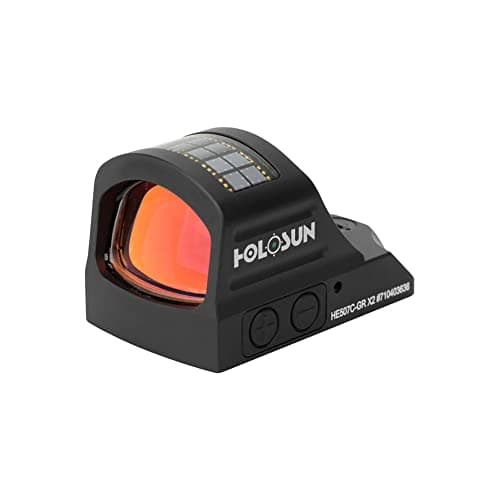
HE507C-GR-X2, Green 2 MOA Dot + 32 MOA Circle

A green emitter with a 2 MOA dot inside a 32 MOA circle. Two things that help at once: green is the wavelength most astigmatic shooters report reading cleaner, and a circle you can center is usable even when the dot itself is not crisp.

Green helps many people and not all of them. It is a cheap thing to try and it is not a guarantee — if nothing helps, an etched reticle is the answer that does not depend on your eye at all.

$245.99Amazon (affiliate link)

Price as of October 4, 2026. Prices move — Amazon's is the one that counts.

#ad · we may earn a commission from this link to HE507C-GR-X2, Green 2 MOA Dot + 32 MOA Circle

The verdict first: try green before you try anything else, and the Holosun HE507C-GR-X2 is the one to try — a green 2 MOA dot inside a 32 MOA circle, which gives you a second thing to aim with if the dot itself stays fuzzy. If green does not fix it, stop buying dots: buy an optic with an etched reticle, like the Vortex Strike Eagle 1-6x24, because an etched reticle is not affected by this problem at all.

And see an optometrist. I am not one, this is not medical advice, and corrected vision fixes more shooting problems than any sight on this page. If your dot smears, your distance vision is probably also softer than it should be, and that is worth knowing for reasons that have nothing to do with shooting.

Why this happens, in one paragraph

The American Optometric Association describes astigmatism as an irregularly shaped cornea or lens that prevents light focusing properly on the retina: the cornea is "shaped more like a football instead of round like a basketball and the eye is unable to focus light rays to a single point."

Hold that last phrase against what a red dot sight actually is. The dot is a tiny LED — as close to a true point source of light as anything you look at all day. An eye that cannot focus light rays to a single point will not render a point source as a point. It renders it as a streak, a comet, a cross or a starburst, depending on the axis of your astigmatism.

That is the whole mechanism, and it explains the two things that confuse people most:

  • Why the sight tests fine. Photograph the dot through the sight with a phone and it is a perfect circle. The camera does not have your cornea. Nothing is wrong with the sight, which is why returning it and buying the same model again does not help.
  • Why the rest of the world looks fine. Everything else you look at is a broad, extended object with edges your brain can resolve. A single bright point against a dark background is the hardest possible test — which is also why headlights at night look starry to the same people.

The three things that actually help

1. Turn the brightness down

Do this first, because it is free. Most shooters run a dot far brighter than they need, and brightness is what makes the smear spread. Take it down to the lowest setting that is still clearly visible against your target, and a great many people find the starburst collapses into something usable. If you only do one thing from this page, do this one.

2. Try green

Green emitters are widely reported by astigmatic shooters to read cleaner than red, and there is a plausible optical reason: the eye's sensitivity peaks in the green part of the spectrum in daylight, so a green dot is visible at a lower output for the same apparent brightness — and lower output means less blooming.

I am going to be careful here. That is a consistent, widely reported finding among shooters and a reasonable explanation of it. It is not something I have measured and it is not a clinical claim. It helps many people with astigmatism and does not help all of them, and the only way to find out which you are is to look through one. The cheapest way to test it properly is a red/green selectable sight like the Vortex StrikeFire II.

3. Use a reticle that is not a point

A circle-dot reticle gives you a 32 MOA ring around the dot. Even when the dot smears, a large circle is an extended shape with edges, and your eye handles it far better. Plenty of astigmatic shooters end up aiming with the circle and treating the dot as a bonus — which works, and is fast.

The answer that does not depend on your eye at all

If none of the above is enough, the category to move to is an optic whose reticle is etched into the glass rather than projected by an LED. A prism sight or a low-power variable like the Strike Eagle has a physical reticle inside the optical system. You are looking at an object through a lens, exactly as you look at everything else in the world, and your eye focuses it the same way it focuses everything else in the world.

This is the fix that is not a workaround. It costs you some weight, some eye relief discipline and — on an LPVO — some money, and in exchange the problem is simply gone. If you have bought three dots and hated all of them, stop buying dots.

One caveat worth stating: an etched reticle can still be illuminated, and on some optics the illumination at high brightness bleeds and reintroduces a halo. Run the illumination low, or off in daylight, and you get the clean etched reticle you paid for.

Our red dot versus LPVO page covers the rest of that trade — speed, weight and what each class is actually good at — and none of it changes because of astigmatism.

What not to waste money on

A bigger dot. A 6 MOA dot smears into a bigger blob, not a cleaner one. Dot size is about speed and precision, not clarity.

A more expensive dot of the same color and design. A six-hundred-dollar open emitter has the same LED-as-point-source problem as a hundred-dollar one. This is the single most common way people spend money on this problem without solving it.

A magnifier, bought hoping it will fix the dot. A magnifier behind a dot magnifies the dot — including the smear. Some shooters do find the magnified image easier to work with, and a magnifier is a reasonable thing to own; buy it for magnification, not as a treatment.

The short answer

Quick picks

#ProductBest forScorePrice
01
Holosun HE507C-GR-X2, Green 2 MOA Dot + 32 MOA Circle
HE507C-GR-X2, Green 2 MOA Dot + 32 MOA Circle

The same optic with a green emitter. If you have astigmatism and red dots read as a comma rather than a dot, green is frequently the fix.

Best green dot
8.4
$245.99Amazon (affiliate link)
02
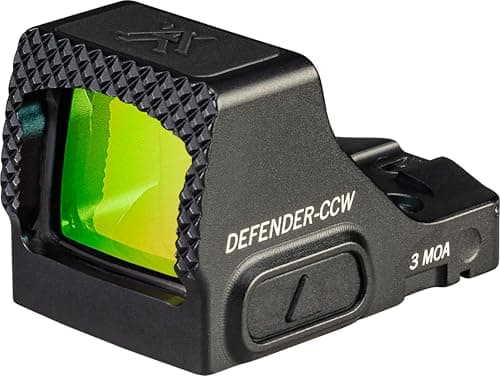
Vortex Defender-CCW Micro Red Dot, 3 MOA Green
Defender-CCW Micro Red Dot, 3 MOA Green

The Defender line is Vortex's serious pistol answer, and the CCW is the small one. It uses the Shield RMSc footprint, which is what compact slides are cut for.

Best green dot for a carry pistol
8.4
$249.00Amazon (affiliate link)
03
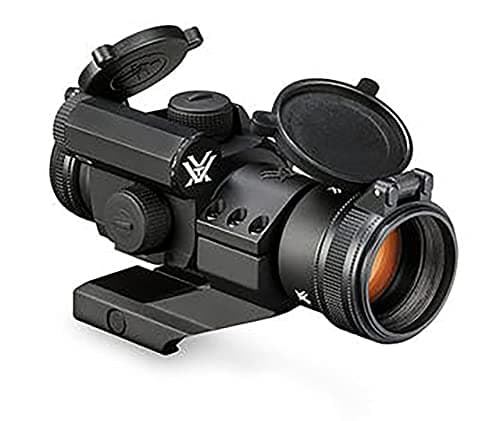
Vortex Vortex Strike Eagle 1-6x24
Vortex Strike Eagle 1-6x24

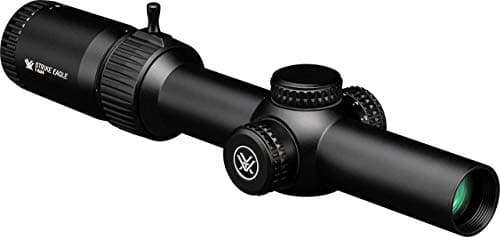
The reticle in this is etched into the glass, not projected by an LED, so an astigmatic eye focuses it the same way it focuses everything else in the scope. If a dot smears for you, this is the category that stops the problem rather than managing it.

Best answer that is not an emitter at all
8.4
$239.99Amazon (affiliate link)
04
Vortex Vortex Strikefire II
Vortex Strikefire II

A 30mm tube at the right height for a magnifier behind it, with a red or green dot for different light conditions.

Cheapest way to find out whether green helps
7.8
$144.85Amazon (affiliate link)
05
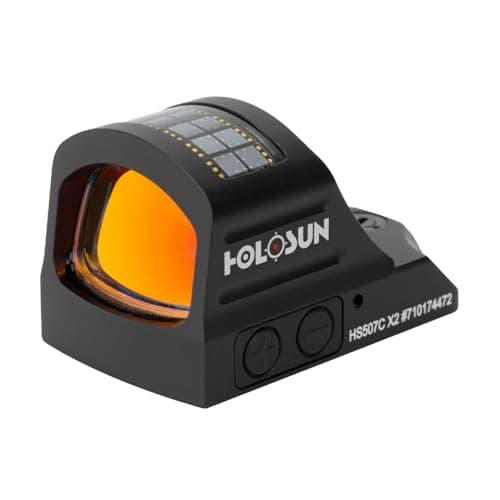
Holosun HS507C-X2, 2 MOA Dot + 32 MOA Circle
HS507C-X2, 2 MOA Dot + 32 MOA Circle

The default full-size pistol optic. Staccato sells a factory DPO kit for the 507C footprint specifically, which makes the mounting question a solved problem.

Best if the circle works better than the dot
8.8
$219.99Amazon (affiliate link)

#ad · Live prices from the Amazon Creators API, as of October 4, 2026. Where we have no verified live price we show none — a gap beats a number that has rotted.

In detail

The picks, in full

01
Holosun HE507C-GR-X2, Green 2 MOA Dot + 32 MOA Circle

Best green dot

HE507C-GR-X2, Green 2 MOA Dot + 32 MOA Circle

Green 2 MOA dot with 32 MOA circleOpen reflexSolar failsafeShake Awake
8.4/10

The same optic with a green emitter. If you have astigmatism and red dots read as a comma rather than a dot, green is frequently the fix.

Dot clarity
9
Battery life
9
Zero retention
8
Build quality
8
Value
8

What's good

  • Many shooters with astigmatism see a green emitter far more cleanly than a red one
  • The human eye is more sensitive to green, so it reads brighter at the same setting
  • Identical mounting and features to the red version

What's not

  • Twenty-three dollars more than the red X2
  • Green emitters historically draw more current, though solar backup offsets that here
  • If red works fine for you, this is money spent on nothing

Skip it if…

…you see a red dot as a crisp dot. Then red is cheaper and equally good.

$245.99Amazon (affiliate link)

Price as of October 4, 2026. Prices move — Amazon's is the one that counts.

#ad · we may earn a commission from this link to HE507C-GR-X2, Green 2 MOA Dot + 32 MOA Circle

02
Vortex Defender-CCW Micro Red Dot, 3 MOA Green

Best green dot for a carry pistol

Defender-CCW Micro Red Dot, 3 MOA Green

3 MOA green dotShield RMSc footprintMicro reflexMotion activation
8.4/10

The Defender line is Vortex's serious pistol answer, and the CCW is the small one. It uses the Shield RMSc footprint, which is what compact slides are cut for.

Dot clarity
9
Battery life
8
Zero retention
9
Build quality
9
Value
7

What's good

  • RMSc is the dominant footprint on compact and subcompact optic-ready slides
  • Green dots read as brighter to most eyes at the same power draw
  • Motion activation means it is on when the gun moves

What's not

  • Open emitter, so rain and lint can obscure the dot
  • Footprint fit is a hard yes-or-no — confirm your slide cut before ordering
  • Two hundred and forty-nine dollars on a pistol that may have cost five hundred

Skip it if…

…your slide is cut for the RMR or DeltaPoint Pro footprint. It will not fit and no adapter makes a small footprint bigger.

$249.00Amazon (affiliate link)

Price as of October 4, 2026. Prices move — Amazon's is the one that counts.

#ad · we may earn a commission from this link to Defender-CCW Micro Red Dot, 3 MOA Green

03
Vortex Vortex Strike Eagle 1-6x24

Best answer that is not an emitter at all

Vortex Strike Eagle 1-6x24

I run this one

Runs Strike Eagles on his ARs.

1-6x24Second focal planeBDC3 reticleIlluminated
8.4/10

The reticle in this is etched into the glass, not projected by an LED, so an astigmatic eye focuses it the same way it focuses everything else in the scope. If a dot smears for you, this is the category that stops the problem rather than managing it.

Glass clarity
8
True 1x
9
Illumination
8
Durability
9
Value
8

What's good

  • Genuine 1x rather than 1.5x, which is what makes both-eyes-open shooting work
  • 6x is enough to identify a target at distance
  • Illuminated reticle usable in daylight at the top setting
  • Vortex VIP warranty

What's not

  • Heavier than a red dot by a large margin
  • Second focal plane means the BDC is only correct at 6x
  • Slower to acquire up close than a red dot

Skip it if…

…speed inside 50 yards is the priority. A red dot is faster and weighs a third as much.

$239.99Amazon (affiliate link)

Price as of October 4, 2026. Prices move — Amazon's is the one that counts.

#ad · we may earn a commission from this link to Vortex Strike Eagle 1-6x24

04
Vortex Vortex Strikefire II

Cheapest way to find out whether green helps

Vortex Strikefire II

4 MOA dot30mm tubeRed/green dotMagnifier compatible height
7.8/10

A 30mm tube at the right height for a magnifier behind it, with a red or green dot for different light conditions.

Dot clarity
7
Battery life
8
Zero retention
9
Build quality
8
Value
7

What's good

  • Correct mounting height for a flip-to-side magnifier without shims
  • Green dot is easier to see against foliage than red
  • 30mm tube gives a large, forgiving window
  • Vortex VIP warranty

What's not

  • 4 MOA dot is coarse for precision
  • Larger and heavier than a micro red dot

Skip it if…

…you want the smallest, lightest optic possible. A 30mm tube is a deliberate size choice for the window and the magnifier.

$144.85Amazon (affiliate link)

Price as of October 4, 2026. Prices move — Amazon's is the one that counts.

#ad · we may earn a commission from this link to Vortex Strikefire II

05
Holosun HS507C-X2, 2 MOA Dot + 32 MOA Circle

Best if the circle works better than the dot

HS507C-X2, 2 MOA Dot + 32 MOA Circle

2 MOA dot with 32 MOA circleOpen reflexSolar failsafeShake AwakeAluminum housing
8.8/10

The default full-size pistol optic. Staccato sells a factory DPO kit for the 507C footprint specifically, which makes the mounting question a solved problem.

Dot clarity
9
Battery life
10
Zero retention
8
Build quality
8
Value
9

What's good

  • The circle-dot reticle is faster to find under stress than a bare dot and just as precise once you settle
  • Solar failsafe plus Shake Awake means it is essentially always on
  • Staccato lists a Dawson Precision DPO kit for the 507C/508T footprint, so the mount exists from the factory

What's not

  • Open emitter — rain, snow and lint can obscure the dot
  • The reticle button sequence takes learning
  • Two hundred and thirty-three dollars before you have bought the mounting kit

Skip it if…

…the gun gets carried in bad weather. An enclosed emitter is the honest answer for that, and it costs more.

$219.99Amazon (affiliate link)

$232.996% off

Price as of October 4, 2026. Prices move — Amazon's is the one that counts.

#ad · we may earn a commission from this link to HS507C-X2, 2 MOA Dot + 32 MOA Circle

Buying notes

Go in this order

Brightness down — then green — then a circle-dot reticle — then an etched reticle. Each step costs more than the one before it, and plenty of people stop at step one.

Buy from somewhere you can return it

This is the one optics category where you genuinely cannot know from a specification sheet whether the thing will work for you. Buy where returns are easy, and look through a friend's sight first if you can.

Test it the way you will use it

Outside, in daylight, at the brightness setting you would actually run, at the distance you actually shoot. A dot examined in a dim room at maximum brightness looks terrible to everybody.

Corrected vision first

Glasses or contacts that correct your astigmatism correct the dot too, because they correct the focus at the cornea. If you shoot in glasses, make sure the prescription is current before you conclude that sights are the problem.

Nothing here is medical advice

This page explains the optics of why a point source smears and what shooters do about it. It is not a diagnosis and it is not a substitute for an eye exam, and if your vision has changed recently that is a reason to see a professional rather than to buy a sight.
How these were picked

1 of these is mine. The rest are research, and I say which is which.

Anything carrying the "I run this one" stamp above is gear I actually own and use, and I write about it in those terms. What I do not do is invent numbers to dress that up — there are no group sizes, round counts or chronograph figures on this site, because I did not record them. For everything without the stamp: I read the manufacturer's published specification, compile the numbers that decide the purchase, do the arithmetic in the open, check the live price, and name one product to skip. Those scores are judgments against a published rubric, not measurements I took.

Questions

Frequently asked

Why does my red dot look like a starburst?
Because an LED dot is close to a true point source of light, and an astigmatic eye cannot focus light rays to a single point — the AOA describes the cornea as football-shaped rather than spherical. The sight is almost certainly fine: photograph the dot through it and the circle will be perfect, because the camera does not have your cornea.
Is a green dot better for astigmatism?
Many astigmatic shooters report that it is, and the plausible reason is that the eye is most sensitive to green in daylight, so a green dot can run at lower output for the same apparent brightness — and lower output blooms less. It helps a lot of people and not everybody. The cheap way to test it is a red/green selectable sight.
What is the first thing I should try?
Turn the brightness down. It is free and it is the single most effective change for most people, because brightness is what makes the smear spread. Run the lowest setting that is clearly visible against your target.
Will a prism or LPVO fix it?
Usually, yes — because the reticle is etched into the glass rather than projected by an LED, so your eye focuses it like any other object. That is the fix that does not depend on your eye at all. Keep the illumination low, since bright illumination on an etched reticle can reintroduce a halo.
Will a bigger dot help?
No. A 6 MOA dot smears into a larger blob rather than a cleaner one. Dot size changes how fast you find it and how precisely you can place it; it does not change how your eye focuses a point source.
Should I just wear my glasses?
If you have a current prescription that corrects your astigmatism, yes — corrected vision corrects the dot, because it corrects the focus at the cornea. A lot of people discover this problem because their prescription is out of date, which is a reason to book an eye exam rather than buy a sight.

Keep reading

Receipts

Sources

We do not run a testing lab and we do not pretend to. Where a measured number came from a manufacturer's published specification or someone else's lab, we name them and link them. Where we could not verify something, we say so on the page rather than quietly leaving it out. Read the full method.