We earn a commission when you buy through our Amazon links, at no extra cost to you. It never changes the order of the picks, and we say so when the cheaper thing is the better buy. How this works.
BTU per hour is the number every camp stove listing competes on, and it measures how fast the stove consumes fuel. It does not measure how fast your water boils, because outdoors almost all of your heat is lost to moving air before it reaches the pot.
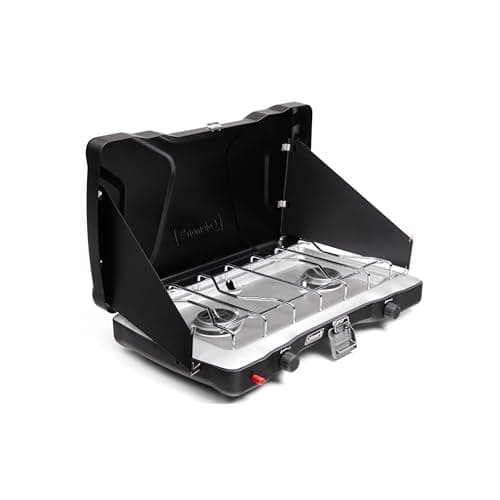
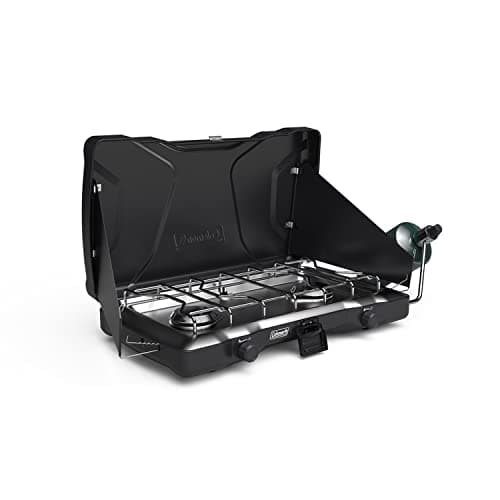
A 22,000 BTU Coleman with proper wind guards will out-cook a 60,000 BTU open burner in any real breeze, every time. This is not a close call, and it is why the stove at the top of this list is not the one with the biggest number.
After wind protection, the second most useful specification is cooking area — whether two full-size pans actually fit. A lot of two-burner stoves have burners spaced for two small pots and no more.
A stove and a cooler are the two halves of camp food, and the cooler is where most of the money goes. Our cooler roundup ranks the category, what size cooler you need is the question to settle first, and Yeti against RTIC is the head-to-head most people end up making.
A 150,000 BTU claim on a two-burner camp stove is the tell. That is roughly seven times a Coleman Triton, and BTU is not a quality score — it is fuel consumed per hour, with no wind protection to use it efficiently.
#ad · Live prices from the Amazon Creators API, as of October 19, 2026. Where we have no verified live price we show none — a gap beats a number that has rotted.
In detail
The picks, in full
01
Best overall
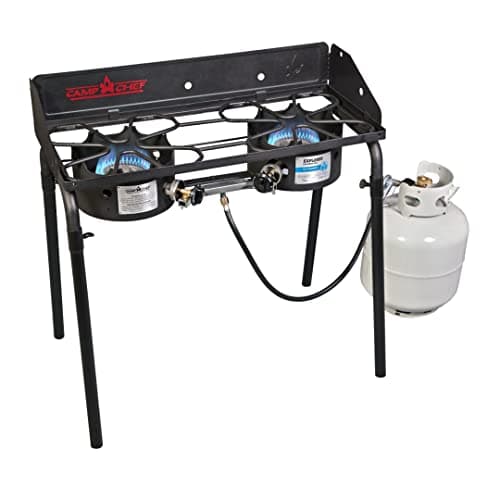
Camp Chef Explorer Two-Burner
2 x 30,000 BTU14 x 32 in surfaceCast aluminum burnersDetachable legs
7.4/10
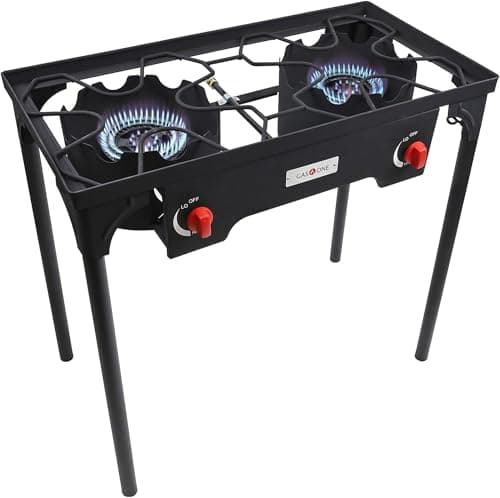
Two 30,000 BTU cast-aluminum burners on legs, with a cooking surface big enough for real pans — this is a camp kitchen rather than a camp stove.
Real output
9
Wind resistance
7
Cooking area
10
Portability
4
Value
7
What's good
+The large cooking surface takes two full-size pans, which the compact stoves cannot
+Cast aluminum burners survive far more seasons than stamped steel
+Legs put it at a working height instead of on a picnic table
+Accepts Camp Chef's griddle and pizza-oven accessories
What's not
−Big and heavy — a base-camp stove, not a portable one
−Requires a 20lb propane tank plus regulator for sensible run time
−Most expensive stove here
Skip it if…
…you camp out of a small car or move sites daily. The size is the whole product and it is not negotiable.
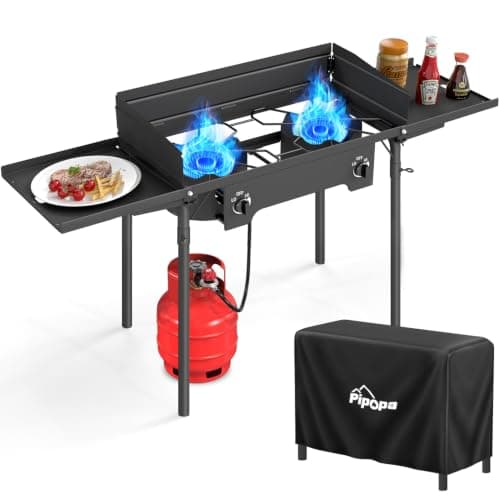
A 150,000 BTU claim on a two-burner camp stove is the tell. That is roughly seven times a Coleman Triton, and BTU is not a quality score — it is fuel consumed per hour, with no wind protection to use it efficiently.
Real output
7
Wind resistance
2
Cooking area
6
Portability
4
Value
5
What's good
+Genuinely powerful if the figure is real
+Cheap for the stated output
What's not
−BTU per hour measures fuel burn rate, not cooking performance — a high-output burner with no wind protection loses to a modest one with wind guards every time outdoors
−Real-world heat loss to moving air dominates outdoor cooking, which is exactly what this design ignores
−150,000 BTU would empty a 20lb propane tank in roughly three hours of use
−No simmer control at that output
Skip it if…
…you are choosing on the BTU number. The Coleman Triton at a quarter of the output cooks faster in wind, and costs less.
Look for wind guards that are tall enough to be useful and that fold in three sides. Where a stove has none, a homemade foil or aluminum screen placed around it — never touching the fuel line, and never fully enclosing a canister stove — makes a genuine difference.
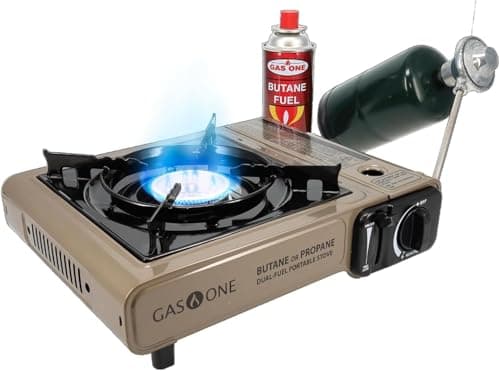
Fuel: propane, butane or liquid
Propane works well in cold, is available everywhere, and comes in 1lb canisters or refillable 20lb tanks. Butane canisters are compact, clean and cheap, and perform badly below freezing. Liquid fuel works at any temperature and altitude and requires priming and maintenance. For car camping in North America, propane is the default and a 20lb tank plus an adapter hose is dramatically cheaper per meal than green 1lb canisters.
Measure your pans against the burner spacing
"Two-burner" does not guarantee two 10-inch pans fit side by side. Check the stated cooking surface dimensions against the pans you actually own before buying.
Simmer control matters more than maximum output
High-pressure burners are excellent at boiling large volumes and poor at anything delicate. If you cook eggs, buy for simmer range rather than for BTU.
Backpacking is a different question entirely
For a backpacking stove the calculation flips to weight and fuel efficiency — grams of canister gas per boil — and a two-burner propane stove is entirely the wrong tool. That is a separate purchase with separate rules.
How these were picked
I haven't handled these. Here's what I did instead.
Everyone in this category says they tested twenty of these. I haven't tested any, and I say so. What I do instead: read the manufacturer's manual and published specification, compile the numbers that decide the purchase, do the arithmetic in the open, check the live price, and name one product to skip. The scores above are judgments from that research against a published rubric — they are not measurements I took, because I do not have a lab and I am not going to pretend otherwise.
Questions
Frequently asked
How many BTU do I need in a camping stove?+
Ten to twelve thousand BTU per burner is plenty for camp cooking. Beyond that you are mostly buying faster fuel consumption. Wind guards and a stable pan support affect real cooking time far more than the BTU figure.
Propane or butane for camping?+
Propane for cold weather and general use — it vaporizes well below freezing and is available everywhere. Butane for compactness and clean burning in mild weather. Dual-fuel stoves take either, which is genuinely useful.
Can I use a 20lb propane tank with a camp stove?+
Yes, with an adapter hose and the correct regulator, and it is dramatically cheaper per meal than disposable 1lb canisters. Check your stove's documentation — some require a specific regulator rather than a plain hose.
Why does my camp stove take so long to boil water?+
Almost always wind. Heat is stripped from the sides of the pot before it transfers in. Use the wind guards, position the stove so a solid object blocks the prevailing wind, and put a lid on the pot — the lid alone often halves boil time.
We do not run a testing lab and we do not pretend to. Where a measured number came from a manufacturer's published specification or someone else's lab, we name them and link them. Where we could not verify something, we say so on the page rather than quietly leaving it out. Read the full method.