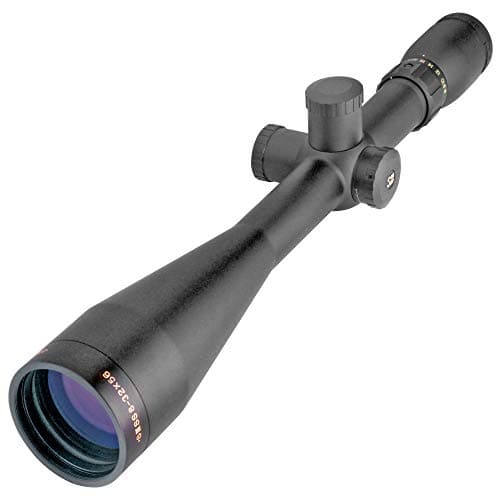
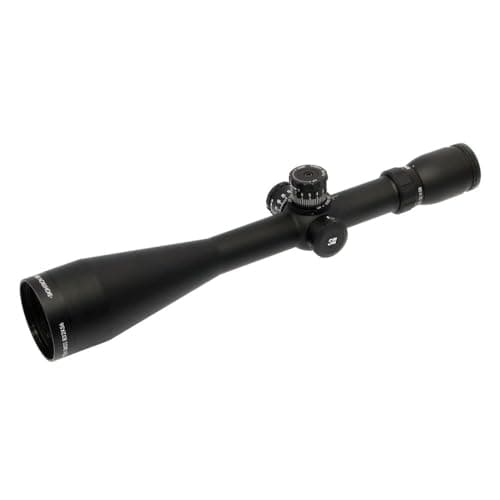
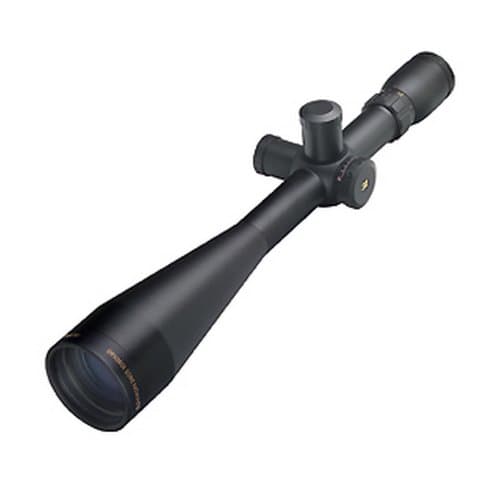
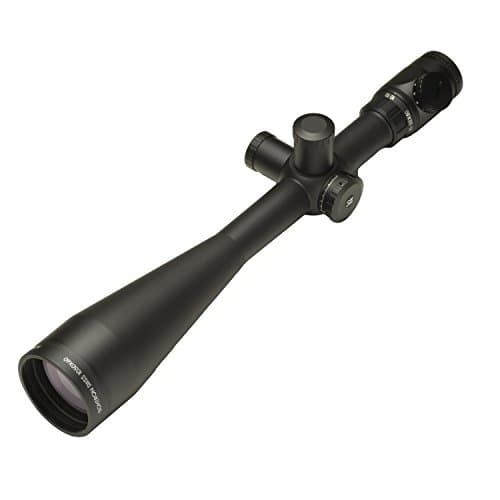
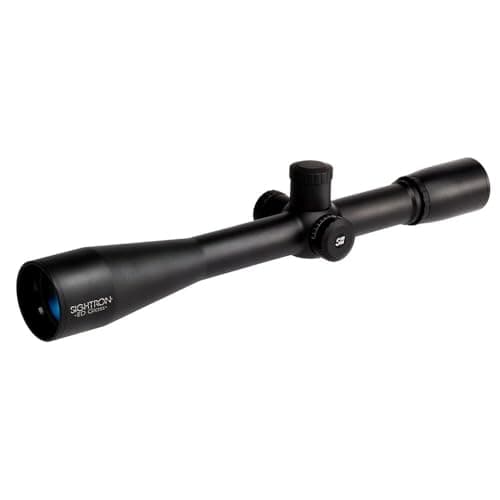
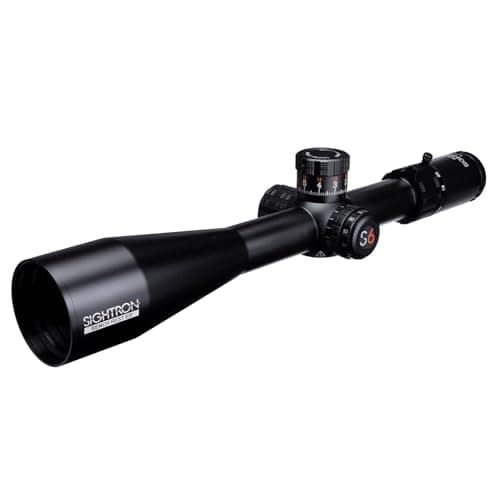
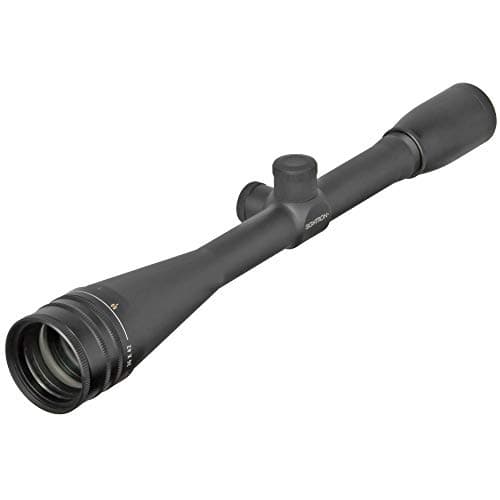
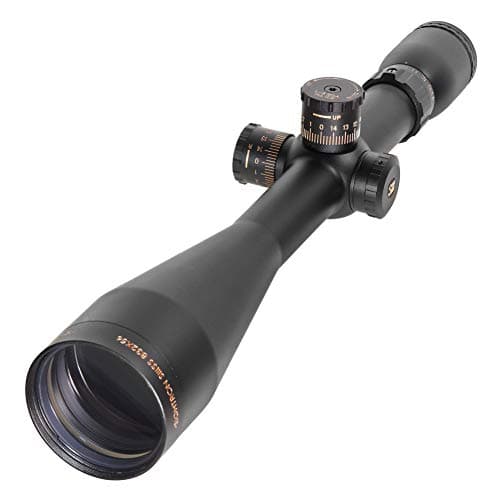
Target shooting asks different things of a scope than hunting does. Nothing here needs to be light, nothing needs a low bottom end, and nothing needs to survive being dragged through brush. What it needs is resolution, repeatable turrets and a reticle that does not cover the aiming point.
Sightron's SIII and SV lines are built in the company's Japanese facility and this is where their reputation comes from. Everything on this page except the last pick is from those lines.
Mine is the SIII 8-32x56, on a Remington 700, and it carries the owner-run stamp below. It is the best pure glass I have bought for the money and I do not think the brand gets nearly enough credit for that. The rest of this page is research — I have not had the 10-50x60 or the S6 on a rifle, and I am not going to imply otherwise.
What actually decides a target scope
Resolution beats magnification
Past about thirty-two power in normal conditions you are fighting mirage, not the optics. A scope that resolves cleanly at 32x is more useful than one that goes to 60x and turns to soup at 40x. This is why the 8-32x56 models are the practical recommendations here and the 10-60x is a competition-only choice.
Click value decides how fine your corrections can be
Quarter-MOA clicks move roughly a quarter of an inch at a hundred yards. Eighth-MOA clicks halve that. For benchrest, where the difference between a good group and a great one is measured in tenths, eighth-MOA is a genuine advantage. For everything else it just means twice as many turns.
Reticle: fine dot or fine crosshair, not a tree
At 32x a target dot covers very little of the aiming point. A dense holdover tree covers a great deal of it. Sightron's target reticles are deliberately traditional and that is the right call for this discipline — though it is a limitation if you also want to hold for wind rather than dial it.
Total elevation travel is a hard ceiling
The SIII LR 10-50x60 offers 50 MOA of total elevation. That is plenty for short-range benchrest and it will run out past six hundred yards. The 6-24x50 Mil-Dot lists 100 MOA. Check this number against the distances you actually shoot — no reticle fixes a scope that cannot dial far enough.
Where I would start
F-class: the SIII LR 8-32x56 with the MOA-2 reticle. Enough magnification to see your own holes at three hundred yards in good conditions, a reticle with structure, and the glass the brand is known for.
Benchrest: the 8-32x56 Target Dot with eighth-MOA clicks, or the fixed 45x45 ED if you want the optical consistency of a fixed erector.
Field target: the SIII Field Target 10-50x60 with illumination, which is built specifically for a discipline where you range by focusing the parallax.
Competition benchrest, no budget ceiling: the S6 10-60x56 ED BR, the current flagship.
One honest warning about availability
Almost every scope on this page showed one or two units in stock at the last price check. That is what a low-volume premium brand's marketplace presence looks like — it is not scarcity marketing. If a specific model is the one you want, buy it when you see it or go through a dealer.
Buying a target scope properly
Match the click value to the discipline
Eighth-MOA for benchrest, where corrections are tiny and distances are fixed. Quarter-MOA for F-class and anything where you dial across several hundred yards and do not want to count forty clicks to get there.
Exit pupil gets small fast at high magnification
Divide the objective by the magnification. A 45mm objective at 45x gives a one-millimeter exit pupil, which is unforgiving of head position — you will find the image blacking out if your cheek weld moves. A 56mm at 32x is far more comfortable. This is a real ergonomic consideration, not a specification footnote.
Fixed power has fewer things to move
A fixed erector cannot shift. That is why fixed-power target scopes hold zero exceptionally well and why they remain popular in benchrest despite being obviously less flexible.
Illumination means a two-year warranty part
Sightron covers electronics for two years rather than for life. The optical body is still covered under the limited lifetime terms. On the illuminated field target models, that is worth knowing in advance.
Budget for rings that match the tube
The SV on this page has a 34mm tube; most of the SIII models are 30mm. Rings are not interchangeable between the two and a mismatched ring set is an expensive afternoon. Our mounting hardware page covers the rings and the torque wrench.