One is not better. They fail in opposite directions, and which failure you can live with is decided by whether you dial, hold, and how dark it is when you shoot.
We earn a commission when you buy through our Amazon links, at no extra cost to you. It never changes the order of the picks, and we say so when the cheaper thing is the better buy. How this works.
The verdict first. If you hold over at varying magnifications — precision rifle matches, anything where the shot clock is running — buy first focal plane. If you dial your elevation, or you hunt in poor light at low magnification, second focal plane is the better tool and it is not a compromise.
What actually differs. In a first focal plane scope the reticle is ahead of the magnifying lenses, so it grows and shrinks with the image and its subtensions stay true at every power. In second focal plane the reticle is behind them: it stays the same apparent size no matter the magnification, and the holdover marks are only correct at one power, usually maximum.
The honest part about my own rifles: the glass on my LR-308 is a Vortex Viper PST 6-24 in second focal plane, and the Sightron SIII 8-32x56 on my Remington 700 is the best pure glass I own. Both are SFP. That is not a position against FFP — it is what those two rifles are for. They get ranged, dialed and shot at maximum magnification, which is exactly the case where second focal plane costs you nothing.
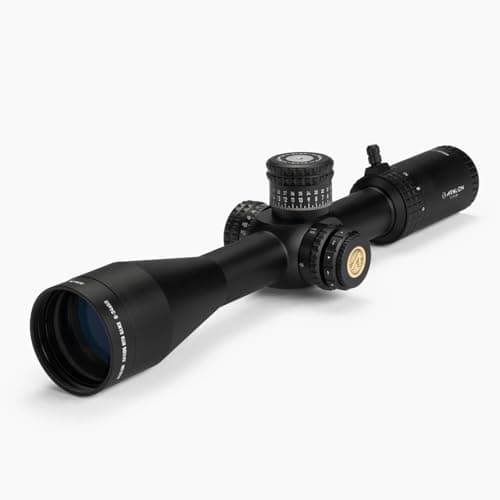
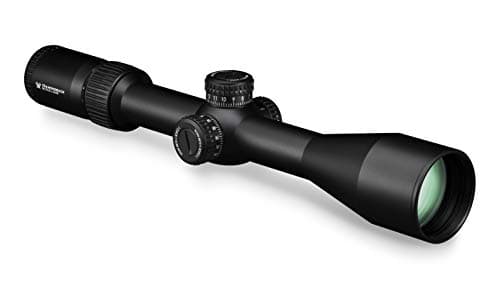
The scope that made first focal plane normal at this price. Holdovers are true at every magnification, which is the whole argument for FFP and the only one that matters.
The same argument as the Vortex with an illuminated reticle, which is the direct answer to the FFP-at-low-power complaint. If the thin-reticle problem is what is stopping you going FFP, this is the version that solves it.
Second focal plane, twenty-four power, on a rifle I shoot at distance. The reticle is only true at max magnification and I have never found that a limitation, because at distance I am on max magnification anyway.
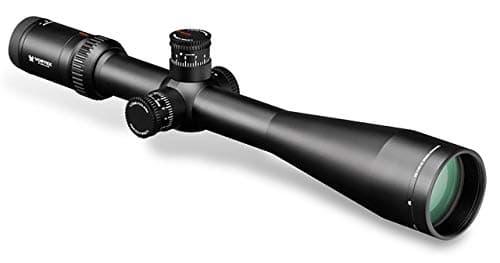
Built for the shooter who dials rather than holds. If your process is range it, dial it, send it, second focal plane costs you nothing and gives you a reticle that stays visible at every power.
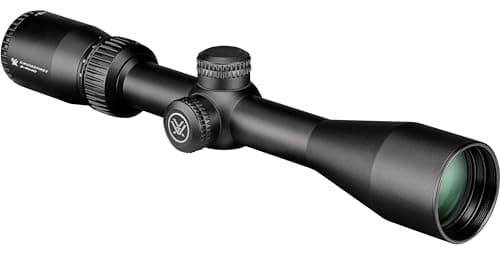
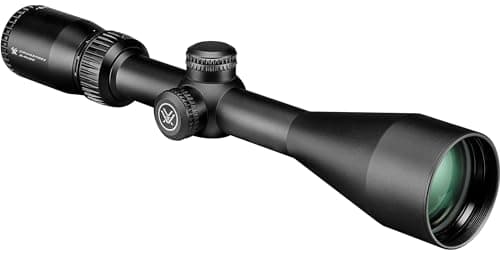
The honest answer for a hunting rifle inside 300 yards, and the clearest illustration of why second focal plane has not gone anywhere. At 3x on a gray morning the reticle is still there, which is the entire job.
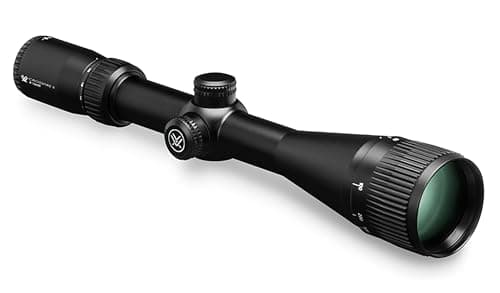
Twenty-four power and an adjustable objective for around two hundred and fifty dollars. It is the cheapest honest way to find out whether you actually enjoy shooting at distance before you spend four hundred more.
Thirty dollars more than the 3-9x40 for a bigger objective that forces taller rings, raises your cheek off the stock and buys light you will not notice at nine power.
#ad · Live prices from the Amazon Creators API, as of Sep 7, 2026. Where we have no verified live price we show none — a gap beats a number that has rotted.
The scope that made first focal plane normal at this price. Holdovers are true at every magnification, which is the whole argument for FFP and the only one that matters.
Reticle usability
8
Turret quality
8
Optical quality
8
Warranty
10
Value
8
What's good
+Subtensions are correct at any power, so you can hold rather than dial without thinking about it
+Exposed, resettable turrets that come back to zero
+Vortex's unconditional warranty applies, which is a real part of the value at this tier
What's not
−At 6x the reticle is genuinely fine and hard to see against a dark background
−Costs roughly three times the budget SFP hunting scopes below
Skip it if…
…you hunt in low light at low magnification. An FFP reticle shrinks with the power and at dawn on 6x it can disappear into brush — which is precisely why SFP hunting scopes still exist.
The same argument as the Vortex with an illuminated reticle, which is the direct answer to the FFP-at-low-power complaint. If the thin-reticle problem is what is stopping you going FFP, this is the version that solves it.
Reticle usability
9
Turret quality
8
Optical quality
8
Warranty
9
Value
8
What's good
+Illumination fixes the single real weakness of a first focal plane reticle at low power
+Athlon's warranty is transferable, which is unusual and genuinely worth something
+Priced within a few dollars of the Vortex, so the choice is on features rather than budget
What's not
−Illumination is another battery to check before a hunt
−Athlon has less dealer presence than Vortex if you want to look through one first
Skip it if…
…you want the widest service network and the simplest warranty story. Vortex's is the one everybody already knows works.
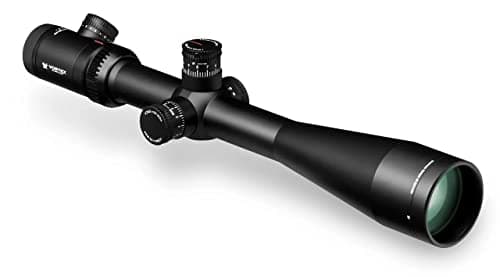
This is the glass on my LR-308 — the same scope described in full on that build page. Gen I is the older generation and Vortex has moved the line on since; it is still what I judge this bracket against.
Second focal plane, twenty-four power, on a rifle I shoot at distance. The reticle is only true at max magnification and I have never found that a limitation, because at distance I am on max magnification anyway.
Reticle usability
8
Turret quality
9
Optical quality
8
Warranty
10
Value
8
What's good
+A second focal plane reticle stays the same visual size at every power, so it never gets thin
+Turrets that return to zero, which is the feature that makes dialing trustworthy
+The EBR-1 is a usable holdover reticle at full magnification
What's not
−Holdovers are only true at one magnification, and forgetting that is the classic SFP mistake
−Gen I is superseded, so availability moves around
Skip it if…
…you intend to hold rather than dial at varying magnifications. That is exactly what FFP is for, and fighting an SFP scope into that role is the wrong tool.
Built for the shooter who dials rather than holds. If your process is range it, dial it, send it, second focal plane costs you nothing and gives you a reticle that stays visible at every power.
Reticle usability
8
Turret quality
9
Optical quality
8
Warranty
10
Value
7
What's good
+Reticle visibility never changes with magnification, which matters more than people admit
+Target turrets with a zero stop make dialing repeatable
+MOA reticle and MOA turrets, matched — the mistake this pairing prevents is the expensive one
What's not
−Holdover subtensions are valid at maximum power only
−Nearly four hundred dollars, so it competes directly with the FFP options above
Skip it if…
…your shooting is fast and at varying magnifications. Dialing is slow, and the SFP reticle will lie to you if you hold at 12x thinking you are at 24x.
The honest answer for a hunting rifle inside 300 yards, and the clearest illustration of why second focal plane has not gone anywhere. At 3x on a gray morning the reticle is still there, which is the entire job.
Reticle usability
9
Low-light performance
7
Optical quality
6
Warranty
10
Value
10
What's good
+The reticle stays visible at low power in poor light, which is when hunting shots happen
+One-inch tube and 40mm objective mount low, so cheek weld stays natural
+Under a hundred and twenty dollars with the same unconditional warranty as the expensive ones
What's not
−BDC marks are calibrated to an assumed trajectory and are approximate for your load
−Nine power is not enough for precision work past about 400 yards
Skip it if…
…you are building a rifle to shoot past 500 yards. This is a hunting scope and it is honest about it; buy magnification and exposed turrets for that job.
Twenty-four power and an adjustable objective for around two hundred and fifty dollars. It is the cheapest honest way to find out whether you actually enjoy shooting at distance before you spend four hundred more.
Magnification range
9
Turret quality
6
Optical quality
6
Warranty
10
Value
9
What's good
+The magnification range of scopes costing twice as much
+Adjustable objective removes parallax error, which matters more than people expect at 24x
+Same no-fault warranty as everything above it in the line
What's not
−Capped turrets are less convenient than exposed ones if you intend to dial regularly
−Optical quality at 24x is where the price shows most clearly
Skip it if…
…dialing is your process. Capped turrets discourage it, and a scope you do not dial is a scope you are holding over with an SFP reticle at the wrong magnification.
Thirty dollars more than the 3-9x40 for a bigger objective that forces taller rings, raises your cheek off the stock and buys light you will not notice at nine power.
Optical benefit
4
Mounting height
3
Reticle usability
9
Warranty
10
Value
4
What's good
+A 50mm objective does gather marginally more light, which is a real physical effect
+Identical warranty and reticle to the 40mm version
What's not
−Needs higher rings, which raises the scope above a natural cheek weld on most hunting stocks
−The extra light is not perceptible at 9x, where the exit pupil is already larger than your eye can use
−Thirty dollars more for a heavier, taller-mounting scope
Skip it if…
…you want a low-mounted hunting scope, which is almost everybody with a 3-9x. Buy the 40mm, mount it low, and put the thirty dollars into ammunition.
You hold over rather than dial, at varying magnifications.
You shoot on a clock and cannot afford the time dialing takes.
You range with your reticle rather than a laser.
You shoot in daylight, where a thin reticle at low power is not a problem.
Buy second focal plane if
Your process is range it, dial it, send it.
You hunt at dawn and dusk, at low magnification, against dark backgrounds.
You want a reticle whose visibility never changes.
Budget is genuinely the constraint — SFP costs less at every tier.
The failure mode of each, stated plainly
FFP fails at low power. Wind the magnification down and the reticle shrinks with it. At 6x on a first focal plane 6-24, the marks are fine hairs against brush. Illumination is the direct answer, and it is why an illuminated FFP scope is worth the premium if low power matters to you.
SFP fails when you forget. The subtensions are true at one magnification. Hold over at 12x on a scope calibrated at 24x and you will be off by a factor of two — a large, expensive, entirely avoidable miss. This is the single most common SFP mistake and the reason to know which power your reticle is calibrated at.
Magnification range makes the choice for you
On a 3-9x hunting scope, focal plane barely matters: the ratio is small enough that an FFP reticle at 3x would be nearly invisible, which is why almost nobody makes one. On a 5-25x, it matters enormously. As a rough rule, the higher the zoom ratio, the more the argument moves toward FFP.
Neither one makes a scope accurate
Focal plane says nothing about glass, turret repeatability or tracking. A cheap FFP scope with turrets that do not return to zero is worse than a good SFP scope in every way that matters. Buy tracking and glass first, focal plane second. The brand-level version of that argument is on the Vortex guide and the Sightron guide.
Read the reticle before you buy the scope
Two scopes at the same price with the same focal plane can be very different tools depending on the reticle. If your reticle is in MIL, your turrets should be in MIL, and your card should be in MIL — see MOA vs MRAD for why mixing them is the expensive mistake.
How these were picked
1 of these is mine. The rest are research, and I say which is which.
Anything carrying the "I run this one" stamp above is gear I actually own and use, and I write about it in those terms. What I do not do is invent numbers to dress that up — there are no group sizes, round counts or chronograph figures on this site, because I did not record them. For everything without the stamp: I read the manufacturer's published specification, compile the numbers that decide the purchase, do the arithmetic in the open, check the live price, and name one product to skip. Those scores are judgments against a published rubric, not measurements I took.
Questions
Frequently asked
Is FFP more accurate than SFP?+
No. Neither affects where the bullet goes. What changes is whether your reticle's holdover marks are true at the magnification you are currently on — a usability difference, not an accuracy one.
At what magnification is an SFP reticle correct?+
Whatever the manufacturer calibrated it at, which is usually maximum power but not always — some are calibrated at a mid-range setting instead. Check the manual for your specific scope. Assuming rather than checking is how people miss by a factor of two.
Which is better for hunting?+
Second focal plane, for most hunting. Shots happen in poor light at lower magnification, and that is precisely where an FFP reticle disappears. An illuminated FFP scope closes the gap, at a price.
Which is better for precision rifle matches?+
First focal plane, almost universally. Match shooting means holding at whatever magnification the stage and the mirage allow, and FFP is the only focal plane where that is safe to do without thinking about it.
Do I need illumination on an FFP scope?+
If you will use the bottom of the magnification range in poor light, yes — it is the direct fix for FFP's one real weakness. If you shoot daylight targets on the top half of the range, it is a battery you do not need.
Why is SFP cheaper?+
The etched reticle in a first focal plane scope sits in a more demanding optical position and has tighter tolerances, and the erector assembly is more complex. At every price tier, an SFP scope generally buys you better glass than the FFP scope beside it.
We do not run a testing lab and we do not pretend to. Where a measured number came from a manufacturer's published specification or someone else's lab, we name them and link them. Where we could not verify something, we say so on the page rather than quietly leaving it out. Read the full method.