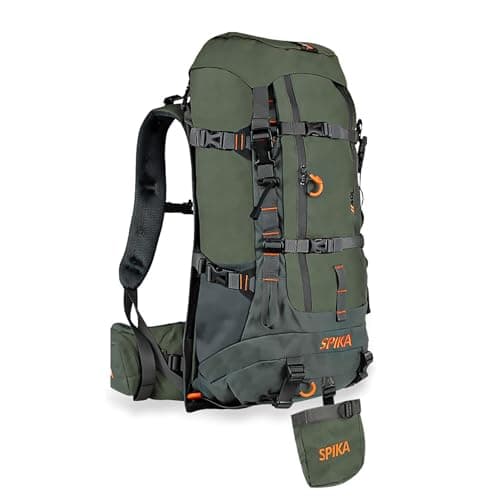
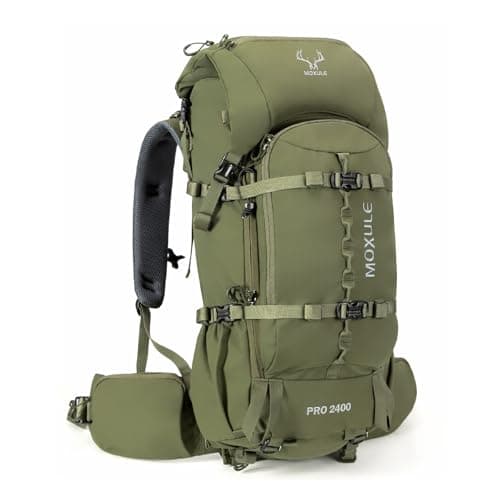
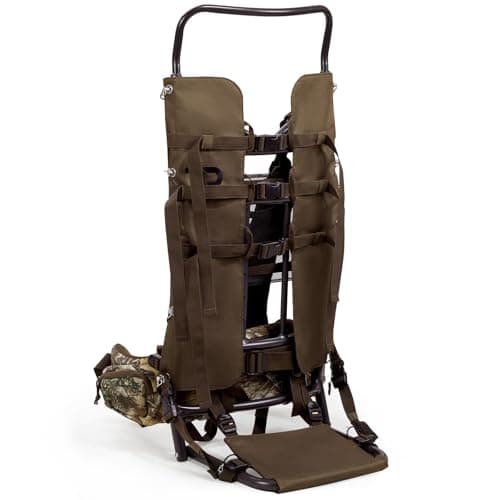
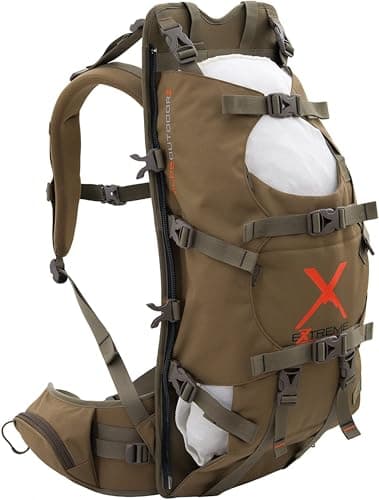
The verdict first: if there is a realistic chance you will carry an animal out on your back, buy an external frame — the ALPS OutdoorZ Extreme Commander X, for the western or backcountry hunter whose hunt ends with a quarter on the frame. If there is not, buy an internal frame: the SPIKA 40L+ is for the hunter who walks in, hunts, and walks out carrying roughly what they came in with. Those two sentences cover most people, and the rest of this page is for everyone in between.
Capacity is a separate question and we answer it separately in what size hunting pack you need. For the category ranked on the merits rather than split by architecture, our hunting pack roundup is the page.
What the frame is for
Both frame types exist to do one thing: move weight off your shoulders and onto your hips, which is where your skeleton can actually carry it. A frameless pack puts the load on your shoulder straps and your spine, which is fine for twenty pounds and punishing at sixty. The difference between the two architectures is entirely about HOW they do that transfer and what they give up for it.
External frame
A rigid frame on the outside — traditionally aluminum tubing — with the bag attached to it. The load sits further from your back and higher, and because the frame is external it can carry things directly: a shelf or lashing straps hold a load the bag could never contain. On the Commander X the bag detaches entirely so the frame carries meat on its own.
Internal frame
Stays or a framesheet built inside the pack body. The load sits close to your back and lower, so it moves with you rather than levering against you. This is what almost all modern hiking packs are, and it is why they took over.
The four trades, honestly
1. Heavy load carriage: external wins
Under a genuinely heavy, awkward, shifting load — which is exactly what boned-out meat is — a freighter frame transfers weight to the hips better than an internal frame does. This is the entire reason external frames survived in hunting after hiking abandoned them.
2. Mobility and brush: internal wins
An external frame catches. In thick timber, on a climb, ducking under deadfall, the frame snags where an internal-frame pack slides past. A load that sits close to your back also lets you keep your balance on steep ground, which matters more than people expect the first time they side-hill with a tall external frame loaded high.
3. Carrying something the bag cannot hold: external wins
This is the underrated one. An external frame is a platform. A quarter, a boned-out load, a tree stand, a bulky decoy — all of it lashes to a frame and none of it fits inside a sealed bag. Our game bags page covers what the meat should be in while it is on there.
4. Weight and cost when you never haul: internal wins
An external frame is heavier empty, which you pay for on every hunt including the hundred where you carry nothing out. The SPIKA's own listing warns you off elk quarters and the Commander X's warns that it is overkill for a drive-to whitetail stand. Both warnings are correct, and between them they are the whole decision.
The hybrids, and why they are multiplying
The two categories are blurring. A lot of current hunting packs are internal-frame bags with a load shelf behind them — you pull the bag away from the frame, put meat between the two, and cinch it down. The MOXULE Pro 2400 is the version of this in our picks: a day-sized bag on a hauling frame.
Be clear-eyed about what a hybrid is. It is a day pack that can haul, not a haul pack that can day-hunt. It will not carry a hundred pounds like a dedicated freighter frame, and it does not need to — most pack-outs are several trips with a reasonable load each, not one heroic carry. For a hunter who day hunts regularly and packs out occasionally, the hybrid is genuinely the right answer and we would not talk anybody out of it.
The specification that is missing from most of them
Load rating. How much weight the frame and suspension are designed to carry is the single most useful number for this decision, and most budget listings do not publish it. The TR aluminum frame above is the clearest case: about a hundred dollars for an adjustable external frame with lashing straps, and no stated load rating, which means you are guessing about the one figure that decides whether the frame is adequate for the load you are planning.
We have not load-tested any of these packs to failure and we are not going to tell you which frame holds what. What we can do is point out where the number is absent, which is what that caveat is. How we pick explains the basis for every score on this site.
Decide it in two questions
- Will I carry an animal out on my back? If no, buy an internal frame and stop. If yes, continue.
- Is that every season or once in a while? Every season, in open country, with heavy loads: dedicated external frame. Occasionally, mostly day hunting: a hybrid with a load shelf.
Whatever you land on, fit beats architecture. A frame sized to your torso and belted on your hips carries better than a theoretically superior frame that does not fit, and how you load it is worth more than either.
Buying notes
Measure your torso, not your height
Pack fit is set by the distance from the bony bump at the base of your neck to the top of your hip bones. Two people the same height can need different frame sizes, and an adjustable frame like the TR above exists precisely because of it.
Look for a stated load rating, and be suspicious when there is none
It is the number that tells you whether a frame is adequate for a pack-out. Where a listing omits it, treat the frame as rated for whatever you would carry comfortably, not for the load you are hoping it will take.
A detachable bag is the real external-frame feature
Not the frame material and not the capacity. If the bag does not come off, the frame cannot carry meat directly against the shelf, which was the reason to accept an external frame in the first place.
Think about where the sling will sit
A rifle sling and a pack's shoulder strap compete for the same shoulder. Packs with a rifle carry system solve it; otherwise plan which side each lives on before the first climb. Our sling roundup covers the other side of that conflict.