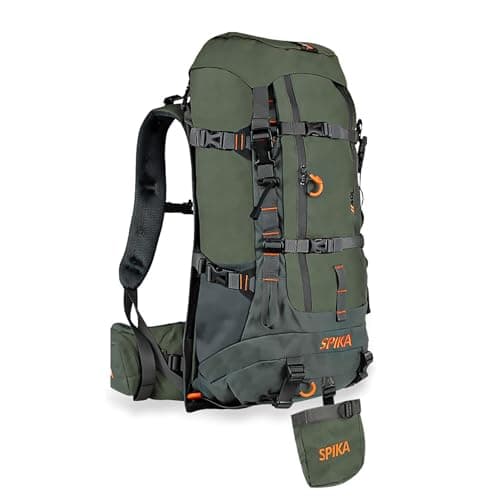
The verdict first: for most hunters, most of the time, buy about 40 liters — for us that is the SPIKA 40L+ internal frame pack, which suits the hunter doing day hunts from a vehicle or a camp who occasionally stays out longer than planned. Buy bigger only when you can name the gear that needs the space. If the load you are planning for is an animal rather than equipment, capacity stops being the question and you want a frame instead.
If you want packs ranked rather than sized, our hunting pack roundup is the page. If you have the pack and want it loaded properly, that is a separate page too. And if the question behind the question is frame architecture rather than volume, internal versus external frame is here.
Two units, one number
Hunting packs are quoted in liters or in cubic inches and the conversion is the first thing to get straight, because the two numbers look nothing like each other. One liter is about 61 cubic inches. So:
- 1,500 cu in is about 25L — a large daypack
- 2,400 cu in is about 40L — a full day hunt
- 3,500 cu in is about 57L — an overnight
- 5,500 cu in is about 90L — multi-day, or a camp on your back
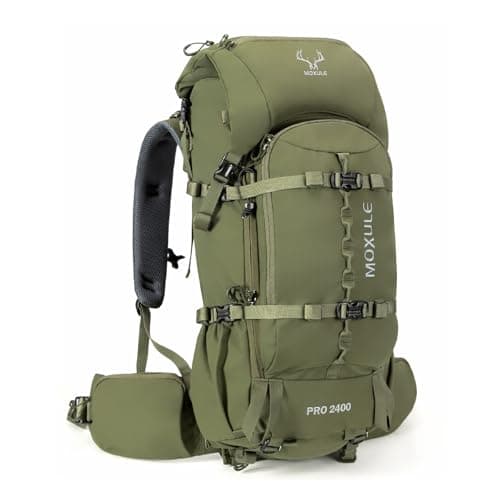
The MOXULE Pro 2400 above is quoted in cubic inches and the SPIKA in liters, and they are much closer in size than the numbers suggest. Convert before you compare.
Capacity by hunt
Day hunt from the truck: 25-35L
Water, food, a layer, binoculars, a rangefinder, a knife and a kill kit. That is a 25 to 35 liter load and it fits in a large daypack. The argument for going to 40 is not that you need the volume today, it is that an expandable 40 covers the day you stay out overnight without owning a second pack.
Full day, hard country, layers for weather: 35-45L
This is the sweet spot and the reason the SPIKA leads this page. Everything above plus a rain shell, an insulating layer, more water and the ability to carry some meat if the day goes very well. A rifle carry system matters more here than ten extra liters does, because on a steep climb the thing you want most is both hands.
Overnight or a spike camp: 50-65L
Sleeping bag, pad, shelter, stove, food. Note that this capacity is set by your sleep system, not by your hunting gear — a bulky synthetic bag can cost you fifteen liters against a compressible one. Our sleeping bag page and pad page are where that volume is actually decided.
Multi-day backcountry: 80L and up
Several days of food, a full sleep system, and the capacity to carry meat out afterwards. The TIDEWE 90L is the value entry here. Its own listing is honest about the downside and so are we: ninety liters on a day hunt gets filled because it is there, and then you carry all of it, all day.
When the load is an animal: capacity is the wrong question
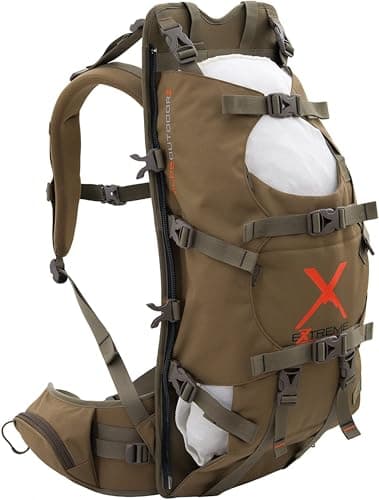
A quartered elk is not a volume problem, it is a load-carriage problem. What you need is a frame that transfers weight to your hips and a shelf or a lashing system that holds meat against it — which is what the ALPS Commander X is, with a detachable bag so the frame can carry the quarter directly. Game bags and the field dressing kit are the rest of that system.
The rule that stops you overbuying
A pack gets filled to its capacity, not to your need. This is not a discipline problem, it is just how people pack: empty space feels like waste, so it attracts a spare layer, a second water bottle, a tripod you will not use. Buy the pack for the hunt you do most often and accept lashing something to the outside on the rare bigger day.
The exception is compression. An expandable pack with real compression straps gives you a 40 that carries like a 30 when it is half full, and that is genuinely worth paying for — it is the feature that lets one pack cover two sizes.
What capacity does not tell you
Three things matter as much as the number and are not in it:
- Torso length and fit. A pack is sized to your back, not your height. A 65L pack that does not fit carries worse than a 40L pack that does, every time.
- Load rating. How much weight the suspension is designed to carry. Most budget listings do not publish it — the TR frame on our frame page is a good example of a pack where that absence is the main caveat.
- Empty weight. A heavy 90L pack costs you several pounds before you put anything in it, on every hunt, including the ones where you use a third of the volume.
Buying notes
Convert the units before comparing two packs
One liter is about 61 cubic inches. A 2,400 cubic inch pack and a 40 liter pack are effectively the same size, and a listing in one unit beside a listing in the other is the most common way people buy the wrong volume.
Load it before you decide it fits
Put thirty pounds in it, cinch the hip belt, and walk. An empty pack tells you nothing about fit, and the hip belt is where the weight should sit — if it is on your shoulders, the pack is the wrong size for your torso, whatever the volume says.
A rifle carry system is worth more than ten liters
On any climb where you want both hands, a pack that holds the rifle beats a slightly bigger pack that does not. Those are also the moments a sling matters — our sling roundup covers the other half.
Buy the frame for the pack-out, not the volume
If an animal is going on your back, the decision is frame and suspension, not liters. A large bag on a weak frame is the worst of both.