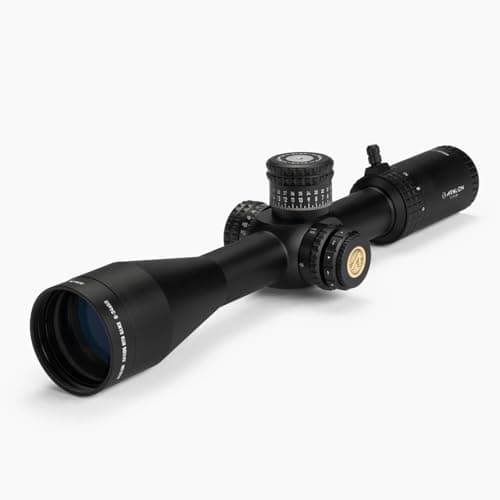
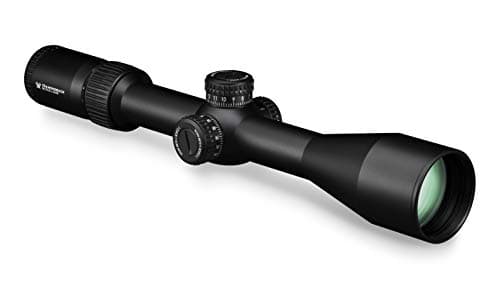
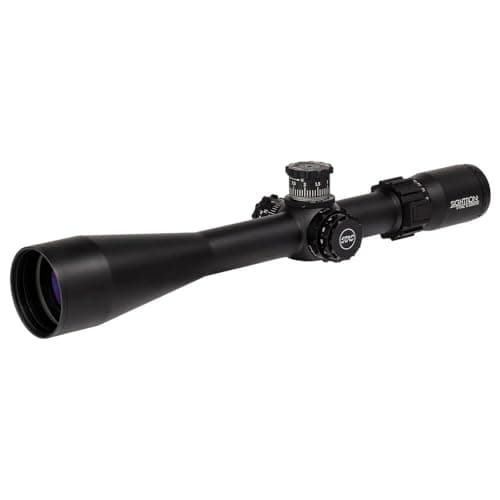
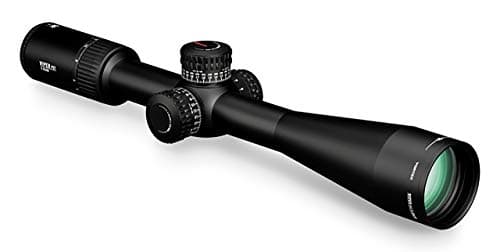
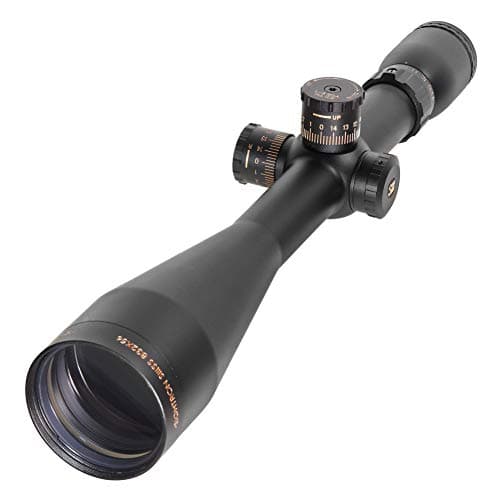
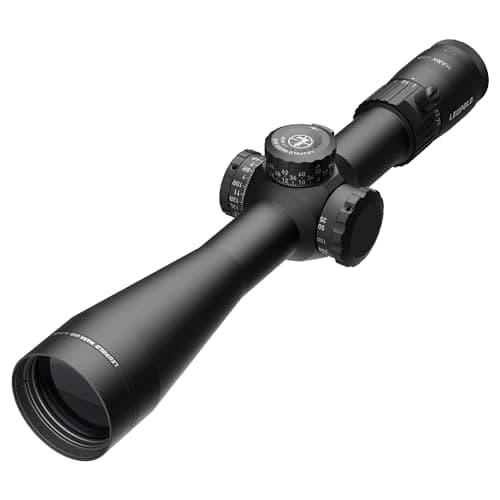
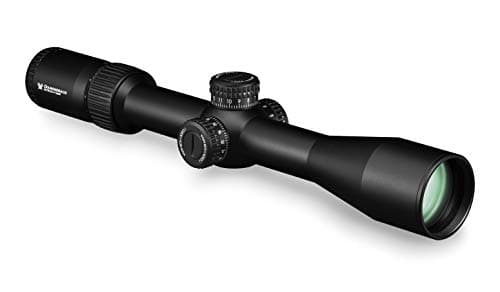
The verdict first: buy the Vortex Diamondback Tactical 4-16x44 FFP and spend what you saved on ammunition. It is for the shooter who has a rifle capable of distance and has not yet proved he can hold up his end of it — which is nearly everybody, including most people who are about to spend a thousand dollars. If you already dial for a living and want the scope you will not outgrow, the Viper PST Gen II 5-25x50 is the ceiling worth paying for, and the Sightron SIII LR 8-32x56 is the one on my own Remington 700.
This site already has a rifle scope roundup, and it is a deer-rifle page: three to nine power, a BDC reticle, under four hundred dollars, and the right answer for a rifle that gets carried in timber. This page is the other problem. Everything here has a first or second focal plane target reticle, exposed turrets you are expected to turn, and enough internal elevation to get somewhere.
What actually separates these, in order
Shooters rank scopes by glass. Scopes fail by turret. Those two facts explain almost every disappointing precision rifle I have ever heard about.
- Turret tracking and return to zero. A long-range scope has exactly one non-negotiable job: when you dial eight minutes up and eight minutes back, the rifle must shoot where it shot before. A scope that does not track is a scope you cannot use past the range you can hold over at, no matter how good the glass is.
- The reticle. Specifically whether it has usable wind holds. You dial elevation and you hold wind, because wind changes while the bullet is in the air and turrets are too slow for that. A reticle with a horizontal tree is doing most of the work on a windy day.
- Focal plane. First focal plane means the reticle subtensions are true at every magnification. Second focal plane means they are true at one magnification — usually the top one — and lying everywhere else. We have a whole page on FFP versus SFP; the short version is that FFP is what you want if you hold over, and SFP is what you want if you shoot in the dark.
- Glass. Last, and it belongs last. Glass decides how pleasant a scope is to look through and how late in the evening it stays useful. It does not decide whether you hit.
The price steps, honestly
Around $400. First focal plane, exposed turrets, a tree reticle. Ten years ago this did not exist at this money. The Diamondback Tactical and the Athlon Argos BTR are the same argument with and without illumination, and the illuminated one answers the only real complaint about FFP — that the reticle disappears at low power in low light.
Around $800. You are buying a zero stop and better turret feel. A zero stop is a mechanical floor you dial down into, so you can return to your zero in the dark by touch without counting revolutions. Once you have shot a match or a long dusk session without one you will understand why it costs money.
Around $1,000. The Viper PST Gen II is where I would tell most people the sensible road ends. Tracking, reticle, illumination and glass are all genuinely good, and the remaining gap to a two-or-three-thousand-dollar scope is real but smaller than the price gap. Almost nobody is being held back by a Viper.
If you want one brand's ladder laid out instead of a cross-brand ranking, Vortex is the one with a scope at every step — their hunting-side lineup is broken out here and the full tier guide is here.
Above that you are paying for glass, and you should be honest about whether you are buying capability or buying a nicer view. The Sightron SIII is on this page because its Japanese glass genuinely outperforms its price and reputation — that is my standing position on the brand and it is why my precision money went there — and the Leupold Mark 4HD is here because if American manufacture matters to you, it is the one on this page that answers it.
The part nobody budgets for
A scope is not mounted when it is tight. It is mounted when it is level, at the right height, torqued to a published figure, and sitting on a base that gives you enough elevation to reach where you want to shoot. People spend a thousand dollars on glass and then clamp it down with whatever rings came in the box, and then wonder why the elevation runs out at eight hundred yards.
Budget another sixty to two hundred and fifty dollars for that, and read the rings and mounts page before you order. If your rifle is a bolt gun that will live past six hundred yards, a 20 MOA base is the cheapest capability on the whole rifle.
What none of these will fix
A scope will not fix a position, a trigger pull, or ammunition that varies. If you have not yet shot the group your rifle is capable of from bags on a bench, the honest advice is to stop shopping and go shoot. That is the same advice the DOPE card page gives, and it is the cheapest upgrade on this site.
Buying notes
Check the elevation travel, not just the magnification
Total internal elevation is published for every scope here and it is the number that decides your maximum distance. A 30mm tube with 60 MOA of travel, centered, gives you about 30 MOA up — and a 20 MOA canted base hands you most of that back without spending anything on the scope.
MOA or MRAD, and then never mix them
Either works. What does not work is a scope in one unit and a ballistic solver or a shooting partner in the other. We argue that out properly here; pick the one the people you shoot with use.
Illumination is a battery to forget
It genuinely helps an FFP reticle at low power in bad light, and it is one more thing to check before a hunt. If the scope lives at a range, you can skip it and save the money.
Second focal plane is not the cheap option
It is a different tool. SFP keeps a bold reticle visible at low magnification, which is why the Sightron SIII and the Viper HS-T still sell to target shooters. If you hold over constantly and change magnification constantly, FFP. If you dial everything and want the clearest possible sight picture, SFP is fine.
Buy the mount with the scope
Not after. The rings decide the height, the height decides whether you get a repeatable cheek weld, and the cheek weld decides whether the scope was worth buying. Order both at once and torque them with a wrench that reads inch-pounds.