The most common hunting-gear mistake in America is a 1,000-gram boot on a spot-and-stalk hunt. It happens because insulation grams get read as a quality ranking — more is better — when they are actually a use-case rating. More insulation is worse if you are moving, because you sweat, and a wet foot in a heavily insulated boot gets colder faster than a dry foot in a light one.
So this list is ordered by what the boot is for, not by price. Matching the number to the hunt is the entire decision, and everything else — brand, camo pattern, sole aggression — is secondary to it.
One thing you will notice: we score a boot down for a claim rather than a defect. No footwear standard produces a temperature rating, so a boot advertised as "-20°F rated" is quoting a number nobody measured. Sleeping bags have ISO 23537. Boots have insulation weight, and that is the specification to buy on.
The short answer
Quick picks
#ad · Live prices from the Amazon Creators API, as of Sep 4, 2026. Where we have no verified live price we show none — a gap beats a number that has rotted.
In detail
The picks, in full
Best overall
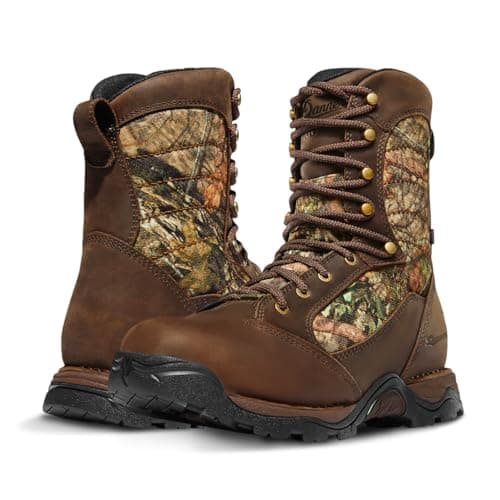
Danner Pronghorn 800g
800g insulationWaterproofMossy Oak Break-Up CountryWide sizing
800 grams is the general-purpose insulation number, and Danner is the maker whose boots are still repairable a decade in.
- Warmth
- 8
- Waterproofing
- 9
- Comfort
- 8
- Durability
- 10
- Value
- 6
What's good
- +800g is the right band for most whitetail seasons — warm sitting, tolerable walking
- +Danner boots are recraftable, which no budget boot is
- +Available in wide, which matters more than most listings admit
- +Proven waterproof construction rather than a coating that wears off
What's not
- −Roughly twice the price of the Rocky options
- −800g is too much for early-season spot-and-stalk
- −Requires genuine break-in time before a long day
Skip it if…
…you hunt early season or cover serious ground. You will sweat, and wet feet in a warm boot get cold the moment you stop.
Best value
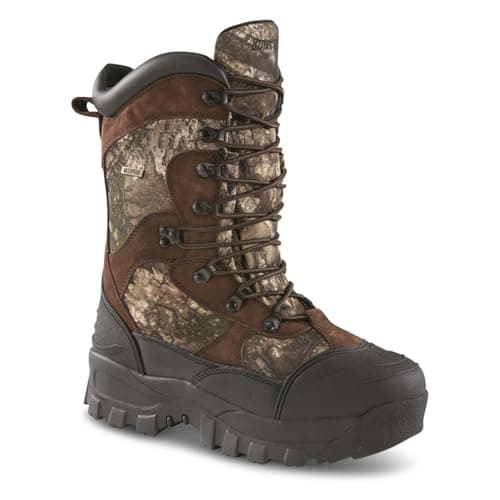
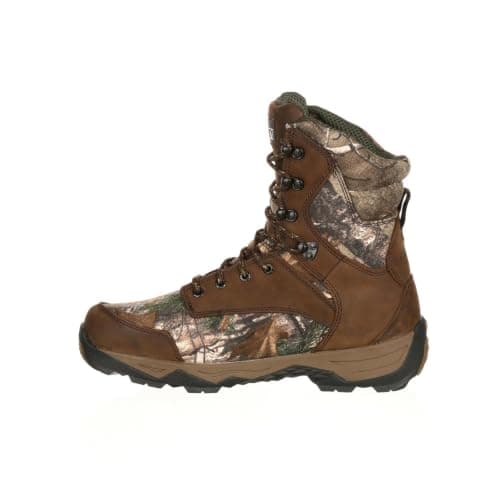
Rocky Retraction 800G
800g insulationWaterproofRealtree XtraRubber outsole
The same 800-gram insulation band as the Danner at roughly half the money, and the honest recommendation for most hunters.
- Warmth
- 8
- Waterproofing
- 8
- Comfort
- 7
- Durability
- 7
- Value
- 9
What's good
- +Hits the general-purpose insulation band at a genuinely accessible price
- +Waterproof construction from an established boot maker
- +Aggressive outsole grips wet leaves and mud
What's not
- −Not recraftable — when the sole goes, the boot goes
- −Heavier than the Danner for the same insulation
- −Sizing runs inconsistent between models
Skip it if…
…you will put a hundred days a season on them. This is a three-to-five-season boot, not a decade boot.
Best for cold sitting
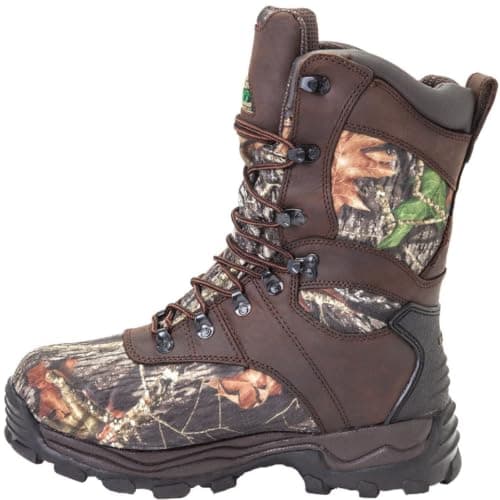
Rocky Sport Utility 1000G
1000g insulationWaterproofMossy Oak Break-UpSteel shank
A thousand grams is a stand boot, and that is exactly the job it should be bought for.
- Warmth
- 10
- Waterproofing
- 8
- Comfort
- 6
- Durability
- 7
- Value
- 8
What's good
- +1000g is genuinely warm for long static sits in December
- +Waterproof and tall enough for shallow crossings
- +Steel shank supports a foot standing on a treestand platform
What's not
- −Far too warm for walking any distance
- −Heavy, which compounds over a long approach
- −Stiff until well broken in
Skip it if…
…you walk more than half a mile to your stand. You will arrive with wet feet, and wet feet in a 1000g boot get cold faster than dry feet in a 400g one.
Best rubber boot
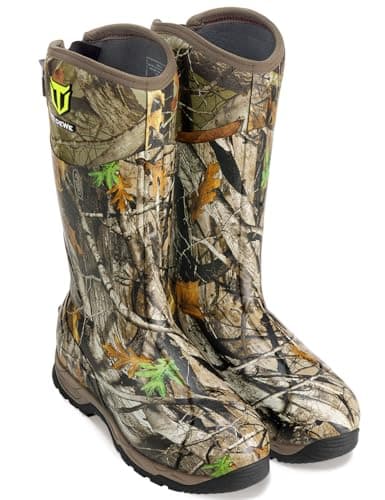
TIDEWE Rubber Hunting Boots 800G
800g insulationFull rubber upperNeoprene liningPull-on
Rubber over the whole boot means genuinely waterproof rather than water-resistant, and it holds almost no scent.
- Warmth
- 8
- Waterproofing
- 10
- Comfort
- 6
- Durability
- 6
- Value
- 9
What's good
- +A rubber upper has no seams to leak — the only truly waterproof construction here
- +Scent-free relative to leather, which matters to whitetail hunters
- +Pull-on means no laces to freeze or fail
What's not
- −Rubber does not breathe at all — feet sweat and stay damp
- −Less ankle support than a laced boot
- −Rubber cracks with age and UV exposure
Skip it if…
…you cover broken ground. A pull-on rubber boot gives you far less ankle support than a laced leather one, and that is where injuries come from.
Best late-season stand boot
HUNTRITE Insulated 1600-gram
1600g insulationWaterproofRT Edge camoRubber outsole
The most insulation on this list, for the one job that genuinely needs it: sitting still in the cold for hours.
- Warmth
- 10
- Waterproofing
- 7
- Comfort
- 5
- Durability
- 6
- Value
- 8
What's good
- +1600g is the top of the practical insulation range and it is genuinely warm
- +Priced like a 400g boot from a bigger name
- +Waterproof construction
What's not
- −Unusable for walking — you will overheat within a quarter mile
- −Very heavy
- −Less established brand, so long-term durability is unproven
Skip it if…
…this is your only pair of hunting boots. A 1600g boot is a specialist tool for static hunting, and buying it as an all-rounder is the classic insulation mistake.
Skip this one
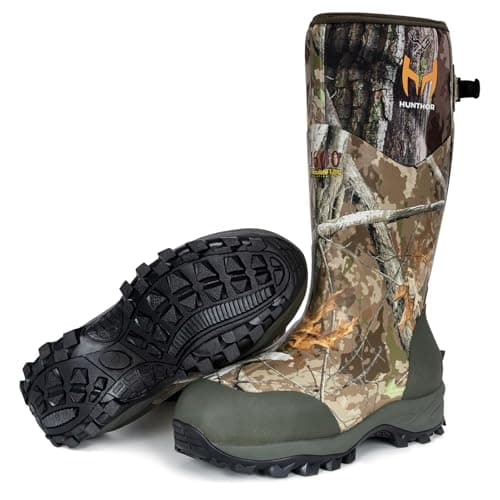
Hunthor 1600g -20°F Rated
1600g insulation claimed"-20°F rated"Waterproof claimed
Not because the boot is necessarily bad, but because the headline claim is meaningless — there is no standardized temperature rating for footwear, so a stated -20°F is a marketing number, not a measurement.
- Warmth
- 7
- Waterproofing
- 5
- Comfort
- 5
- Durability
- 4
- Value
- 6
What's good
- +1600g of insulation, if accurate, is genuinely a lot
- +Inexpensive for the stated insulation level
What's not
- −No footwear standard produces a temperature rating — unlike sleeping bags, which have ISO 23537. A quoted °F figure on a boot is not comparable to anything
- −Insulation weight is the only comparable specification, and it is the one to buy on
- −Warmth depends enormously on fit, sock and activity level, none of which a temperature claim can account for
- −Unestablished brand with no durability record
Skip it if…
…you are choosing based on the temperature number. Buy on insulation grams and fit instead — the HUNTRITE gives you the same stated 1600g without the unverifiable claim attached.
Matching insulation to your hunt
| Insulation | Activity | Typical use |
|---|
| Uninsulated–200g | Moving constantly | Early season, spot-and-stalk, upland, warm-weather scouting |
| 400–800g | Mixed walking and sitting | Most whitetail seasons, general-purpose, cold mornings |
| 1000–1200g | Mostly stationary | Late-season stand hunting, blinds, short approaches |
| 1400–1600g+ | Stationary in real cold | December treestands, ice-fishing shelters, no walking |
Fit matters more than the number
Insulation works by trapping air. A boot crammed tight with a heavy sock has no loft left and is colder than a looser boot with a thinner one. Size for the sock you will actually wear, and if you are between sizes in an insulated boot, go up.
Waterproof construction beats a waterproof coating
A membrane bootie sewn inside the boot keeps water out for the life of the boot. A durable water-repellent finish sprayed on the outside wears off in a season. Rubber uppers have no seams at all, which is why they are the only genuinely waterproof option — at the cost of zero breathability.
Break them in before the season, not during it
Every leather boot here needs miles before opening day. The one advantage of a rubber pull-on boot is that there is nothing to break in.
Two pairs beats one compromise pair
If you hunt both early and late season, a 400g boot and a 1000g boot will outperform a single 800g pair at both ends. That is a genuinely better use of the same money than one premium boot trying to do both jobs.
How these were picked
I haven't handled these. Here's what I did instead.
Everyone in this category says they tested twenty of these. I haven't tested any, and I say so. What I do instead: read the manufacturer's manual and published specification, compile the numbers that decide the purchase, do the arithmetic in the open, check the live price, and name one product to skip. The scores above are judgments from that research against a published rubric — they are not measurements I took, because I do not have a lab and I am not going to pretend otherwise.
Questions
Frequently asked
How many grams of insulation do I need for deer hunting?+
For most whitetail seasons, 400 to 800 grams. Go to 1,000 or above only if you sit still in genuine cold and walk a short distance to the stand. Below 200 grams is early-season and spot-and-stalk territory.
Are rubber boots warmer than leather?+
Not inherently — warmth comes from the insulation, not the upper. Rubber is completely waterproof and completely non-breathable, so your feet stay dry from outside and damp from inside. Rubber's real advantage for whitetail hunters is that it holds far less scent.
Is a -20°F boot rating real?+
No. There is no standardized temperature test for footwear, unlike sleeping bags which have ISO 23537. Any °F figure on a boot is a marketing estimate that cannot account for your sock, your fit, your circulation or whether you are moving. Buy on insulation grams.
Should hunting boots be a size bigger?+
Often, yes — insulated boots need room for a thicker sock plus air space around the foot, and that air is what actually insulates. A tight insulated boot is a cold boot.
Receipts
Sources
We do not run a testing lab and we do not pretend to. Where a measured number came from a manufacturer's published specification or someone else's lab, we name them and link them. Where we could not verify something, we say so on the page rather than quietly leaving it out. Read the full method.