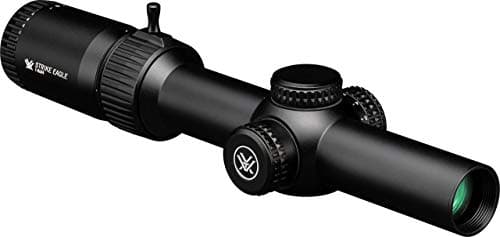
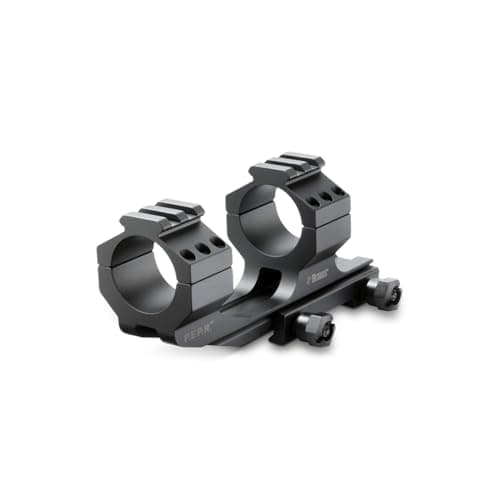
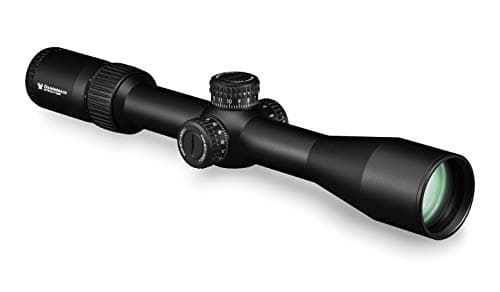
The verdict first: put a Vortex Diamondback Tactical 4-16x44 FFP on it. That is for the person who bought a .308 or 6.5 Creedmoor gas gun to shoot at distance and wants one optic that does not need replacing. If the rifle is a short, handy .308 for use inside three hundred yards, the right answer is the Vortex Strike Eagle 1-6x24 and it is not a compromise — it is a different and correct tool. Either way, budget sixty dollars for a cantilever mount, because the platform will not work properly without one.
Three existing pages here cover adjacent ground and none of them covers this. The deer-rifle roundup is 3-9x40 glass under four hundred dollars for a bolt gun carried in timber. The long-range roundup is cross-brand precision glass from four hundred to sixteen hundred, mostly bound for bolt guns on bipods. And the LPVO page is a match page. This page is about the platform.
What the platform changes
- Eye relief, which is really a mounting problem. A flat-top AR has a long receiver rail and a stock that puts your head where the manufacturer decided. Mount a scope in conventional rings and the eyepiece typically ends up too far back for a comfortable, repeatable head position. A one-piece cantilever mount moves the tube forward by an inch or so and solves it. This is not optional on an AR-10 and it is the single most common mistake on a first build.
- Weight. An AR-10 starts heavier than an AR-15 and a 6-24x50 with a 34mm tube is not a small object. If the rifle gets carried, the scope is part of that decision. If it lives on a bipod, buy whatever you like.
- Reticle and turret unit discipline. Gas guns get shot at multiple distances in a hurry, which means holdovers rather than dialing, which means the reticle matters more than it does on a rifle you have time with. Pick MOA or MRAD and then never mix it with a solver or a partner in the other — we argue that out here.
Pick the magnification from the rifle's job, not the caliber
"Best scope for a .308" is not actually a question, because two rifles in .308 can be built for jobs three hundred yards apart. Sort it like this:
A battle rifle or a truck gun. Short barrel, used fast, most shots inside two hundred yards, occasionally identifying something further out. A 1-6x or 1-8x low-power variable, second focal plane, illuminated. True 1x at the bottom lets you shoot with both eyes open; 6x at the top is enough to tell what you are looking at. The Strike Eagle is the one I run on my own ARs.
A designated marksman build. An 18 or 20 inch barrel, shots from a hundred to six or eight hundred yards, shot from improvised positions rather than a bench. This is the 4-16x bracket and it is where most AR-10s land. First focal plane if you hold over, which on this kind of rifle you will.
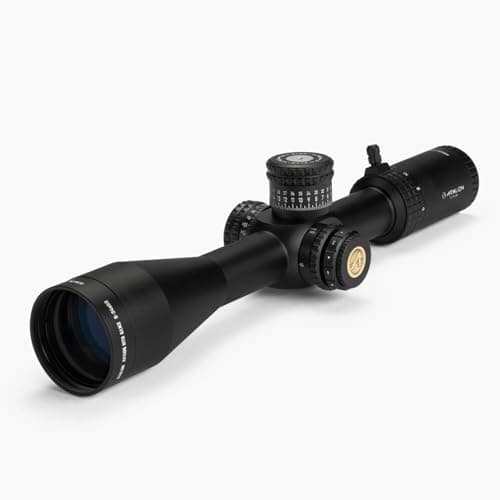
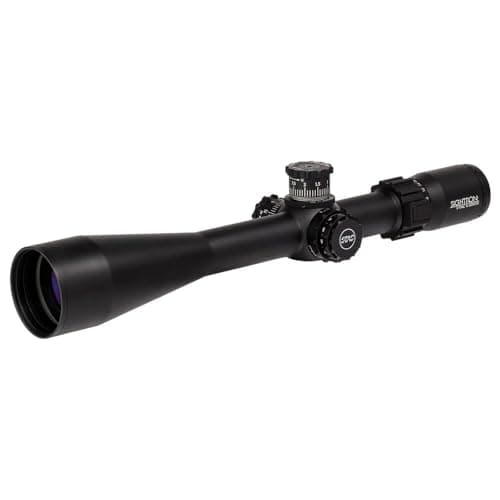
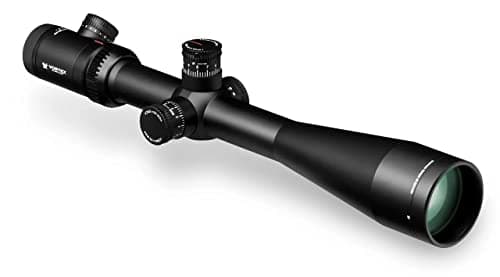
A precision gas gun. Heavy barrel, bipod, paper and steel at known distances. Now the 6-24x makes sense, and so does a zero stop. The Sightron S-TAC and the Athlon Argos BTR both land here; so does the Viper PST Gen I 6-24x50 that is on my own LR-308, which is the rifle that taught me most of what is on this page. That build log — parts, costs and what I would change — is the honest version of this page with one rifle instead of six scopes.
The elevation question, early
A 30mm tube with sixty MOA of total internal elevation gives you roughly thirty MOA up from an optically centered zero. On a .308 that runs out somewhere around eight hundred yards depending on your load and your zero, and the fix is cheap: a mount with built-in cant. Cantilever mounts are available flat or with twenty MOA of cant built in, and the canted version hands you most of your elevation back for no extra money and no change of scope.
Decide that before you buy, not after. The rings and mounts page goes through height, cant and torque properly, and it is worth ten minutes before you spend four hundred dollars on glass.
What none of these will fix
A gas gun has a wider accuracy band than a bolt gun of the same quality, and no scope narrows it. If the rifle is shooting two minutes of angle, a better scope shows you two minutes of angle in sharper detail. Ammunition consistency, the gas system and your position are all upstream of the optic. The cheapest genuine upgrade on this page is writing down what the rifle actually does, and it costs nothing.
Buying notes
Buy the mount at the same time as the scope
Not afterwards. The mount decides the height, the height decides whether you get a repeatable cheek weld on the stock you already own, and the cheek weld decides whether the scope was worth buying. For a flat-top AR that means a one-piece cantilever, not rings.
Torque it with a wrench that reads inch-pounds
Ring screws and mount screws both have published figures, usually in the 15 to 25 inch-pound range for rings and higher for the mount-to-rail interface. "Tight" is how tubes get crushed and how scopes walk under recoil. One torque wrench outlives every scope you will own.
First focal plane if you hold over, second if you shoot in the dark
FFP keeps the reticle subtensions true at every magnification, which is what you want on a rifle shot at varied distances in a hurry. SFP keeps a bold reticle visible at low power, which is what you want at last light. The full comparison is here.
Illumination is worth it on this platform
More than on a bolt gun. A thin FFP reticle at the bottom of its magnification range in bad light is the one real weakness of the format, and illumination is the direct answer to it. The Athlon on this page exists specifically because it solves that at the same money as the Vortex.
Check the rail length before you order
Cantilever mounts need a run of rail forward of the receiver, and a short free-float handguard or a carry handle cut can interfere. Measure, do not assume.